
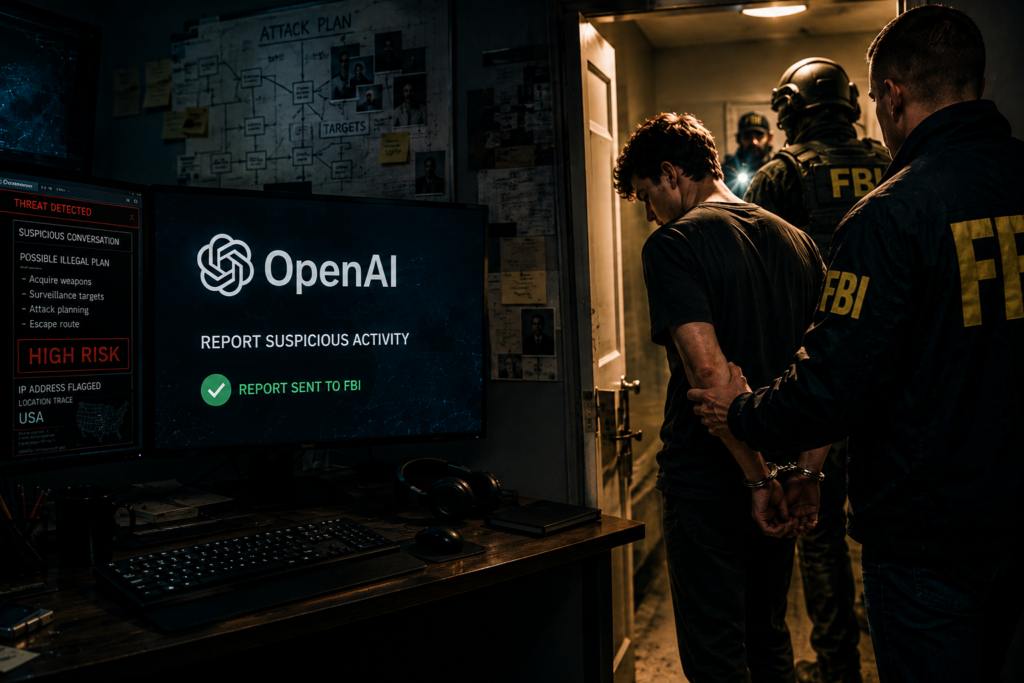
OpenAI reported a ChatGPT conversation to the Federal Bureau of Investigation after a Goldman Sachs analyst wrote out a plan to kill his ex-girlfriend and uploaded photos of firearms, according to details described in the case record. The report led to an arrest in Florida, and the case later ended with a plea deal and an eight-year probation sentence.
ChatGPT exchange led to FBI report
Between March and April this year, Darren Zhou, a 25-year-old resident of South Palm Beach, wrote in a ChatGPT conversation: 「I’m going to kill her by the end of this month. If I can’t have her, no one can.」 The material also included photos of an AR-15-style rifle, a Glock pistol and a 12-gauge shotgun.
OpenAI chose to notify the FBI. The evidence was then passed to the Palm Beach County Sheriff’s Office, which checked on the former girlfriend’s safety and arrested Zhou.
Authorities said the threat was credible
Details cited from the indictment and arrest report said Zhou was not treated as someone acting on impulse alone. He graduated with honors from Northeastern University and was working as a financial analyst at Goldman Sachs at the time of the incident. He had no prior criminal record.
Zhou had dated a 21-year-old woman who lives in Lake Worth Beach for about six months. She broke up with him because he was described as 「extremely emotionally unstable, jealous and highly controlling.」 After the breakup, she was repeatedly harassed by phone calls, text messages and social media messages. She was also questioned about why men were leaving comments under her social media videos, and she gave screenshots of those exchanges to police.
The arrest report said Zhou’s messages in ChatGPT went beyond a single threat. He described a full attack plan: waiting outside his former girlfriend’s gym with flowers, forcing her at gunpoint to drive back to his South Palm Beach residence, sexually assaulting and holding her there, and if police arrived, shooting her first and then killing himself.
He also uploaded her photo and described her routine and interests to the chatbot. Those details, together with the firearm photos, were cited as key reasons the threat was judged credible.
Three charges filed in June
OpenAI sent the conversations to the FBI in May 2026. Zhou was arrested, posted $100,000 bail and was released two days later.
In June, prosecutors charged him with aggravated stalking, written threats to kill, and unlawful use of a two-way communications device. The three counts carried a combined maximum sentence of 25 years. Goldman Sachs fired him the same month.
On Aug. 12, Zhou pleaded guilty to all three charges under a plea agreement.
Judge imposed probation and withheld adjudication
Judge Suskauer sentenced Zhou to eight years of probation. For the first two years, he must wear an electronic monitor. He was also ordered to complete a batterers’ intervention program and a mental health evaluation, and he is barred from possessing firearms, using drugs or alcohol, or contacting his former girlfriend.
The court handled the case with a withhold of adjudication disposition. As described in the report, that means Zhou will not have a felony conviction on his record if he complies with the probation terms.
Case puts OpenAI’s reporting standard back under scrutiny
The Florida case is not the first time OpenAI has faced questions over whether to alert police. In February 2026, a shooting took place in Tumbler Ridge, Canada. It was later discovered that ChatGPT had banned the shooter’s account eight months before the attack but did not report him to police. The gunman later killed eight people, and OpenAI Chief Executive Officer Sam Altman publicly apologized afterward.
OpenAI later said it would proactively notify law enforcement when it encountered potential threats. The Florida case has been presented as one of the few public examples showing that the updated policy was put into action: in the earlier case, the response was only an account ban; in this one, the company reported the matter directly to the FBI.
The case also leaves unresolved questions about privacy and internal thresholds. According to the report, stopping a threat like this requires the system to read what users type and then decide whether to pass it to police. Florida Attorney General James Uthmeier has already opened an investigation into ChatGPT after a separate Florida State University shooting, and attorneys general from multiple U.S. states are also examining whether OpenAI was lax in protecting user privacy and safety.
The standard itself has not been made public. The report said there is still no clear explanation of what level of threat leads to a police referral and what level results only in an account ban. The Canada case and the Florida case produced two different outcomes.