

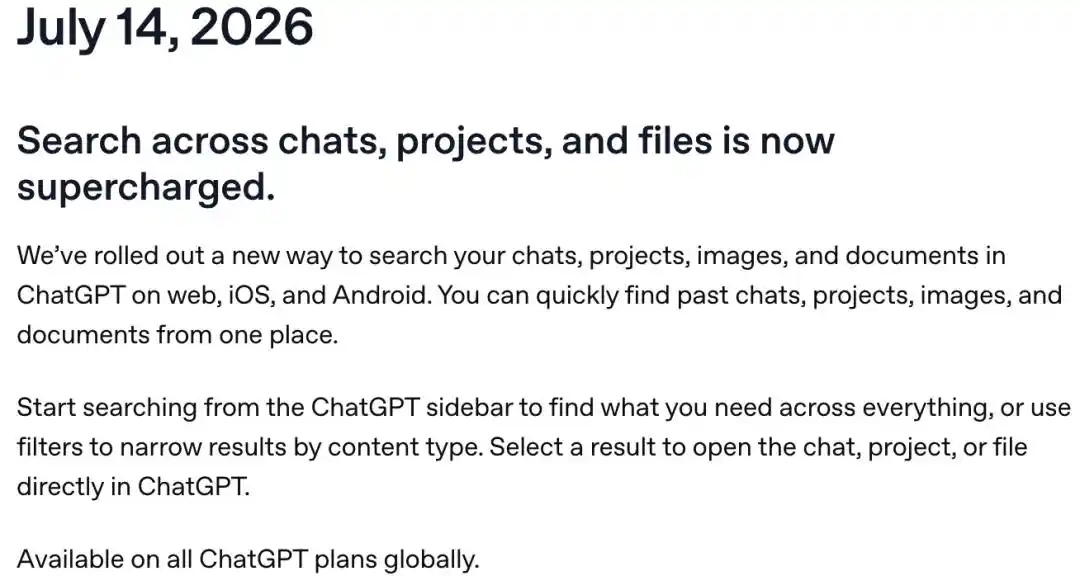
OpenAI has introduced a new unified search feature in ChatGPT, giving users a single place to search the material accumulated inside their accounts. According to the report, the rollout began on July 14 and spans web, iOS, and Android, with availability across all plans worldwide, from free tiers to enterprise offerings.
The feature covers four content types stored within ChatGPT: chat history, images, documents, and projects. Users can filter by content type and jump straight to matching results instead of scrolling back through old conversations one screen at a time.
A single search entry point inside ChatGPT
The report stresses that this is not the same thing as ChatGPT Search for the public web. This update is aimed at a different problem: finding a user’s own material that has built up inside ChatGPT over time.
That distinction matters for people who have used the product heavily over the past several years. As chats, files, images, and project threads pile up, older discussions can become difficult to retrieve. The article describes the previous sidebar search as a long-running source of frustration in the OpenAI developer community, especially once conversation volume grows.
There is also a clear boundary to what the new cross-content search can reach. It only includes material uploaded into ChatGPT or content generated inside Project and Work. Connected external apps such as Google Drive are not searchable for now, and the report says OpenAI has not provided a timetable for expanding support.
So at this stage, ChatGPT can search only the portion of a user’s data that was directly handed to the service or created within its own environment.
From chat tool to personal knowledge base
The article argues that the significance of the change goes beyond a better search box. For most of its nearly four-year life, ChatGPT has functioned mainly as a conversation tool. Users could create a large amount of valuable material with it, but much of that value faded once a chat dropped into history and became hard to retrieve.
With unified search now in place, the report says ChatGPT is starting to grow from a chatbot into a personal knowledge base. In its framing, the product is beginning to resemble a system with its own file structure for the work users and AI have produced together.
The piece contrasts that role with existing tools. Notion and Obsidian organize a user’s own notes. Google Search indexes information on the public internet. ChatGPT, in this telling, is moving to organize a different category altogether: the conversations, project artifacts, generated media, and working material that users have built jointly with AI.
The report’s central claim is that, in the AI era, this body of accumulated interaction data may end up being more durable than any one model generation. Models change. A user’s long-running record of prompts, drafts, code discussions, project context, and generated assets does not disappear as easily, and it is much harder for others to replicate.
More useful data, and more attention on its boundaries
The article also points to the other side of the shift. Search makes stored data easier to use, but it also makes the indexed record more complete and, in the report’s words, more sensitive.
One issue it highlights is the default data setting on consumer plans. On Free, Plus, and Pro, conversations are used for model training by default unless users manually disable that option in Data Controls. The report says many users have never opened that setting.
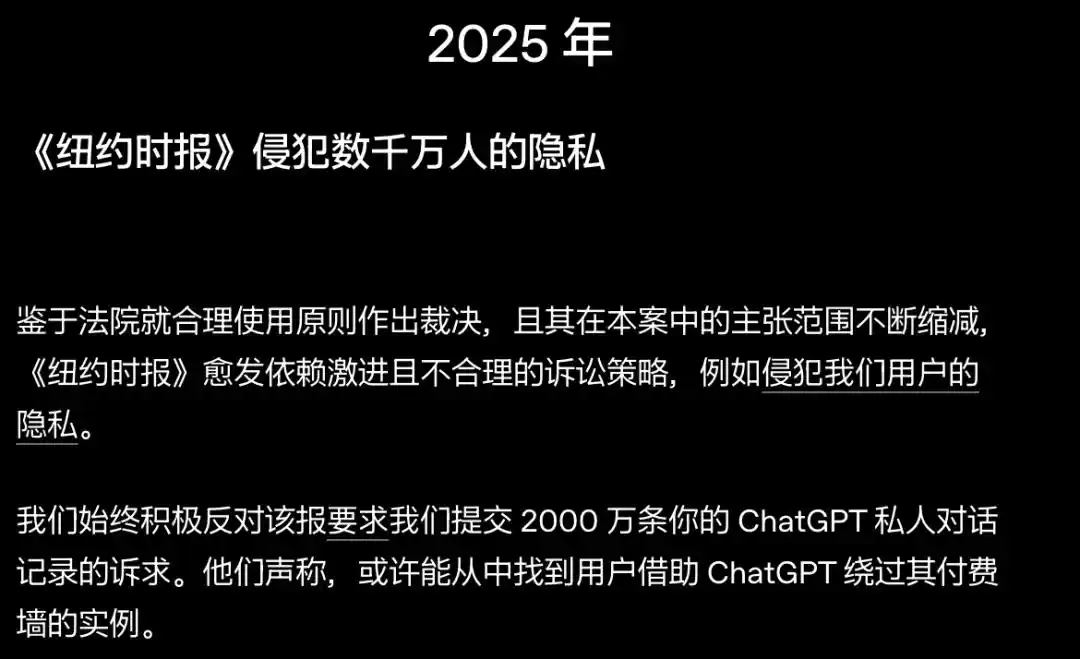
A second point comes from a legal dispute cited in the story. It says that on Jan. 5 this year, in the copyright case brought by The New York Times and other media organizations against OpenAI, a U.S. federal court upheld an order requiring OpenAI to provide 20 million de-identified ChatGPT chat logs to the plaintiffs. Those 20 million logs were described as 0.5% of the company’s retained logs, with the total corpus said to be in the tens of billions.
The report says OpenAI argued on privacy grounds, but the court did not accept that argument. One reason cited in the article was that the chats were considered material users had voluntarily submitted to OpenAI. The piece also notes that OpenAI published a response page opposing The New York Times’ request to obtain 20 million user chat records.
It then adds another detail attributed to TechCrunch: plaintiffs had previously alleged that OpenAI claimed it could not search those logs. Now, the company has given users a broad search capability on the front end.

The article does not say OpenAI changed its privacy policy along with this launch, and it states that no new use of the data has been announced. Still, the easier it becomes to retrieve years of accumulated content, the more important that body of data becomes.
Why search matters now
The timing, in the report’s view, reflects what ChatGPT has become. It links the search launch to a wider run of OpenAI product moves over the past one to two years: file uploads, Projects, Memory, ChatGPT Work for long-running tasks, Sites for generating websites and lightweight apps, a new desktop client that combines Chat, Work, and Codex, and three GPT-5.6 model tiers.
The argument is simple. OpenAI is trying to turn ChatGPT into the place where users actually do work. If users continue pouring in project material, writing records, code discussions, and generated images, the amount of stored content keeps rising. At that point, weak retrieval becomes a structural problem rather than a minor inconvenience.
That is why the report treats search as the missing piece in a larger product loop. In its wording, ChatGPT is gaining something close to its own file system: it can store, organize, and search.
Part of a broader industry shift
The article says this is not only an OpenAI story. It presents the rollout as part of a broader correction across the AI sector, where model capabilities have improved rapidly but the accumulated user data inside these products has not been managed nearly as well.
It cites reactions calling on Anthropic to copy the feature, with criticism directed at Claude’s current search experience. It also compares the strategic directions of three major players in 2026. ChatGPT is described as following a personal assistant path that pulls user-AI output into one place. Gemini is leaning on Google’s ecosystem by tying together email, cloud storage, and calendars. Claude is said to be focusing on long-term memory and Skills to accumulate context over time.
The paths differ, but the destination described in the article is similar: organize the user’s data, make it searchable, and have it ready on demand.

That is where the piece places the next stage of AI competition. If the first phase was about whether a model could answer in a humanlike way, the next phase may revolve around who can hold onto and activate the user’s own accumulated data most effectively.
In that framing, the late arrival of robust internal search is not just a delayed feature release. It is a sign that the industry is starting to recognize the long-term value of the material users have created together with AI.
For a product that has been live for nearly four years, the article argues, the notable part is not simply that users can now search their own history. It is that the data built through those years of interaction is increasingly being treated as the most valuable layer in the system.
Referenced materials mentioned in the report
- Posts on X from testingcatalog
- Posts on X from btibor91
- OpenAI Help Center release notes for ChatGPT
- OpenAI’s response page on The New York Times request for user chat records