Work

AI Agents
2026-09-22 05:59:38

Dreamforce 2026 puts AI agents under a revenue test as Salesforce shifts from seats to usage

Dreamforce 2026 has sharpened a question that has been building across U.S. equities after years of heavy AI infrastructure spending: when does all that compute turn into visible software revenue? The article argues that the market is starting to rotate from the hardware side of AI toward enterprise applications that can show measurable work completed, recurring revenue, and actual usage. Against that backdrop, Salesforce used the event and its latest quarterly disclosures to frame AI agents not as copilots that wait for prompts, but as digital workers that can operate across systems, over time, and with audit trails. The piece highlights several data points disclosed by Salesforce, including Agentforce ARR above $1.5 billion, combined Agentforce and Data 360 ARR near $3.9 billion, and 7 billion cumulative Agentic Work Units completed by Agentforce and Slack. It also points to customer examples, Flex Credits pricing, and new products such as AIforce, Claudeforce, and Agentforce Coworker. At the same time, it stresses that commercialization is still being tested. Margin pressure, the risk that usage revenue may not offset shrinking seat counts, and a widening security surface tied to non-human identities remain central issues. The broader takeaway is that AI may be entering a third phase: turning compute into productivity.


140
Dreamforce 2026 puts AI agents under a revenue test as Salesforce shifts from seats to usage
Stripe
2026-09-22 03:03:00

Stripe’s OpenRouter Bet Centers on Control, Not Just Routing

Stripe said on Aug. 19, 2026 that it had reached an agreement to acquire OpenRouter in what would be the company’s largest acquisition to date. The final price was not disclosed, though media reports placed the deal at more than $7 billion to $8 billion, with The New York Times citing roughly $7.5 billion. That figure stands in sharp contrast to OpenRouter’s roughly $1.3 billion Series B valuation just 83 days earlier, implying a near sixfold repricing in less than three months. The PANews analysis argues that OpenRouter has already proved one thing at scale: inference demand can be aggregated across hundreds of models and dozens of compute providers. The company says it handles more than 400 trillion monthly tokens, serves more than 10 million global users, connects 80-plus suppliers and 500-plus models, and supports more than 250,000 apps reaching over 4.2 million end users. Yet the same OpenAI-compatible standard that helped OpenRouter grow also keeps switching costs extremely low, since developers can often leave by changing a base URL and API key. In that framing, Stripe is not simply buying an API gateway. It is betting that OpenRouter can evolve from a replaceable middleware layer into a control point that links model routing, telemetry, agent identity, budgeting, metering and settlement. Whether that transition happens is presented as the central question behind the deal.

120
Stripe’s OpenRouter Bet Centers on Control, Not Just Routing
Mexico
2026-09-21 13:31:17

Remote Mexico mining bust exposes power theft risks beyond on-chain transparency

Mexican authorities uncovered a suspected illegal cryptocurrency mining operation in the Sierra region of Puebla in early September 2026, seizing a site that housed about 300 machines, transformers, 80 medium-voltage connection points, and eight satellite dishes. Prosecutors are treating the case as a theft of state energy rather than a standalone crypto-mining offense, because mining itself is not specifically criminalized in Mexico. Investigators say the site was likely positioned near the Nuevo Necaxa hydroelectric system to exploit access to electricity, and an unauthorized transformer installation helped lead police to the property. The case has also widened into a financial inquiry, with forensic accountants tracing how the expensive equipment was purchased and whether money laundering was involved. The broader backdrop is a fragmented regulatory environment: crypto ownership, trading, and mining are generally allowed in Mexico, even though cryptocurrencies are not legal tender. The article argues that while blockchain ledgers make token transfers visible, they do not capture the physical energy chain that powers mining. That gap leaves room for organized illicit operations, with the costs of stolen electricity ultimately absorbed by utilities, power grids, and paying consumers.

100
Remote Mexico mining bust exposes power theft risks beyond on-chain transparency
TypeSafe AI
2026-09-21 11:23:00

TypeSafe AI’s Jev spread to about 13% of Vercel’s paid teams within 24 hours of launch

TypeSafe AI came out of stealth on Sept. 15, 2026 and introduced Jev, a model built for structured decisions rather than text generation. Within 24 hours, about 13% of Vercel’s paid teams had started using it, and Vercel described the rollout as one of the fastest-adopted launches in its history. Native support from Cloudflare, LangChain, and Langfuse followed within days. Jev is positioned as a “System One Model,” designed to return probabilities, scores, and confidence values instead of natural-language answers. TypeSafe says the model is 40x to 200x faster than comparable large language models on classification-style tasks, with end-to-end latency of 70 to 500 milliseconds and costs that are 40x to 400x lower. Its pricing is unusual as well: input tokens cost $0.042 per million, while output tokens are free. The company says Jev is not a replacement for large language models. It is aimed at narrow, high-frequency decision tasks such as spam detection, moderation, and routing. Third-party tests cited by developers and platform engineers point in the same direction on speed and cost, though long-term production reliability, retention, failure rates, and the durability of its business model remain unclear. TypeSafe has also not disclosed Jev’s underlying architecture.

100
TypeSafe AI’s Jev spread to about 13% of Vercel’s paid teams within 24 hours of launch
Shibarium
2026-09-21 06:28:21

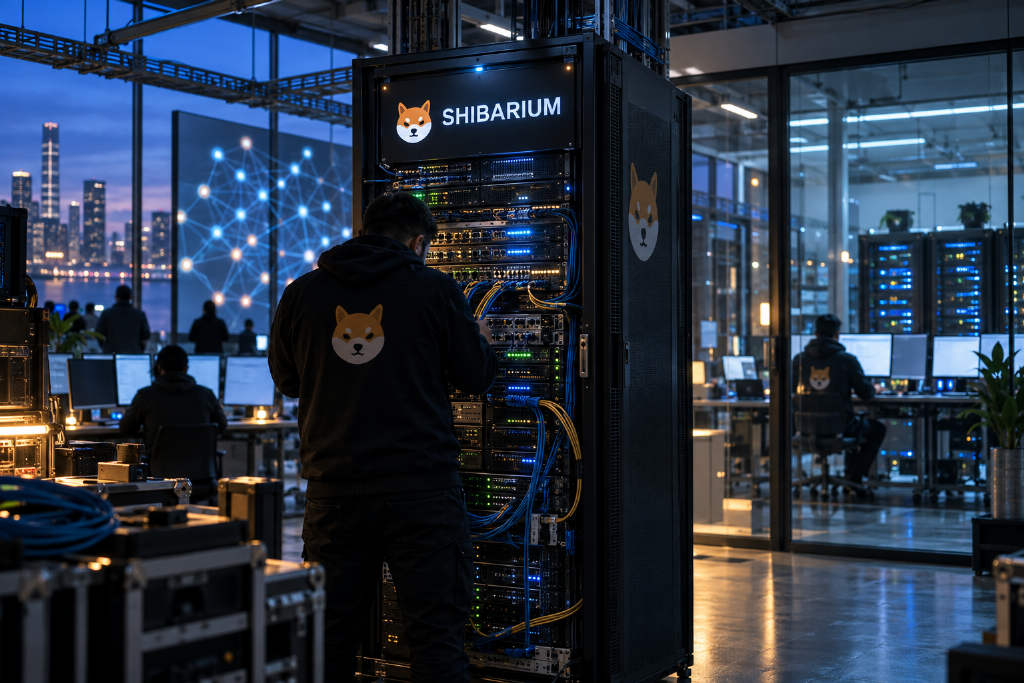
Shibarium reorganization issue resolved as dRPC migration and node updates continue

Shibarium, the Layer 2 network tied to the Shiba Inu ecosystem, has resolved its network reorganization issue, according to Techub, citing Crypto.news. Work on the network is not yet fully complete, however. The report said the dRPC migration is still underway, alongside peer node updates and reindexing for the block explorer. The update points to a partial return to normal operations, while backend maintenance and infrastructure adjustments remain in progress. No additional timeline or technical details were provided in the source brief.

70
Shibarium reorganization issue resolved as dRPC migration and node updates continue
North Korea h
2026-09-21 03:18:59

Four-country alert says North Korea-linked WaterPlum used fake interviews to steal $10.71 million in crypto

Authorities in Japan, the United States, Australia and Germany issued a joint alert on Sept. 18 accusing the North Korea-linked hacking group WaterPlum of posing as recruiters from AI, cryptocurrency and NFT companies to trick software engineers into running malware during fake job interviews. The notice said the campaign compromised at least 30,000 computers across more than 100 countries between December 2025 and July 2026, leading to losses from more than 7,000 crypto wallets. According to the alert, the stolen assets were moved to wallets tied to North Korea, with total losses reaching at least JPY 1.7 billion, or about $10.71 million. Investigators said the main victims were individuals, including web designers, engineers and professionals working in crypto, blockchain and Web3, and that the attackers targeted their personal wallets. The notice also described how the group allegedly hid malware in NPM packages, used AI face-swapping tools during interviews, and relied on remote access trojans and infostealers to extract credentials, wallet keys and personal documents. Japanese authorities said they also dismantled a laptop farm in Japan for the first time, linking it to North Korean IT workers through shared IP addresses.

120
Four-country alert says North Korea-linked WaterPlum used fake interviews to steal $10.71 million in crypto
National Taiw
2026-09-21 02:36:13

National Taiwan Ocean University showcases AI aquaculture and fisheries monitoring technologies at Taiwan Innotech Expo

National Taiwan Ocean University presented six forward-looking patented technologies at this year’s Taiwan Innotech Expo, highlighting work across aquaculture, marine governance, and fisheries digitization. According to the source report, Taiwan began introducing artificial intelligence into aquaculture on a broad scale around five to six years ago. The university’s research teams have been applying optical cameras, color-card calibration, pH and dissolved oxygen data, underwater imaging, and feeding-splash analysis to automate feed control, reduce waste, and monitor fish health. The report also detailed several projects beyond farm-level feeding. One team won a bronze medal for a dormant zooplankton egg preservation system designed to control microbial contamination and maintain hatching quality after long-term storage. Another developed a regional feed delivery system that uses real-time ripple monitoring to calculate feeding volumes. Separate work includes a domestically developed 3D real-time marine and fisheries geographic information analysis system built on AIS, VMS, and VDR data, as well as an Electronic Monitoring system that can identify fish species in difficult onboard conditions with accuracy above 80%. The technologies are being used in areas ranging from IUU detection to offshore wind assessment and sustainability certification.

70
National Taiwan Ocean University showcases AI aquaculture and fisheries monitoring technologies at Taiwan Innotech Expo
Kaiko
2026-09-21 02:31:00

Funding Weekly: Kaiko raises $110 million as Crusoe closes $3.9 billion Series F

PANews’ weekly funding roundup showed that the blockchain sector recorded nine financing deals worldwide between Sept. 14 and Sept. 20, with disclosed funding topping $223 million. Stablecoin payments stood out as the busiest crypto segment of the week, with Velocity, dtcpay and Fin.com each securing fresh capital to build settlement, fiat on-and-off-ramp and banking backend infrastructure. Investors in those rounds included Visa, Circle, Ripple, Coinbase Ventures and SBI, pointing to continued capital flows beyond stablecoin issuance and into payment rails and compliance-heavy infrastructure. The largest checks, however, were written in AI infrastructure. Crypto data provider Kaiko expanded its latest round to $110 million with S&P Global leading, while AI compute infrastructure company Crusoe completed a $3.9 billion Series F at a post-money valuation of about $30.9 billion. Nvidia also committed $2 billion to Brookfield Asset Management’s global AI infrastructure fund. Elsewhere, the report covered funding across tokenized securities, RWA-backed finance, DePIN, AI chips, enterprise AI software, robotics and venture funds, showing how capital remained concentrated in infrastructure layers rather than consumer-facing narratives.

90
Funding Weekly: Kaiko raises $110 million as Crusoe closes $3.9 billion Series F