



Dan Shipper, co-founder and CEO of Every, has published a detailed report titled How Codex Happened, reconstructing how OpenAI’s coding agent Codex went from a weak point inside the company to the product layer that ultimately absorbed the ChatGPT desktop app.
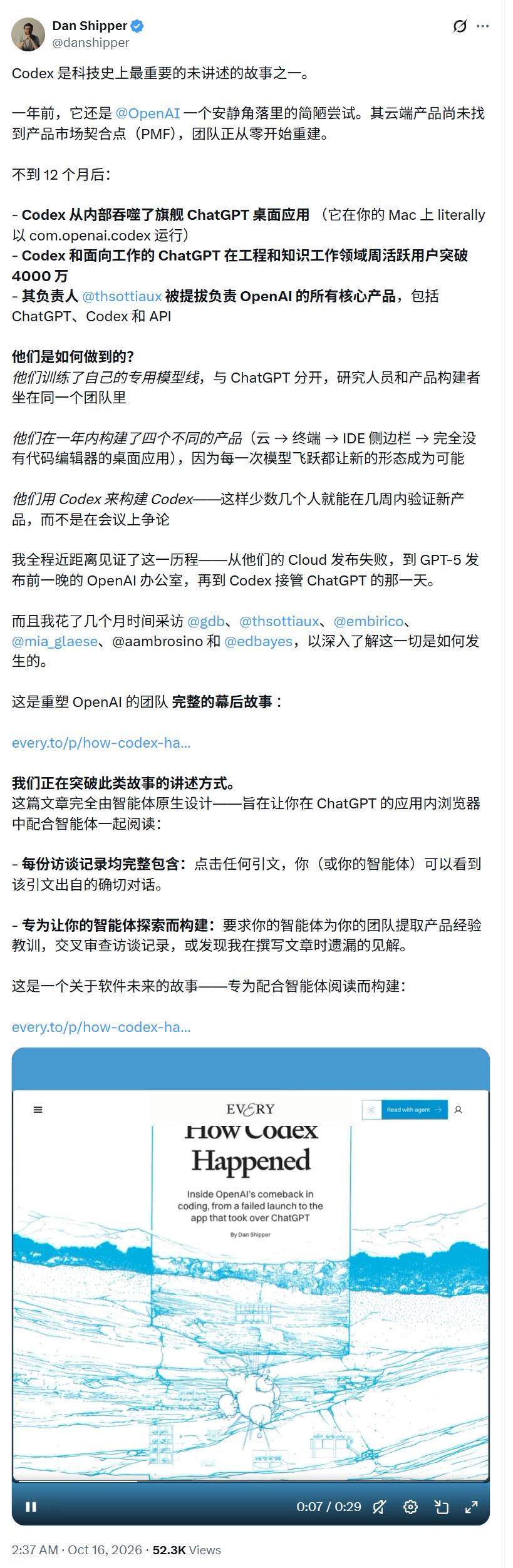
Shipper said he spent months reporting the story and interviewed six people central to Codex: OpenAI president and co-founder Greg Brockman, Codex lead Thibault Sottiaux, former Codex product lead Alexander Embiricos, researcher Mia Glaese, designer-engineer Andrew Ambrosino and designer Ed Bayes. Shipper was also close to the process as an outside observer. Every has regularly received pre-release access to major model launches for its "Vibe Check" reviews, and he wrote that he was sitting in OpenAI’s office on the eve of the GPT-5 release.
The format of the story was unusual as well. Shipper described it as an "agent-native" article: full transcripts of all six interviews were published alongside the piece, readers could click any quote and jump to the source conversation, and they could also use their own agents to cross-check the interviews, extract product lessons or surface details the author missed. Every said Codex itself helped report and write the article.
Codex did not just recover. It ended up underneath ChatGPT.
One of the more revealing details in the report is that the ChatGPT desktop app on macOS still identifies itself internally as com.openai.codex. In Shipper’s telling, Codex effectively swallowed ChatGPT from the inside. He also wrote that what looked from the outside like a top-down decision to create a separate Codex model line was not, in Sottiaux’s account, a formal strategic call at all.
Within a year, the team built four distinct product forms: a cloud version, a terminal version, an editor sidebar and, finally, a desktop app with no code editor. To test whether an app that prevented users from editing code by hand could actually work, Embiricos went around the office asking colleagues the same question every day: had they used it as their primary tool today?
The growth figures cited by Every were significant. Codex passed 5 million weekly active users in June 2026. In July, the Codex desktop app became the new ChatGPT desktop app. Codex and ChatGPT for Work now total more than 40 million weekly active users, and Sottiaux has since been promoted to lead OpenAI’s core products and platform, including ChatGPT, Codex and the API.
On the eve of GPT-5, Shipper thought OpenAI might be building for a workflow that was already fading
Shipper opens the story in the summer of 2025. Every had early access to GPT-5 for a month and liked it in day-to-day use, but the reaction was far less enthusiastic when the model was used inside Codex for programming. It was fast and capable, yet it stopped too early and stayed too close to the edge of what it had been told to do. It behaved more like a cautious pair programmer.
By then, Every had already shifted to another workflow: handing entire tasks to Opus 4 through Claude Code and walking away until a full feature, or even a full application, came back. In a conference room at OpenAI’s Mission Bay office, Shipper shared those observations with Embiricos. Claude Code, he said, felt willing to run hard. GPT-5 felt hesitant. When he admitted that "we don’t really look at code that much anymore," he said he blushed, because the person sitting across from him was building autonomous coding agents for a living.
When he left that night, one thought stuck with him: OpenAI might be perfecting a tool for a workflow on its way out.
The turning point starts with reasoning models
To explain Codex’s rebound, Shipper rewinds to the arrival of reasoning models. Early large language models behaved like improvisers, producing output token by token as they went. In September 2024, OpenAI released the o1 preview and trained the model to reason through steps before answering. Give the same model more thinking time, and it could do better on harder problems.
Programming became one of the clearest beneficiaries. Code creates a tight feedback loop by default: edit, run, and find out within seconds whether the result works. A model can test its own output, detect failure and try again. In theory, the report says, a reasoning model with enough thinking time could independently complete any coding task.
Even the name Codex has had multiple beginnings. The first Codex was the GPT-3 fine-tuned model from 2021 that powered the original GitHub Copilot. After o1, several teams inside OpenAI started chasing the dream again from different angles.
Two quiet threads: Embiricos’s AGI moment and Sottiaux’s bootstrapping loop
One thread runs through Alexander Embiricos. He joined OpenAI in 2024 after his coding collaboration startup Multi was acquired. He worked on the ChatGPT desktop app and the Atlas browser, testing forms of human-computer collaboration, but the models at the time were still too slow and clumsy at reading screens. Late in 2024, that changed. He saw a reasoning model connected to a terminal, reading files, running commands and handling errors on its own. Shipper wrote that this was the first time Embiricos truly felt what AGI could mean.
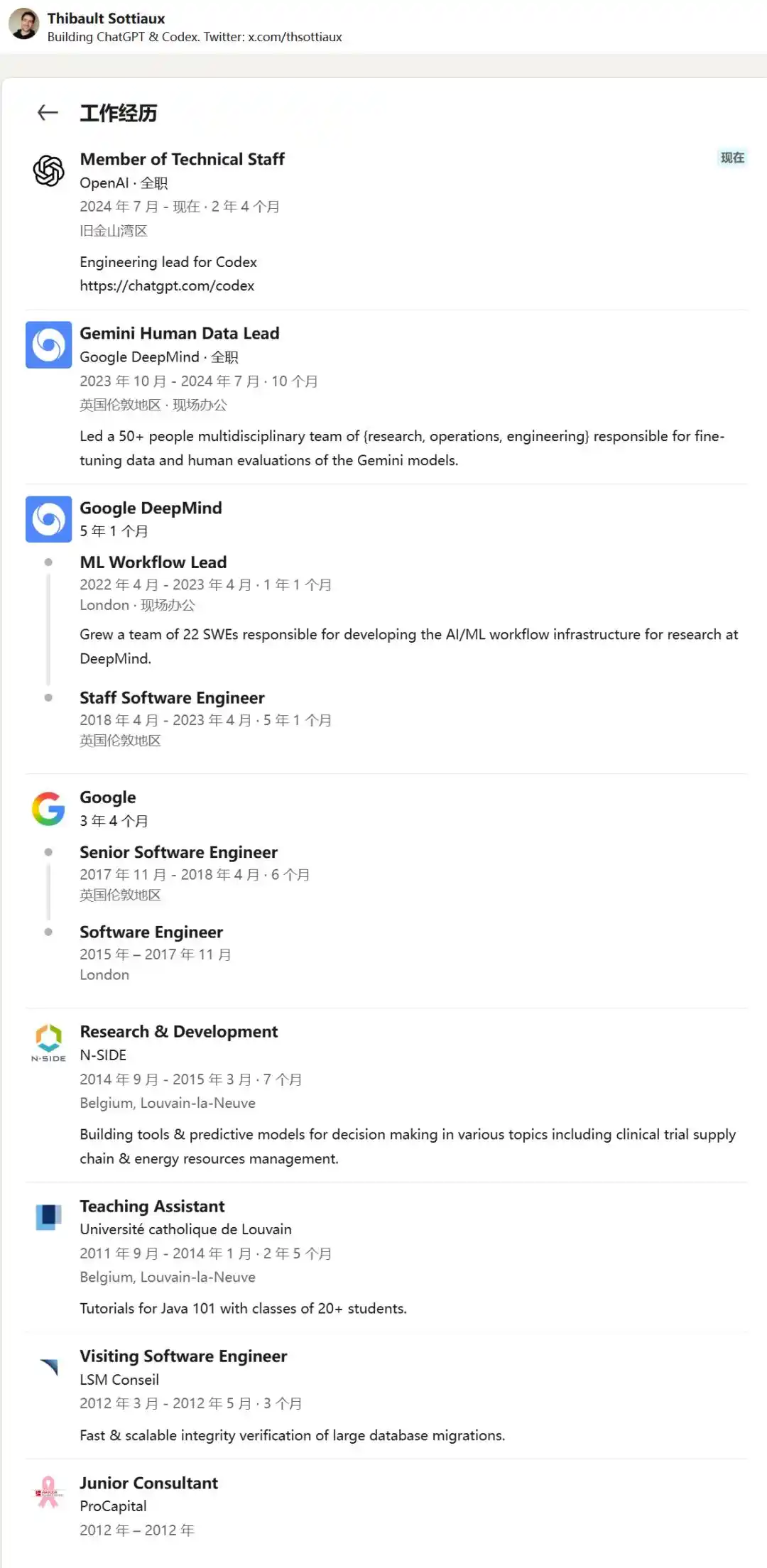
The other thread runs through Thibault Sottiaux, known inside OpenAI as Tibo. Shipper interviewed him in the employee cafeteria and spent time on his appearance and reputation, but the more important detail was his background. Sottiaux spent most of his career building infrastructure for researchers, first at DeepMind and then at OpenAI. In practice, that means the shared systems AI researchers depend on to run, evaluate, reproduce and deploy experiments.
Infrastructure often sounds like plumbing — essential, but easy to ignore until it breaks. In AI labs, though, that work often determines the pace of progress. If one experiment runs faster, researchers can try more of them. Better models arrive sooner. That mindset — building tools for the people building models — also shaped Sottiaux’s path into coding agents.

In December 2024, he began working on coding agents to help OpenAI write infrastructure faster and move research along. His team trained internal coding agents on OpenAI’s monorepo, where researchers used them daily and feedback cycles were extremely short. The report does not spell out the training methods. It only notes that, like peers at other labs, he declined to discuss specifics.
When Shipper pressed him on how the company decided to split out a dedicated model line, Sottiaux’s answer was simple: there was no such decision. It began as a research exploration to make the team itself faster. Researchers used the models to run experiments, produced stronger models, then used those stronger models to run better experiments. Engineers call that bootstrapping.
OpenAI ran several internal startup bets at the same time
By the end of 2024, programming had become a company-level priority at OpenAI, with multiple teams working on the same broad problem. Brockman said the unresolved question was product form: should the agent live in the terminal, in the editor or in a cloud computer of its own?
Shipper cited Sam Altman’s old remark that OpenAI was, in some sense, betting on a set of startups that all happened to exist inside one company. To some insiders, that parallel effort looked messy and wasteful. Shipper argued it was close to unavoidable in a field where the frontier keeps moving. A model that can autocomplete a line of code suits one product. A model that can think for 30 seconds suits another. A model that can work for an hour needs a different form altogether.
Those teams were eventually merged. Brockman described the process as merging two and then merging two again. The resulting Codex group brought together product people such as Embiricos, engineering leaders such as Sottiaux and researchers such as Glaese. Product managers could say, in effect, "what if the model could do this," and researchers could try to make it real.
Codex Cloud was built in seven weeks, worked inside OpenAI and fell short outside it
In February 2025, Anthropic released the Claude Code research preview. It worked directly in the user’s local terminal, used existing files and tools, and let developers interrupt it as needed. Developers adopted it quickly.
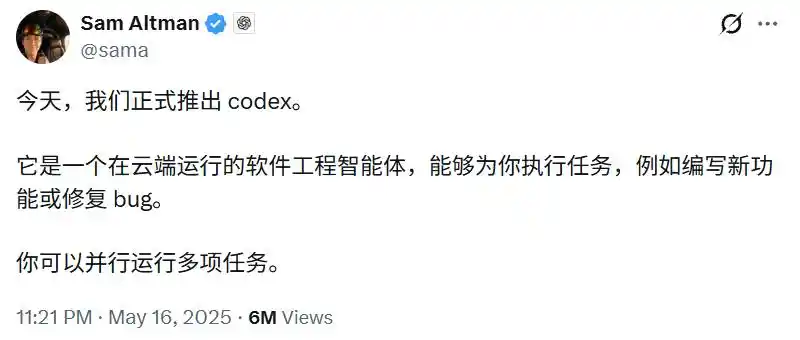
The Codex team made a different bet. It chose the cloud. In roughly seven weeks, it built Codex Cloud and launched it on May 16, 2025. Users could describe a task in ChatGPT, Codex would edit code and run tests on an isolated remote machine, and then return a button to open a pull request.
Inside OpenAI, the product did well. Outside the company, it failed to catch on. Developers had to spend hours recreating their local software, permissions and configuration in the cloud. They also could not steer the task in the middle of a run; even a follow-up question often meant spinning up an entirely new remote machine. OpenAI’s standardized internal environment had hidden how demanding that setup would be for ordinary users. Embiricos acknowledged that the models were not smart enough yet, either. Glaese later said the team had come in with a future-facing vision but had not gone to where users actually were: their laptops.
Sottiaux also said the team had not ignored the terminal route completely. It built an internal terminal prototype, but abandoned it after a month and went all in on the cloud approach. Within OpenAI, the ideal agent had long been imagined as something that could keep working in the cloud after you closed your laptop. Brockman put it this way: the right form was a cloud AI with its own laptop.
Reality was less accommodating. The report says the team’s engineering manager later left for Cursor, and OpenAI’s reported $3 billion acquisition of Windsurf fell apart in July. For the first time, the Codex team was genuinely lost.
Then the team did what reasoning models do: it backtracked
Shipper framed the next move through the logic of reasoning itself. Reasoning models become useful because they can revisit a path, realize the assumptions were wrong and try another route. That is what the Codex team did next.
At the time, Bayes described Codex as a "remote corner" of OpenAI. If you wanted a glamorous design job, ChatGPT was where you went. This was also the period when Sottiaux took over the team and changed its direction. The pivot was toward local execution.
He did not begin by stuffing more features into the CLI. He rewrote the agent in Rust and separated the low-level mechanics — reading files, running commands and so on — from the terminal interface itself. That made it possible to run the same underlying agent in an editor, a desktop app, the cloud or even inside ChatGPT later on.
The model side changed too. The report says Michelle Pokrass led work to make GPT-5 better at real-world programming. Brockman compared the situation to a student who can score highly in programming contests but has never actually seen a messy production codebase. Pokrass’s team sat beside programmers, watched where the model failed and turned those failures into training tasks.
That also recast the "hesitation" Shipper had felt on the eve of GPT-5. Burned by the cloud version, OpenAI had produced a more careful collaborator — and, at that moment, many engineers actually wanted one. The VS Code and Cursor extensions released after GPT-5 saw usage grow by more than 10 times by October, according to the report. For Embiricos, the rebuilt local agent had finally found a model strong enough to drive it.
The boldest bet was a coding app that would not let you edit code
The expected next step would have been to double down on the CLI and editor extensions. Instead, the Codex team made its biggest next investment in a native desktop app.
Sottiaux believed model sessions would get longer, people would soon run several agents at once and spend the day alongside them, and it would feel increasingly absurd to manage all of that through a plain text window from the 1970s. Embiricos saw another opening: a workflow the cloud product had failed to capture, where users start in close collaboration with an agent and then, like onboarding a new teammate, gradually learn which tasks they can trust it to handle alone.
After Ambrosino joined, the four-person team looked less to VS Code than to chat apps for inspiration. Then it made the riskiest product decision in the story: no built-in code editor. If users wanted code changed, the agent had to do it. Ambrosino’s logic was that once you let people type directly, they expect the full editor stack — undo, search, shortcuts and everything else. Codex could not win by being a mediocre editor. It could only win if the agent was good enough that people stopped missing one.
The awkward part was that the team was still using VS Code to build the thing that was meant to replace VS Code. Embiricos walked around asking whether anyone was actually using it as their main tool yet, and early answers were mostly no. Some people complained that replacing a single sentence required writing a prompt. Ambrosino himself said "not being able to edit files" was the product choice he doubted most. Then Google launched Antigravity in November with a full integrated editor, and the team stared at each other. Had they made a major mistake by not forking VS Code?
Model releases changed the equation
Ambrosino’s view was blunt: with model quality where it stood in November, the app could not ship no matter how polished the interface was. Two later releases changed that.
- GPT-5.1 Codex Max, released on November 19, could write code continuously for hours.
- GPT-5.2 Codex, released on December 18, became better at making changes inside large codebases.
Because the Codex model line was separate from ChatGPT, the team could iterate quickly without worrying about disruption across ChatGPT’s 800 million users.

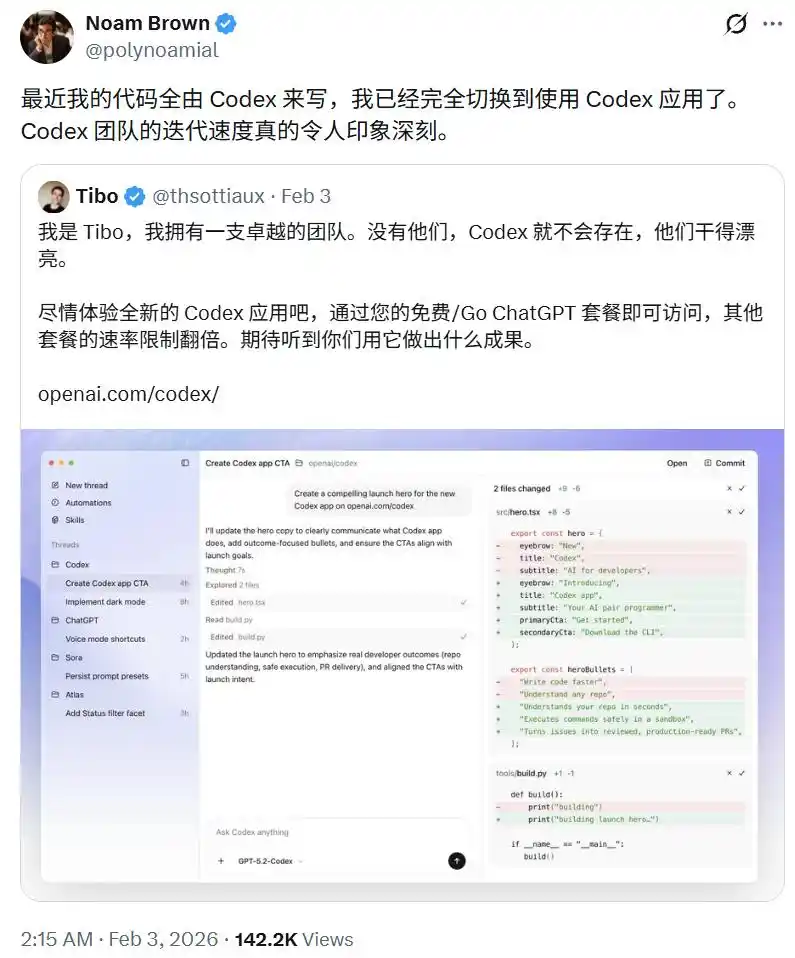
By January, the whole team had switched to using the Codex app. By February, prominent researcher Noam Brown said he had "fully switched." Brockman, a longtime terminal and Emacs user, switched too and said returning to the old workflow felt "like going back to the past." Altman later called it the most internally loved product in OpenAI’s history.
The macOS launch in February 2026 was followed by a fast climb
The cloud version had also been popular internally, so the question remained whether this time would be any different. On February 2, 2026, OpenAI released the Codex desktop app for macOS. Users could ask one agent to fix a bug and another to build a feature, each working in its own isolated copy of the code.
Shipper was explicit that none of those capabilities were entirely new. Claude’s desktop app had already done similar things. His distinction was structural. Claude’s app, in his view, had been assembled in layers from chat to code to coworking. Codex, by contrast, started clean and was agent-centered from the beginning. The absence of a built-in editor meant that almost everything a user wanted done had to flow through the agent.
A few days later, GPT-5.3 Codex arrived and marked another turn. Glaese said this was the first point at which the Codex model line began to move beyond coding-specific training toward broader knowledge work. Shipper himself shifted from using Claude almost exclusively to using Codex heavily, and after GPT-5.4 arrived in early March, Codex became his primary tool.
From there, the adoption numbers kept rising:
- On March 19, weekly active users topped 2 million.
- In April, Codex added a built-in browser and the ability to preview documents, slide decks and spreadsheets.
- In June, weekly active users exceeded 5 million, with about one-fifth of them classified as knowledge workers.
- On July 9, the Codex desktop app officially became the new ChatGPT desktop app.
At the beginning, Codex Cloud had been just another tab inside ChatGPT. Now, Shipper wrote, ChatGPT runs on top of Codex. Bayes recalled leaving the all-hands meeting where the merger was announced and realizing that the few people in the corner had become the future of ChatGPT.
A whiteboard sketch of one curve after another
The article closes in June 2026, when Shipper met Embiricos again in Manhattan. By then, Embiricos had moved into the role of OpenAI’s head of enterprise products.
On a whiteboard, Embiricos drew Codex’s growth curves: the cloud version rose briefly and then flattened; the CLI after GPT-5 was steeper; the editor extension went higher still; and finally GPT-5.3 Codex plus the desktop app made all the earlier curves look small. The very first line, the cloud line, had shrunk into something that looked like a scratch near the bottom of the board.
Shipper said the picture reminded him of the diagram in Clayton Christensen’s The Innovator’s Dilemma: as hardware improves, computing moves from mainframes to personal computers to phones, and each leap enables a simpler form and a larger market. What took half a century in the broader industry, he argued, had been replayed by a few people inside OpenAI in 10 months.
The report also noted that the chart was first introduced by Christensen in a 1995 Harvard Business Review article to explain the dynamics between sustaining innovation and disruptive innovation, and that the Chinese version shown in the article was produced by ChatGPT.
Under Christensen’s theory, the team that wins one curve usually does not win the next one. Shipper argued that Codex escaped that pattern for two reasons. First, OpenAI was deliberately organized around parallel bets, which gave Codex room to iterate outside ChatGPT’s scale. Second, building Codex with Codex changed the practical speed of product development; a few people could build a new form in a few weeks and put it in front of users quickly. As Sottiaux put it, it now takes a lot less talking to convince people.
One final curve remained on the whiteboard. Millions of people had already learned to trust agents running on their own machines. The next step, Embiricos said, is to return to the older vision that once failed: an agent that keeps working after the user walks away. That means a shift toward asynchronous use, and with it, a return to the cloud.
Shipper ended on a small detail. This time, Embiricos’s laptop sat on the conference table with the lid fully closed.
This article is based on a MarsBit item republishing a post from the WeChat public account "机器之心" (ID: almosthuman2014), credited to the author name provided there.