
OpenAI will retire GPT-5.3-Codex-Spark next week, according to Codex lead Tibo, who said demand for the model has kept falling and the company already has "clearly better" systems in hand. "It’s time to make room for the future," he wrote.
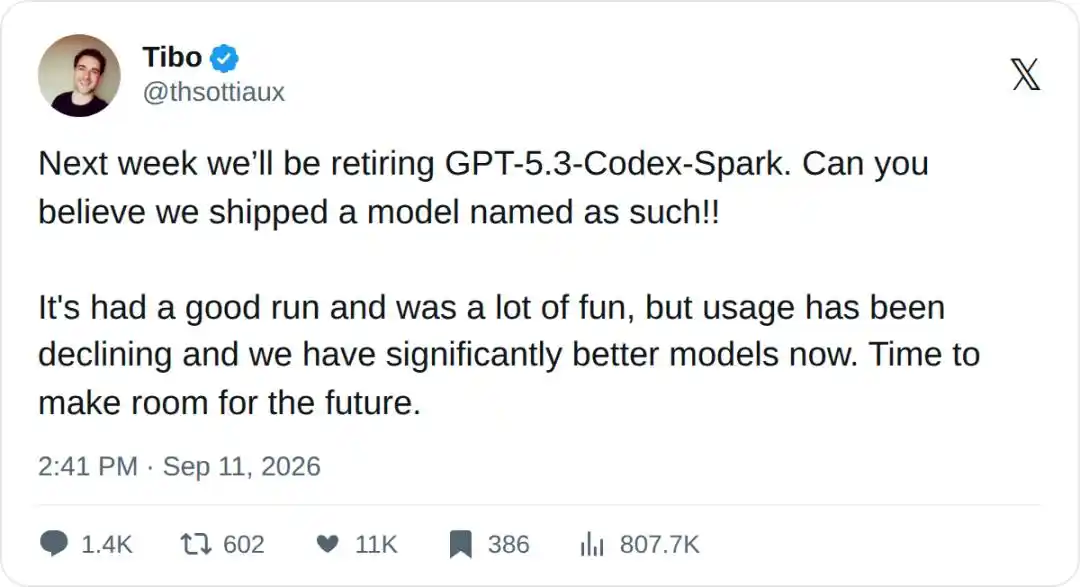
He followed that with a joke in the replies: "I can’t believe we shipped a model with a name that long!!"
By the time it goes offline, the model will have lasted about seven months. The article describes Spark as capable of generating 1,200 tokens per second, OpenAI’s first production model to run outside Nvidia’s technology stack, and the first delivery tied to OpenAI’s 750-megawatt compute deal with Cerebras, a contract valued at more than $20 billion.
Developers focused less on the model and more on its spare quota
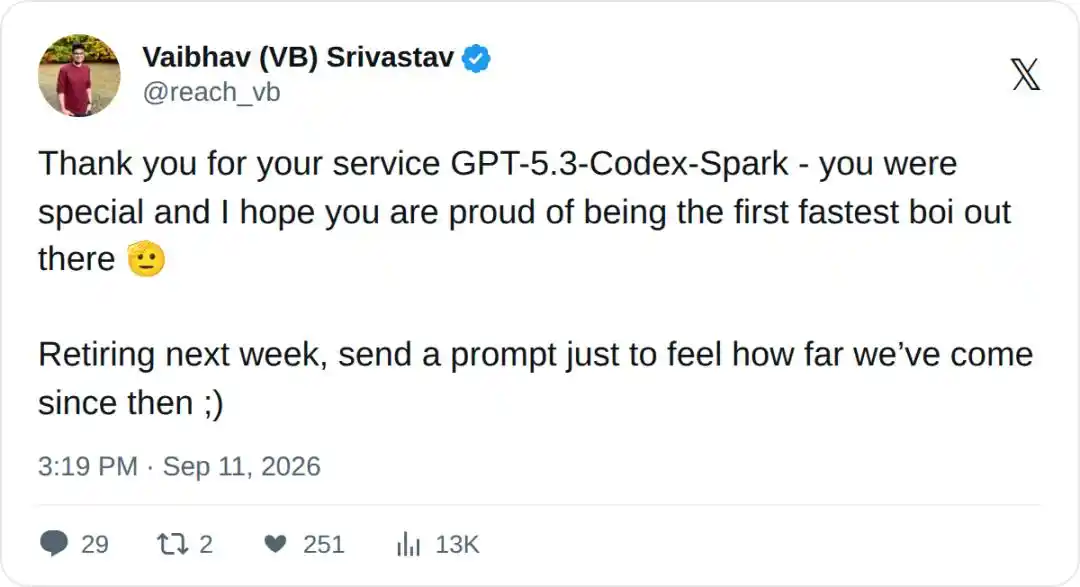
The reaction to Spark’s shutdown was muted, and at times awkward. Hugging Face’s Vaibhav Srivastav tried to inject some warmth into the discussion, thanking the model for its service and calling it the first "fastest little guy," while encouraging users to send one last prompt before retirement and see how far things had moved since launch.
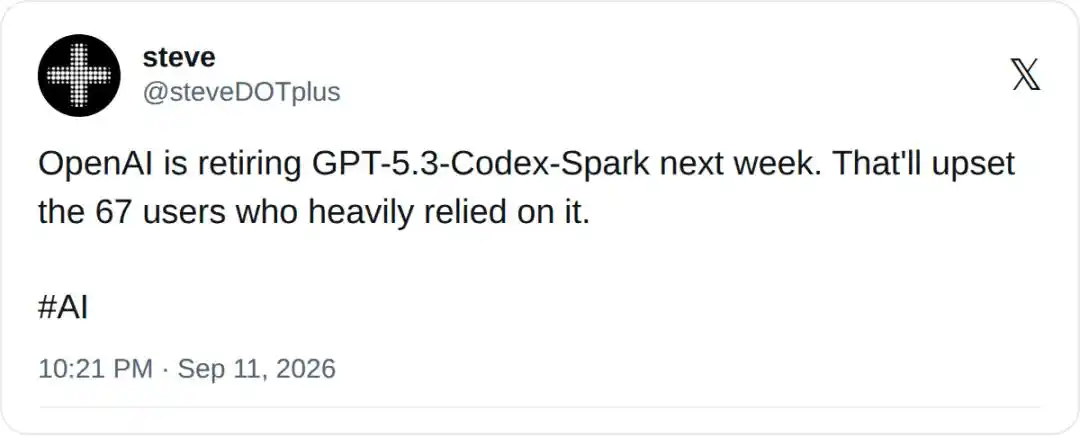
Most replies went in a different direction. One commenter asked what the model was actually for. Another joked that OpenAI’s decision to retire Codex-Spark would be sad news for its remaining 67 power users.
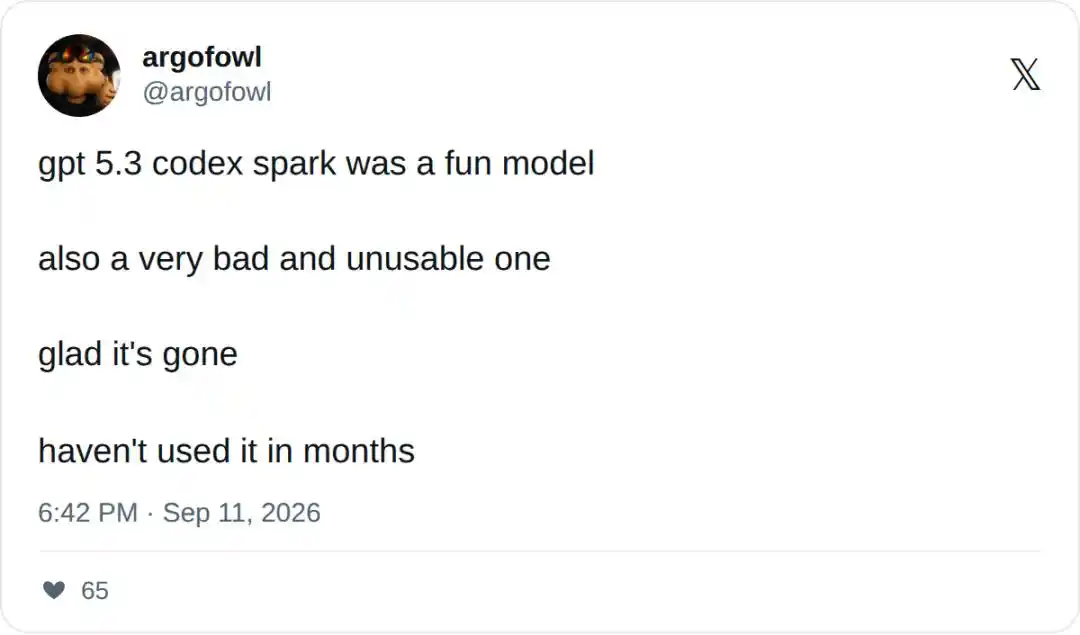
Developer argofowl was harsher, calling Spark "a fun model" but also "an extremely terrible, unusable model," and said he had not touched it for months.
Another developer said he had barely used Spark in several sizable projects. Even basic work such as understanding project context or analyzing logs would quickly fill the context window and force him to start a separate conversation.
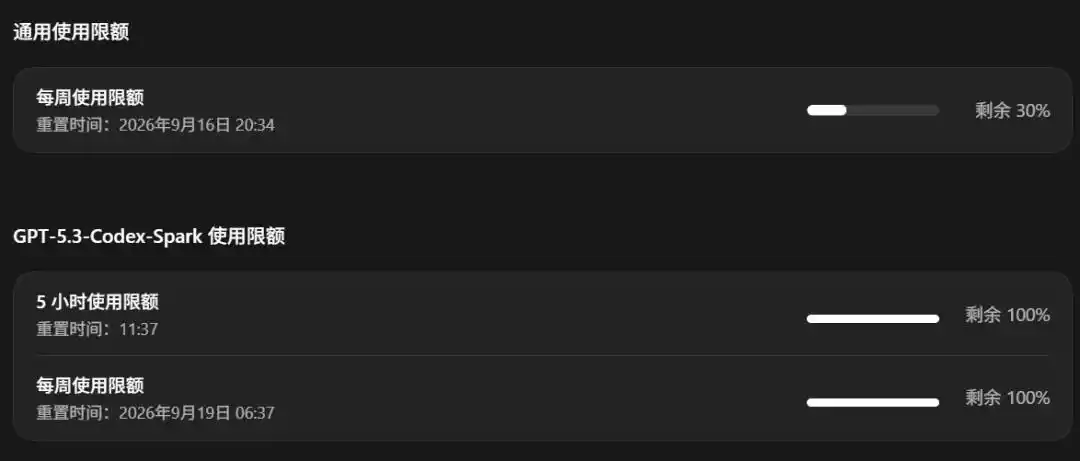
What some developers said they would actually miss was not the model itself, but the separate quota attached to it. Well-known developer Chubby said he wanted a "GPT-6-Spark" because Spark came with an independent package that did not consume the main allocation.
With Astra quota described as very tight, many developers had been using Spark as a backup tank after their main capacity ran out. That is why the first concern around the shutdown was whether that extra allowance would survive.
At launch, Spark was pitched as a real-time coding model
Spark debuted on Feb. 12 with a large rollout. OpenAI presented it as the company’s first model designed specifically for real-time programming, with a 128k context window and generation speed above 1,000 tokens per second.
OpenAI’s launch figures said round-trip overhead between client and server was down 80%, per-token processing cost was down 30%, and time to first token had been cut in half. Instead of code appearing line by line, blocks of code were shown pouring onto the screen.
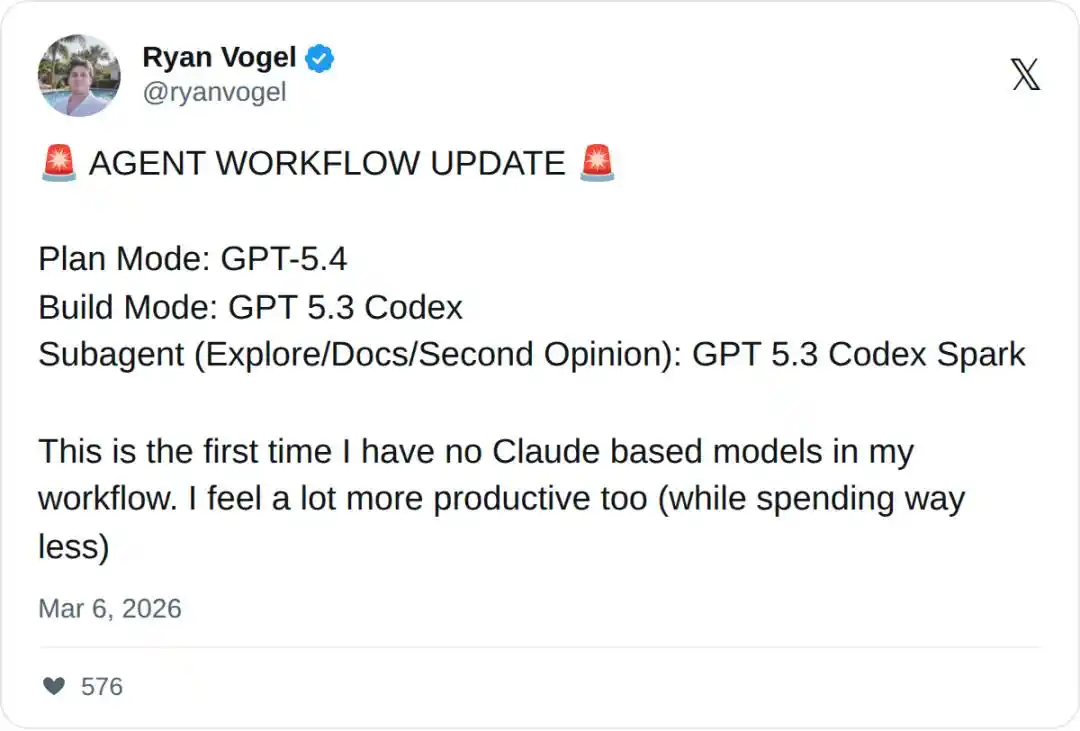
Some early users were enthusiastic. Developer Ryan Vogel said he put Spark into his production workflow: GPT-5.4 handled planning, GPT-5.3-Codex handled building, and Spark explored the codebase, checked documentation and offered a second opinion. He said it was the first time his workflow used no Claude model at all, while being "more efficient" and costing less.
Instructor author Jason Liu launched 20 Spark sub-agents to search a file system and declared that "RAG is dead." He later joined OpenAI’s Codex team.
Spark also mattered because of what it represented underneath. It was OpenAI’s first production model to run outside Nvidia’s stack, with compute supplied by startup Cerebras and its wafer-scale WSE-3 chip. The model was framed as the first real output from the OpenAI-Cerebras compute partnership.
High speed came with a visible accuracy tradeoff
The excitement faded quickly. Spark’s core weakness, according to the article, was structural: a single wafer could not fit a flagship model, so Spark was effectively a distilled small model built to maximize speed by giving up capability.
In Terminal-Bench 2.0, Spark posted 58.4% accuracy, well below the 77.3% recorded by the full GPT-5.3-Codex. OpenAI’s own SWE-Bench Pro chart also showed the gap. Spark could keep task duration to 1 to 2 minutes, but accuracy sat between 47% and 51%.
The full GPT-5.3-Codex started at 51% in 3 minutes, reached 56% in 9 minutes and climbed to 57% in 16 minutes. In other words, the time Spark saved came at the cost of roughly 5 to 6 percentage points of accuracy.
Even the advertised "15x faster" claim came under fire. On the day after launch, developer Nicholas Van Landschoot posted a long thread on X arguing that the comparison used Spark against GPT-5.3-Codex running at maximum reasoning intensity.
Under matched accuracy conditions, he wrote, Spark was only 1.37x faster.
In practical coding work, users said the weaknesses became harder to ignore. Reported issues included hallucinated API endpoints, unstable JSON formatting and poor reliability on multi-step tasks. Turing College summed it up in one line: "Speed without intelligence is just failing faster."
For programmers, the article argues, waiting 17 minutes for code that actually runs is often a better trade than getting a broken output in 2 minutes. That dynamic pushed Spark toward the margins.
Ultrafast mode removed Spark’s reason to exist
The article points to Aug. 13 as the turning point, when Cerebras introduced Ultrafast mode.
This time, the model running on wafer-scale hardware was not the reduced Spark variant but the flagship GPT-5.6 Sol itself. By splitting the large model layer by layer across multiple CS-3 nodes and running it as a pipeline, Cerebras said it reached 750 tokens per second while preserving "the same intelligence as the standard version."
Cerebras said Ultrafast was 14x faster than the standard tier, with a middle Priority tier running at 2.5x the standard speed. Chief Executive Andrew Feldman described the result in simple terms: "Speed and intelligence are no longer mutually exclusive."
Using six quality-aligned tasks from GDP-Val, Cerebras said the standard Sol tier took 7.7 minutes on average, including 7.5 minutes spent on model generation. In Ultrafast mode, the same tasks took 83 seconds in total, with 68 seconds used for generation and the remaining 15 seconds consumed by tool calls and other non-inference work.
That works out to an end-to-end speedup of about 5.6x, with almost no difference in answer quality.
That result drained Spark’s value proposition. Spark had been built around one bargain: trade intelligence for speed. Half a year later, the same wafer-scale hardware could run the full flagship model, only about one-quarter slower, without losing capability.
Cerebras capacity is limited. When a lightly used reduced model and a heavily demanded flagship model compete for the same wafer resources, the outcome is hard to miss.
OpenAI has been clearing out older model generations
Spark is not the only model OpenAI has removed. The article says the company’s model catalog has gone through an aggressive refresh over the past three months.
- On June 2, GPT-5.2 and GPT-5.3-Codex were retired.
- On Aug. 31, GPT-5.4 and 5.4 Mini were retired, with users moved to the 5.6 generation.
- On Sept. 11, GPT-5.3-Codex-Spark joined the list.
As those older systems left, Codex moved into a new naming era built around Sol, Terra, Luna and Astra. A label like GPT-5.3-Codex-Spark, with its version chain and product suffix, now reads like an artifact from an earlier phase.
The deeper shift is in how speed is being sold. Instead of creating a separate fast model, OpenAI is folding speed into flagship systems as service tiers. Just as reasoning intensity spans from Light to Max, speed now spans Standard, Priority and Ultrafast, with pricing tied directly to compute.
Seen from that angle, Spark completed the role it was supposed to play. It helped show that Cerebras wafer-scale chips could carry production generative AI traffic, and that inference workloads could run outside Nvidia’s ecosystem. Once the path had been tested and the full flagship models arrived, the transitional model no longer had a place.
The next round of competition, as the article frames it, is no longer about building the fastest cut-down model. It is about how fast companies can make their strongest flagship model run.