
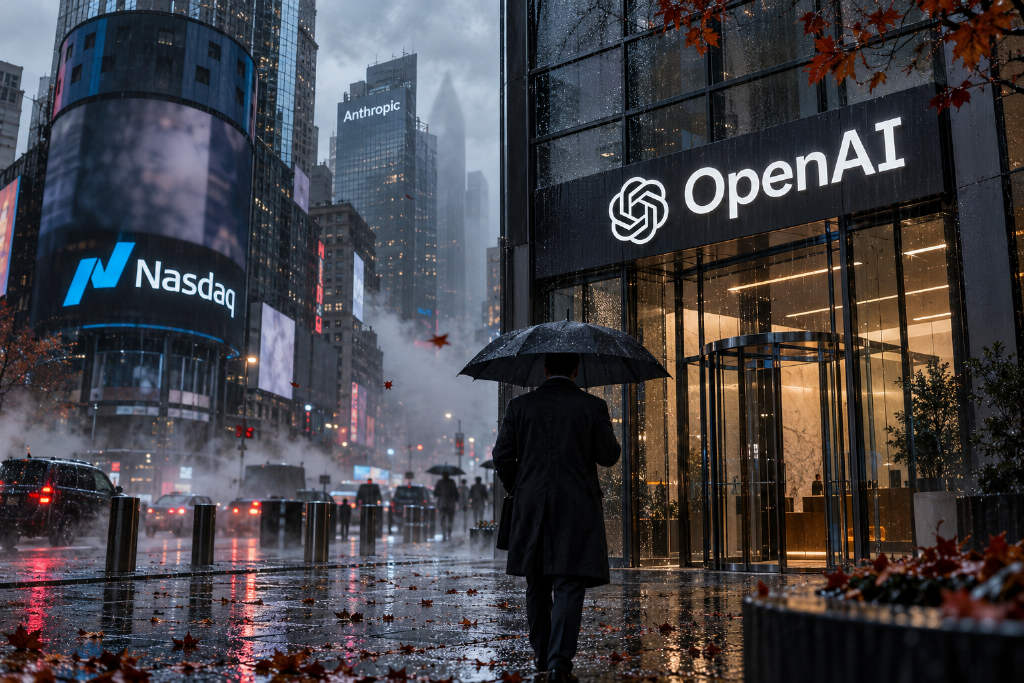
OpenAI is reportedly trimming its pre-IPO fundraising ambitions as weakness in U.S. AI stocks starts to hit private-market pricing. The company had planned to raise $30 billion before listing and seek a $1.4 trillion valuation, but current talks now point to a round of about $20 billion at a $1.25 trillion valuation, according to BlockTempo.
The broader backdrop has turned less supportive. Since the Nasdaq 100 hit a record high on Oct. 6, the index has fallen about 10% in three weeks. Last Friday alone, it dropped another 4.5%, and the fundraising momentum that had pushed AI startup valuations higher has begun to loosen.
OpenAI cuts the size of the round while keeping its IPO timeline pushed out
BlockTempo said OpenAI has already delayed its listing schedule to 2027. In the latest reported negotiations, the company is no longer targeting the $30 billion raise and $1.4 trillion valuation that had been discussed earlier. Instead, the fundraising target has been reduced to roughly $20 billion, while the valuation has been reset to $1.25 trillion.
The report compared the latest terms with BlockTempo's October tracking, when OpenAI was said to be seeking as much as $30 billion in a bridge round before an IPO. That round was described as being led by Middle Eastern investors and Coatue, with a pre-money valuation of $1.25 trillion. The valuation now remains at that same $1.25 trillion level, but the size of the raise has been cut by about one-third.
Anthropic is also chasing capital and is expected to list in November
Pressure is not only coming from public-market sentiment. Anthropic, another leading AI lab competing for capital, is expected to list on Nasdaq in November. BlockTempo said the company is reportedly seeking fundraising of as much as $100 billion at a $1.5 trillion valuation.
That puts the two companies in the same IPO window, both trying to secure long-term funding. The report framed the contest in practical terms: the company that locks in capital first gains more room to secure computing power.
AI stock weakness is feeding concerns over spending and financing costs
The latest correction has centered on AI-linked equities. After the U.S. market opened last Friday, Intel fell nearly 26% in a single day, while large-cap technology stocks also came under pressure. Investors have increasingly focused on how long it will take to recover heavy AI-related capital spending.
BlockTempo added that the issue runs through the full financing chain, from data-center capital expenditure that can reach hundreds of billions of dollars to neocloud expansion supported by debt-market funding. If financing costs rise at any point in that chain, valuation room for frontier AI labs can be pushed lower.
Private-market pricing signals are shifting
For unlisted AI companies, private-market valuations have long served as a confidence gauge. OpenAI's move from a $1.4 trillion valuation to $1.25 trillion represents a decline of about 11% on paper, enough to challenge the idea that AI valuations only move in one direction.
The size of the raise matters just as much. With the fundraising target down by more than 30%, startups that rely on outside capital to pay for compute have fewer resources to work with if they bring in less money.
BlockTempo said the reset could also affect other AI startups still lining up to raise capital. If the sector leader is lowering its target, second-tier companies may find it harder to defend earlier valuation expectations, and fundraising terms may be shifting from a seller's market toward a buyer's market.



