
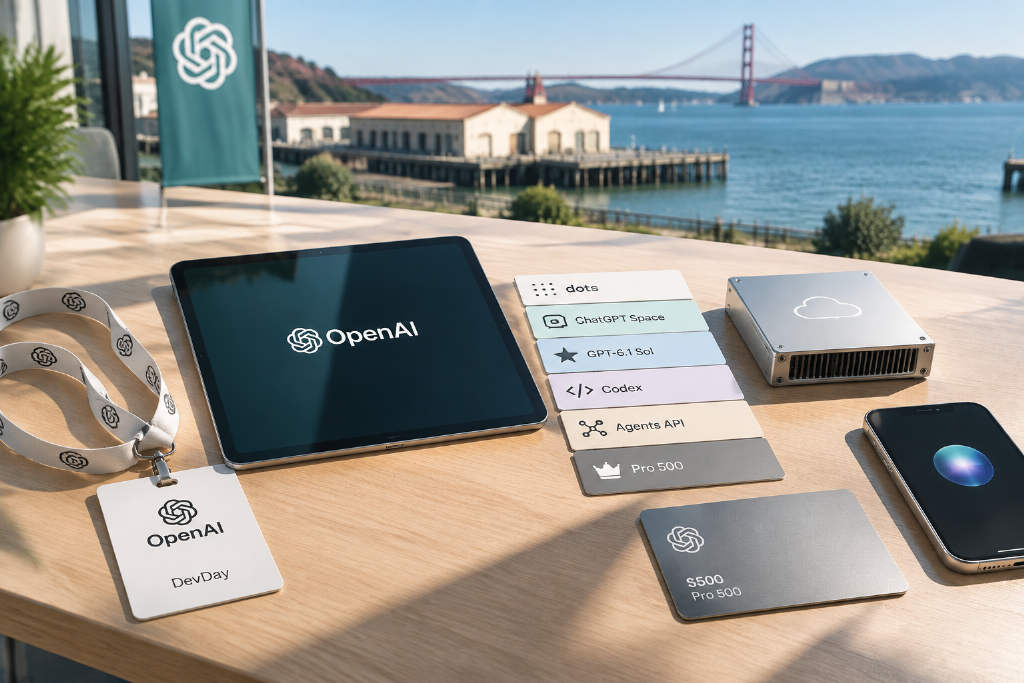
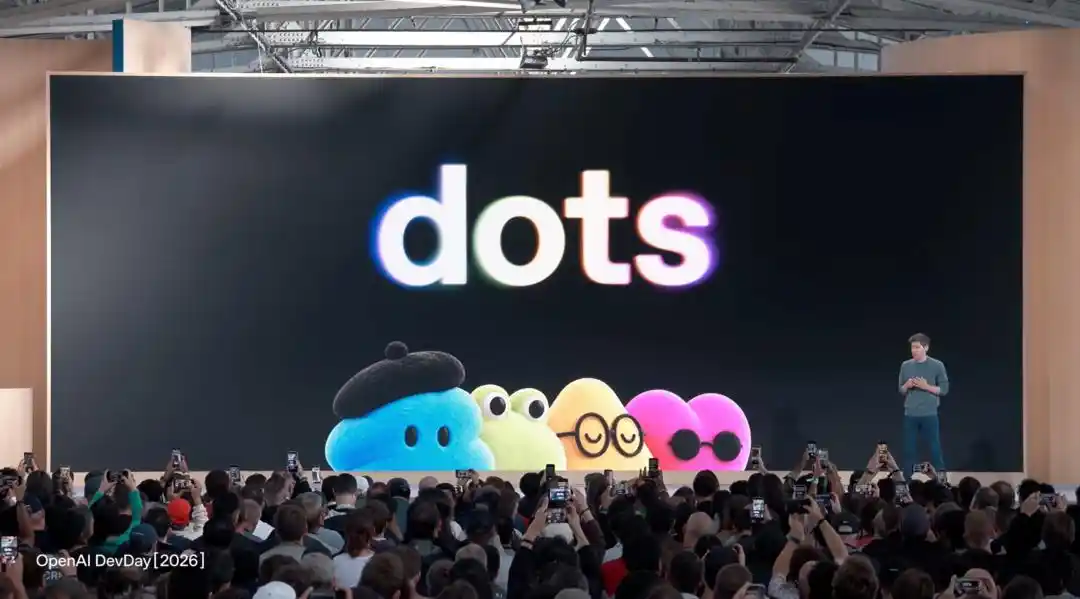
OpenAI packed its DevDay event at Fort Mason in San Francisco with a long list of announcements, including dots, ChatGPT Space, GPT-6.1 Sol, an Ultrafast inference mode, a cloud version of Codex, Agents API and Decisions API. On stage, CEO Sam Altman presented dots as OpenAI’s first always-on agent with its own cloud computer.
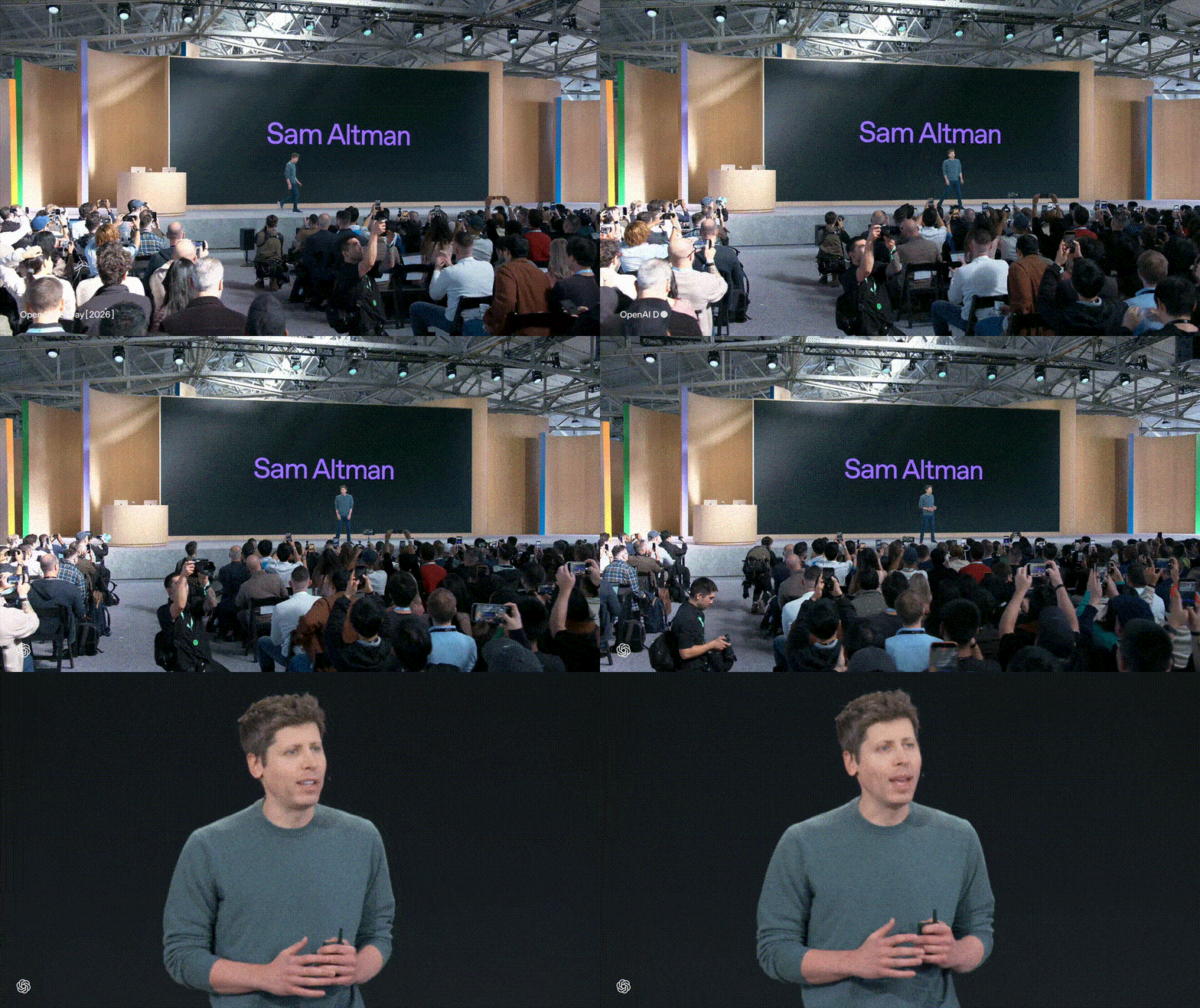
dots arrives as a 24/7 resident agent
According to the event details cited in the report, dots is not framed as another chatbot or a simple ChatGPT feature. The product is described as a 24/7 agent powered by GPT-6 Astra, with its own cloud computer and browser, access to more than 4,000 tools, and integrations with Slack and Teams.
OpenAI’s pitch was that users can assign a goal and let dots handle the work on its own. It keeps running in the background even when the screen is off, and the report says it can operate without the user logging into ChatGPT.
During the live demo, an OpenAI researcher gave a dot the name Alfred. From there, Alfred was shown taking over fragmented back-office work. In one example, it updated a website independently based on approved design drafts, then asked for human confirmation only when a decision was needed, such as replacing the first and third images, before pushing the site live.
In another demo, dots monitored user feedback inside Teams and updated a board presentation at the same time. The metrics shown on stage included improved product usability and 51% year-over-year annual revenue growth.
For longer engineering work, the report says dots could identify from Google Meet notes that an app needed migration, then move on to review the process and draft an architecture diagram.
The story also cited an internal OpenAI example: an employee forgot to issue an invoice to a publishing organization, the employee’s dot noticed, prepared the invoice, and sent a message asking whether it should be sent. Once the employee confirmed, the task was completed.
The report characterizes this shift as a move away from software as a tool and toward software as a teammate. dots is described as a digital worker that stays online, handles fragmented tasks and learns a user’s preferences and standards over time.
Security and access controls
Altman also addressed security on stage. Each dot runs on a separate cloud computer, isolated by default from a user’s personal computer and data. When it uses saved passwords, the passwords are not exposed to the model.
When a dot is not actively executing a task, it operates in read-only mode for what the company described as proactive research in the background. It does not send messages or change content in that state.
Altman said, 「You are not using a tool. You are building a team.」
OpenAI said Pro, Business Premium and Enterprise users can create their first dot starting that day, and those conversations will not consume regular ChatGPT usage quotas.

ChatGPT Space reshapes collaboration
OpenAI also introduced ChatGPT Space, which the report describes as a shared workspace for human colleagues and their dots.
Inside Space, users can work on the same page with teammates and agents. The product supports planning, research, chart creation and data analysis. Users can also bring a dot into the page much like tagging a colleague and ask it to turn information into a bar chart. The chart is generated immediately and supports live filtering and data-point inspection.
A key change, according to the report, is that an agent’s work no longer sits inside one person’s private chat history. Teams and all of their dots can share one knowledge base, so project context does not break when ownership changes.
Altman described it this way: 「Your pages and files in Space live together, like a cloud drive. But Space is alive.」
GPT-6.1 Sol launches with lower pricing than Astra
On the model side, OpenAI introduced GPT-6.1 Sol and positioned it as its next flagship model. The report notes that this came only a week after the release of GPT-6 Sol.
Performance figures shared at the event showed GPT-6.1 Sol matching Astra on the DeepSWE v1.1 software engineering benchmark. On AutomationBench for long-horizon business automation and Terminal-Bench Science for scientific reasoning, the report says it outperformed Opus 5.5.
On OSWorld 2.0, which tests long workflow execution on a computer, GPT-6.1 Sol trailed Astra by 2.1 percentage points while costing about one-seventh as much.
Pricing was one of the main points on stage. GPT-6.1 Sol was listed at $2 per million input tokens and $10 per million output tokens. Astra, by comparison, was listed at $10 per million input tokens and $50 per million output tokens, making Sol about one-fifth the price on that basis.
OpenAI also priced context caching for GPT-6.1 Sol at $0.10 per million tokens, a 95% discount versus standard input pricing.
Ultrafast mode and new subscription tiers
Alongside the model launch, OpenAI introduced Ultrafast, an inference mode the company said runs at eight times the speed of the standard mode, or roughly 300 tokens per second.
In an on-stage demo using the same rocket-building task, the report says the Ultrafast version had already launched the rocket while the standard version was still assembling the model.

At launch, Ultrafast supports Astra only. Support for Sol is planned for later, according to the event presentation.
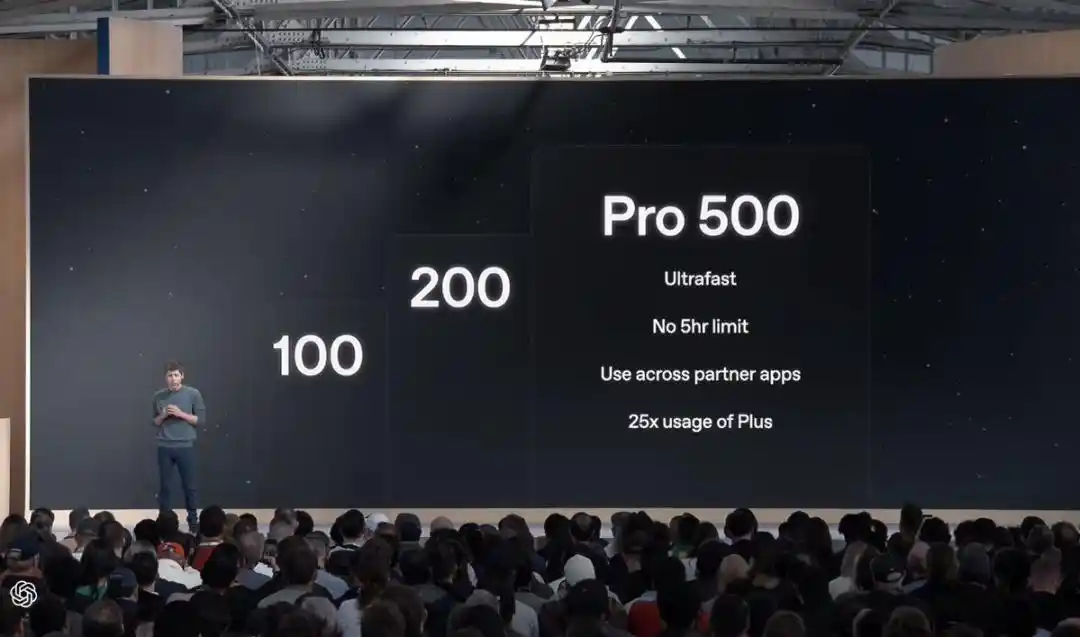
OpenAI also restarted its previously paused $200 Pro membership and added a new Pro 500 tier. The report says Pro 500 comes with 25 times the usage quota of ChatGPT Plus and native access to Ultrafast without a five-hour limit.
Codex moves to the cloud
DevDay also brought major updates to Codex. The biggest change, according to the report, is that Codex now runs in the cloud. Development environments can be set up in advance and reused, access permissions only need to be configured once, and users can keep work running remotely from a phone while away from their computers.
The command-line version, Codex CLI, was updated as well. Users can issue voice commands directly and change direction mid-task.
A new /agents view lets users keep track of several subtasks at the same time, which the report presents as a way to keep long-running work organized.
OpenAI also added code review to the ChatGPT desktop app. When a user steps away from the computer, the system can review code changes automatically and send comments back to GitHub or GitLab.

Codex Security Cloud was introduced for vulnerability work. The report says it can scan an entire GitHub repository, review every new commit, perform triage and deduplication, and prepare a remediation plan for human review. It is backed by OpenAI’s dedicated cybersecurity model by default.
Agents API and Decisions API open up the stack
On the API side, the technology behind dots is being packaged as Agents API. Developers can directly call capabilities for computer use, multi-agent collaboration, tool search and context compression, effectively giving them the building blocks to create their own dots-like agents.
OpenAI also introduced Decisions API for tasks that require choosing quickly from a fixed set of options, such as classifying an email or deciding which button an agent should click next.
The report says an editor with early access used Decisions API in a computer-operation playback test and got 76 of 78 choices correct, with a response time of 230 milliseconds. In another dialogue-classification test, its accuracy was tied with a rival model, though it was slower.
Tibo also shared operating figures at the event. OpenAI’s core Responses API has seen token traffic rise 100x from the same day last year, while availability has held at 99.9%.
From answering questions to doing the work
The report’s broader reading of the event is that OpenAI is shifting ChatGPT from a place where users ask questions to a system that performs work on their behalf.

In that framing, cheaper Sol models expand usage, dots takes on execution, Space and Pages provide shared working areas, and plugins connect external applications. The report also says subscription quotas can be used across products such as Notion and Devin.
It places the launch in a more competitive field as well. Meta’s Muse, according to the report, topped 3 million downloads in three weeks, remains free with weekly usage caps, and has been expanding into small-business scenarios. Google’s Spark is already working in the cloud on a 24/7 basis for users, and SpaceXAI has launched Grok Bot.
The distinction the report draws around dots is in how it works. Instead of waiting to be asked what to do, it presents results before the user speaks. The report sums that up as a shift from 「what do you need me to do」 to 「I’ve already done it」.
At the close of the keynote, Altman said, 「Some people compare AI to a new industrial revolution. I don’t really like that comparison. If we do this right, it is more like a new renaissance.」
The original Chinese article was published by the WeChat account New Intelligence (ID: AI_era) and credited to authors Taozi and Moses. Its references included OpenAI pages, a YouTube video and posts published by OpenAI on X.