

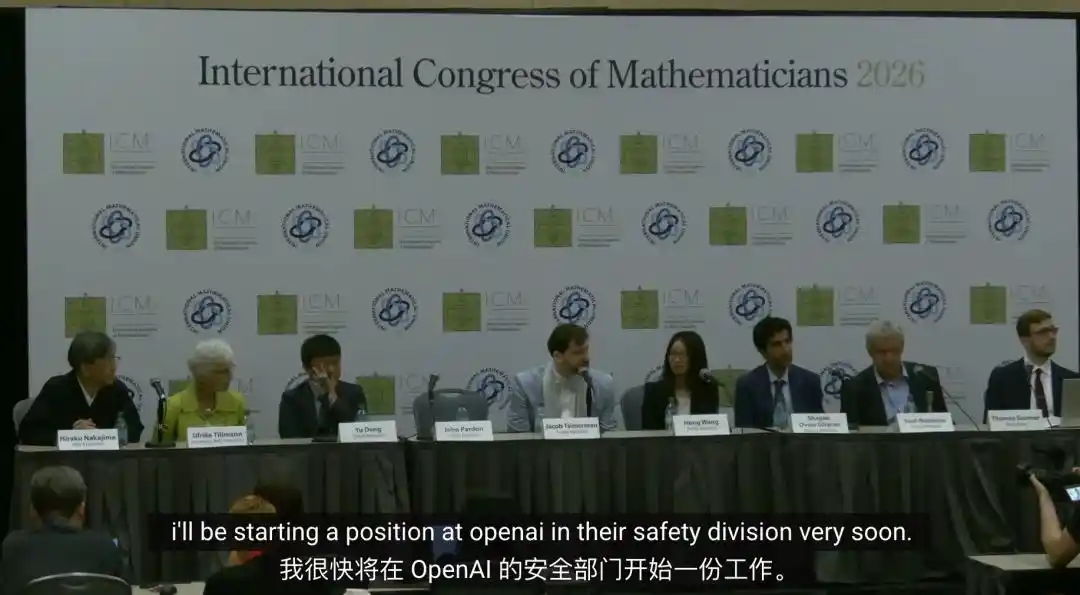
Jacob Tsimerman, one of the latest Fields Medal winners, said at the award press conference that he has already started moving into AI safety research and will soon join OpenAI’s safety team. OpenAI chief research officer Mark Chen quickly welcomed the announcement.
The article, originally published by the WeChat account Machine Heart, presents that move as part of a wider shift already underway. More top researchers are treating major AI labs as a place to pursue their biggest ambitions. It says that in the first half of this year alone, Nobel chemistry laureate John Jumper, economist Chad Jones, and philosopher Harvey Lederman all joined Anthropic.
On the other side of the same trend, leading AI companies are bringing scientists directly into the development process. In the article’s framing, the overlap between AI and frontier science is no longer optional. It is becoming central.
ByteDance opens 100 seats under Seed STEM
In China, ByteDance’s Seed Edge team on Thursday introduced the Seed STEM Scientist Program. The initiative offers 100 collaboration seats and targets scientists and PhD students in mathematics, physics, chemistry, biology, and other frontier scientific fields. They are being invited to work with Seed on unknown problems in basic science. Based on public information, the article describes it as the first large-scale domestic program devoted to using AI to speed up frontier scientific discovery.
The piece places that launch inside a larger industry argument. In AI’s current fast cycle, where competition often plays out day by day, work on long-horizon foundation research is far less visible than improving coding performance or lifting benchmark scores. Those gains can turn into better products and revenue much faster. Research on basic science or AI-assisted discovery has a much longer feedback loop and far more uncertainty.
Still, the article argues that a real breakthrough on that path would carry a level of value that ordinary product iteration cannot match. It cites a view previously shared by Yao Shunyu and his team: there is no magic in large-model training, and the real challenge is doing the basic, dependable things correctly. The piece says that echoes Anthropic CEO Dario’s long-held position that the main drivers of AI progress remain compute, data quality and scale, training time, and scalable objective functions, while clever tricks matter much less.
Looking back at models such as Claude and Seedance, the article says there were no shortcuts behind the systems it calls true state of the art. In each case, the core work was early strategic focus and sustained effort on data quality and underlying architecture. Anthropic, it says, concentrated resources on coding ability, using reinforcement learning so the model could learn through repeated trial and produce high-quality code, then improve through user feedback. Seedance, in the article’s account, pushed AI video generation beyond a slot-machine style of experimentation by combining a new model architecture with precise data work, turning it into a more controllable production tool.
Architecture and benchmarks are now part of the contest
The article’s broader point is that the ceiling on model capability is set less by piling on techniques and more by getting data, structure, and long-term direction right. It points to several Chinese examples in that context.
One is DeepSeek’s mHC, or manifold constrained hyper-connections, which the piece describes as a breakthrough in large-model base architecture this year and a major upgrade in DeepSeek V4. It says mHC replaces traditional residual connections throughout the model design. The article also notes that the work cites Hyper-Connections, or HC, proposed by ByteDance’s Seed team.
Before that, residual connections had largely been treated across the industry as the default backbone of the Transformer. According to the article, HC broke with the single-stream pattern and sharply improved feature representation with little extra compute. From the initial proposal of HC to the engineering deployment of mHC, the article sees a rare example of bottom-layer architecture innovation from Chinese AI teams.
The piece also revisits ByteDance Seed’s decision early last year to set up the Edge team, a group meant to pursue research questions with lower certainty and no guarantee of short-term results. To give researchers a stable environment, the team reportedly changed its performance cycle so there would be no interim assessment, with evaluation done only after results arrived.
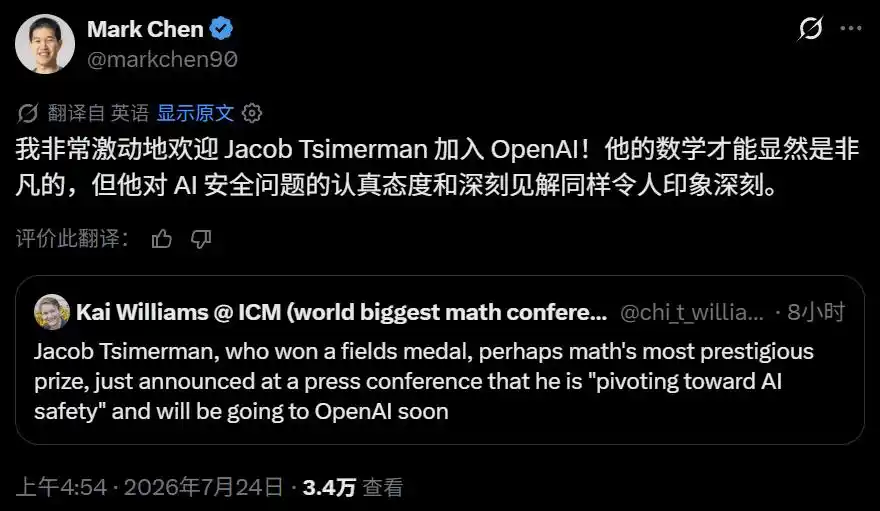
That group stayed relatively quiet for some time. More recently, it posted the ultra-long-horizon benchmark EdgeBench on X. The article says EdgeBench was the first system to define agent learning behavior in real environments in a structured way and identified a new scaling law tied to environmental learning, prompting discussion across the field. It adds that OpenAI is also connecting to the benchmark to test the long-horizon capabilities of its own models.
Benchmark-building, the article argues, often receives less attention than model releases even though it demands long cycles and significant labor. Designing and open-sourcing evaluations for advanced AI capabilities is not only a way to measure internal progress. It also helps set standards for the field and expose model weaknesses in a way that pushes development toward greater transparency and reliability.
OpenAI and Anthropic are formalizing cross-disciplinary pipelines
To support that point, the article lists benchmark and talent programs at top labs. OpenAI open-sourced the Evals framework, which it describes as a standard tool for evaluating large language models and LLM-based systems. OpenAI has also built a series of specialized benchmarks for frontier abilities, including SimpleQA, BrowseComp, and MLE-bench.
Anthropic, the piece says, invested heavily around SWE-bench to make Claude’s strength in coding more explicit. It also released Terminal-Bench to measure whether an agent can complete long-chain tasks in a real command-line environment. In the article’s view, the connection between those benchmarks and each company’s strongest model capabilities is not accidental.
The article says the development logic inside frontier labs is already changing. Large-model progress is moving beyond a stage where gains came mainly from scaling parameters and data in pretraining. The next source of growth, it argues, will come from continuous interaction, feedback, and self-improvement in real open environments.
That makes frontier science an especially important setting because it represents one of the highest forms of open-ended unknowns. In that reading, ByteDance’s Seed STEM Scientist Program is meant to work with scientists on identifying and breaking through research-grade problems while exploring whether AI can accelerate scientific discovery. Scientists are not only bringing topics. They are also bringing judgment, standards, and feedback loops.
Why leading AI firms are competing for scientists
The answer offered by the article is straightforward: the remaining “questions” in conventional model evaluation are no longer hard enough. Most mainstream benchmarks are built around closed tasks with standard answers. There is a fixed solution and a stable scoring rule, so the path for model improvement is relatively clear. Real scientific research works very differently. There is no clean route to a solution. Researchers have to propose hypotheses, design validation methods, handle noisy or abnormal data, and infer underlying mechanisms through repeated trial and error.
That is why real-world tasks, the article says, have become the ultimate test of model capability. After pretraining scaling and test-time scaling, the sector is looking for the next scaling direction, and continuous learning through interaction in open environments is one of the strongest candidates. As a result, top AI teams are no longer relying only on in-house AI researchers refining models behind closed doors. They are bringing in leading domain experts so real disciplinary problems can pull model development forward.
The article points to recent talent moves in North America. In early July, Berkeley EECS chair Jelani Nelson announced an academic leave and joined Anthropic. Since the start of this year, at least 22 professors and researchers have temporarily left or reduced their roles at Stanford, Berkeley, Harvard, and other universities before moving to OpenAI, Anthropic, DeepMind, and Meta. Those four companies, the article says, now collectively include more than 80 current or former university professors.
Residency at OpenAI, STEM Fellows at Anthropic
The article argues that these hires are not isolated cases. They sit on top of formal programs.
At OpenAI, the Residency program has become a standing annual channel for attracting high-end talent. It explicitly targets people whose main research focus is not currently AI. From day one, participants are placed into OpenAI’s frontier application and research teams for hands-on collaboration. The article calls it an accelerated PhD-style track that helps cross-domain experts complete the transition more quickly. It says resident researchers were deeply involved in milestone projects including ImageGPT and Codex, and adds that advances in GPT models on mathematical reasoning and biological mechanism inference also depended on sustained input from cross-disciplinary talent.
At Anthropic, the STEM Fellows Program for experts in science, technology, engineering, and mathematics underwent a systematic, large-scale expansion in 2026, according to the article. The program runs for several months and brings physicists, biologists, mathematicians, economists, and other non-AI specialists inside the company. They can bring unresolved problems or complex workflows from their own disciplines and use unreleased Claude models as well as internal evaluation tools.
The article gives examples from those collaborations. Materials scientists may build dedicated evaluation pipelines around phase-stability reasoning for Claude, while climate scientists may connect the model with professional atmospheric modeling tools. During the residency period, more than 80% of researchers produced high-quality academic output, the piece says. Feedback from those real disciplines then becomes direct signal for model iteration and helps push Claude forward in scientific reasoning and complex tool use.
In that sense, the article argues, the value of such programs already extends beyond research itself. Competition for domain scientists has moved close to the same strategic level as competition for compute.
A long-horizon contest, not a short sprint
The article adds that the arrangement also carries obvious value for the scientific community. Large models are becoming a new layer of research infrastructure. From deriving formulas and running numerical simulations to analyzing huge volumes of literature and experimental data, AI is reshaping how research gets done and making some problems more tractable than they were under older limits of labor and compute.
It compares an invitation into a large-model team’s residency program to giving an astronomer exclusive access to a next-generation space telescope. The benefits, in the article’s account, include access to large amounts of AI compute, early model capabilities, and a way to use AI as an external cognitive system so more effort can go into defining the problem itself.
The article closes by arguing that when a Fields Medal winner chooses OpenAI and more STEM researchers begin working directly with model teams, the next phase of AI competition is shifting away from short-cycle product iteration, leaderboard performance, and narrow task wins. It is moving toward longer, more complex, and more foundational questions. Progress in science requires long-term commitment, the article says, and so does AGI.
The original piece was published by the WeChat account Machine Heart (ID: almosthuman2014) and written by Zenan.