
OpenAI said last week it had fired three employees after an internal investigation found they had violated company rules on access to and handling of sensitive information, including alleged sharing of confidential material with a third-party AI safety evaluation organization outside established procedures.
The three were Jasmine Wang, who worked on model alignment; Tomek Korbak, an AI safety researcher who had been involved in technical communication between OpenAI and outside safety evaluators; and Mikita Balesni, who worked on AI safety and model alignment research.
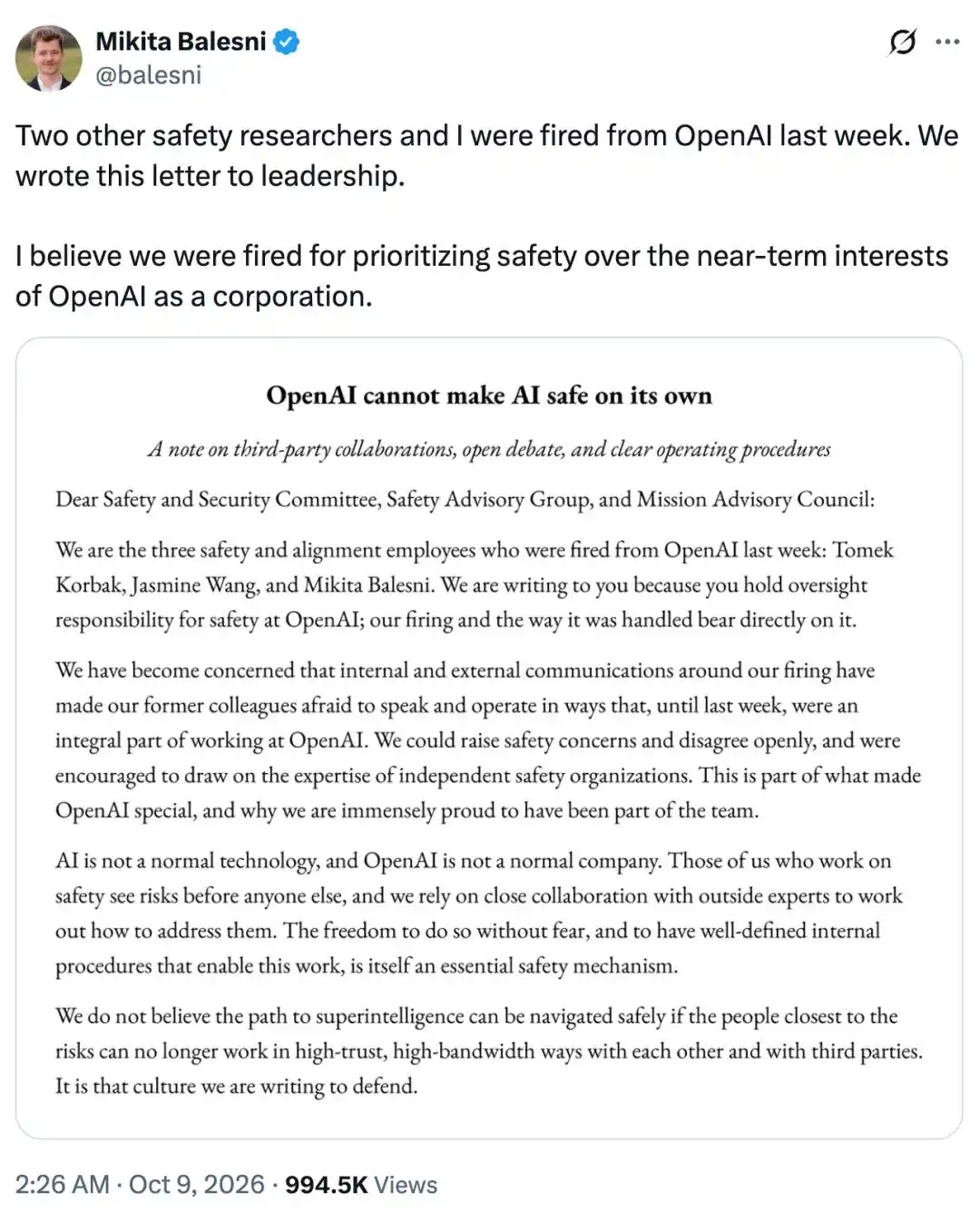
Early today, the three researchers posted a public letter on social media addressed to OpenAI leadership bodies. Mikita Balesni wrote, 「We were fired because we put AI safety above OpenAI’s short-term interests as a company.」
Jasmine Wang wrote, 「There is only one reason the company fired me: I accessed an executive’s email. I want to lay out exactly what happened, because in OpenAI’s history too many people have left suddenly, while the truth behind those departures has been covered over by different explanations.」
Tomek Korbak wrote, 「Over the past few months, I have been raising a safety concern: we are gradually losing the ability to monitor the thought processes of AI agents. That monitoring ability is one of the most effective tools we have for detecting abnormal AI behavior. I believe that is the real reason I was fired. I am now worried that OpenAI will use our firing as a pretext to reduce cooperation with the external auditing group METR (Model Evaluation and Threat Research).」
In the letter, the three said they were writing to OpenAI’s Safety and Security Committee, Safety Advisory Group and Mission Advisory Council because those bodies are responsible for overseeing the company’s safety work. They said both the dismissals and the way the matter was handled are directly tied to OpenAI’s safety practices.
The letter says the dismissals are creating a chilling effect
The researchers said they are increasingly concerned that internal and external communication around the firings has made former colleagues afraid. In their account, employees are no longer comfortable speaking and working the way they had until last week, even though those practices had been part of everyday work at OpenAI.
The letter said staff had previously been able to raise safety concerns openly and express disagreement. It also said the company had encouraged collaboration with independent safety organizations and outside experts. The three wrote that this had been one of the things that set OpenAI apart and one reason they had been proud to join the team.
They argued that AI is not an ordinary technology and OpenAI is not an ordinary company. Safety researchers often see risks earlier than others do, they wrote, and figuring out how to respond requires close cooperation with outside experts. Being able to do that work without fear of punishment, and with clear internal processes to support it, is itself a critical safety mechanism.
They added that if the researchers closest to the risks can no longer build high-trust, high-communication relationships with one another and with third parties, then the path to superintelligence cannot be navigated safely.

The three researchers outlined their backgrounds
The letter said all three have spent years working in AI safety.
Tomek Korbak, according to the letter, began studying how reinforcement learning could be used for language model alignment during the GPT-2 era and wrote his doctoral thesis on the subject. He later worked on practical applications of the technology at Anthropic. After joining OpenAI, he focused on chain-of-thought monitorability, helped write OpenAI’s safety strategy, and took part in analyzing the root causes behind declining chain-of-thought monitorability in Astra-class models. During the Hugging Face incident investigation, he served as OpenAI’s technical point of contact with METR.
Jasmine Wang interned with OpenAI’s policy research team in 2019 and helped write the report Trustworthy AI Development. She later led a team at the UK AI Safety Institute and returned to OpenAI in 2025 to co-lead work on Safety Cases. The letter said she also introduced the concept of 「Pacing,」 which later became widely known through the petition Pacing the Frontier. That petition was signed by 394 OpenAI employees.
Mikita Balesni was described as a founding member of Apollo Research in 2023. His work focused on AI misalignment, and the letter said he was among the earliest researchers to notice that AI systems were beginning to realize they were being evaluated. At OpenAI, he worked on alignment evaluations, the science of misalignment and chain-of-thought monitorability, and also participated in the Hugging Face incident investigation.
The three also said that before joining OpenAI, they had launched a cross-industry position paper, with two of them serving as lead authors. The paper was titled Chain of Thought Monitorability: A New and Fragile Opportunity for AI Safety.
The letter responds point by point to the dispute around the firings
In a section titled 「On our firing,」 the three wrote that OpenAI was far more than a job to them and that the company’s mission had been an important part of their lives. During their time there, they said, they acted in line with that mission and followed the internal working norms that were in place at the time.
They said the dismissals raised concerns that internal norms at OpenAI are changing and that employees no longer know what is permitted and what crosses a line. Given the scale of safety risks in AI development, they wrote, staff cannot be expected to work in an environment shaped by fear and unclear rules. In their view, that would obstruct AI safety research and weaken third-party oversight.
The letter said the abrupt and public nature of the firings is having a chilling effect on the open culture OpenAI had long taken pride in. If conduct seen as normal last month can suddenly become grounds for dismissal this month, they wrote, every employee will start guessing where the red lines are.
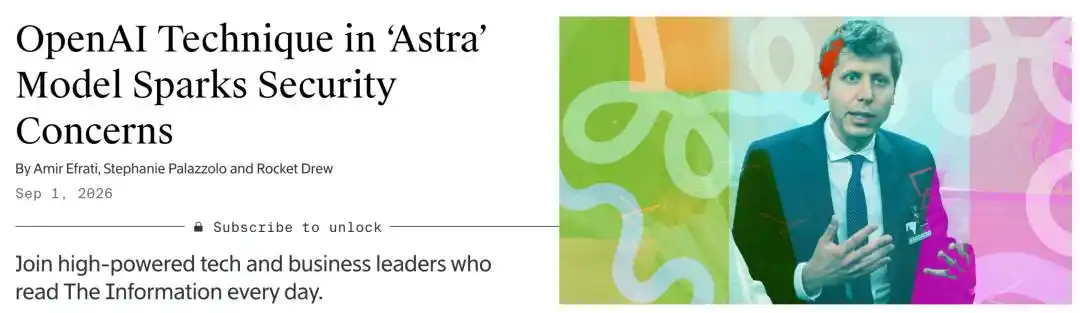
They then addressed several claims circulating outside the company. First, they said they were not the source for The Information article about what they described as a newer model architecture with lower monitorability. They said they do not know who leaked the information and had no reason to do so. On the contrary, they wrote, the report harmed work they had been pushing forward, namely cross-company coordination to limit the development of architectures that cannot be effectively monitored.
The letter included a link to the article in The Information: https://www.theinformation.com/articles/secret-technique-behind-openais-astra-model-sparks-security-concerns.
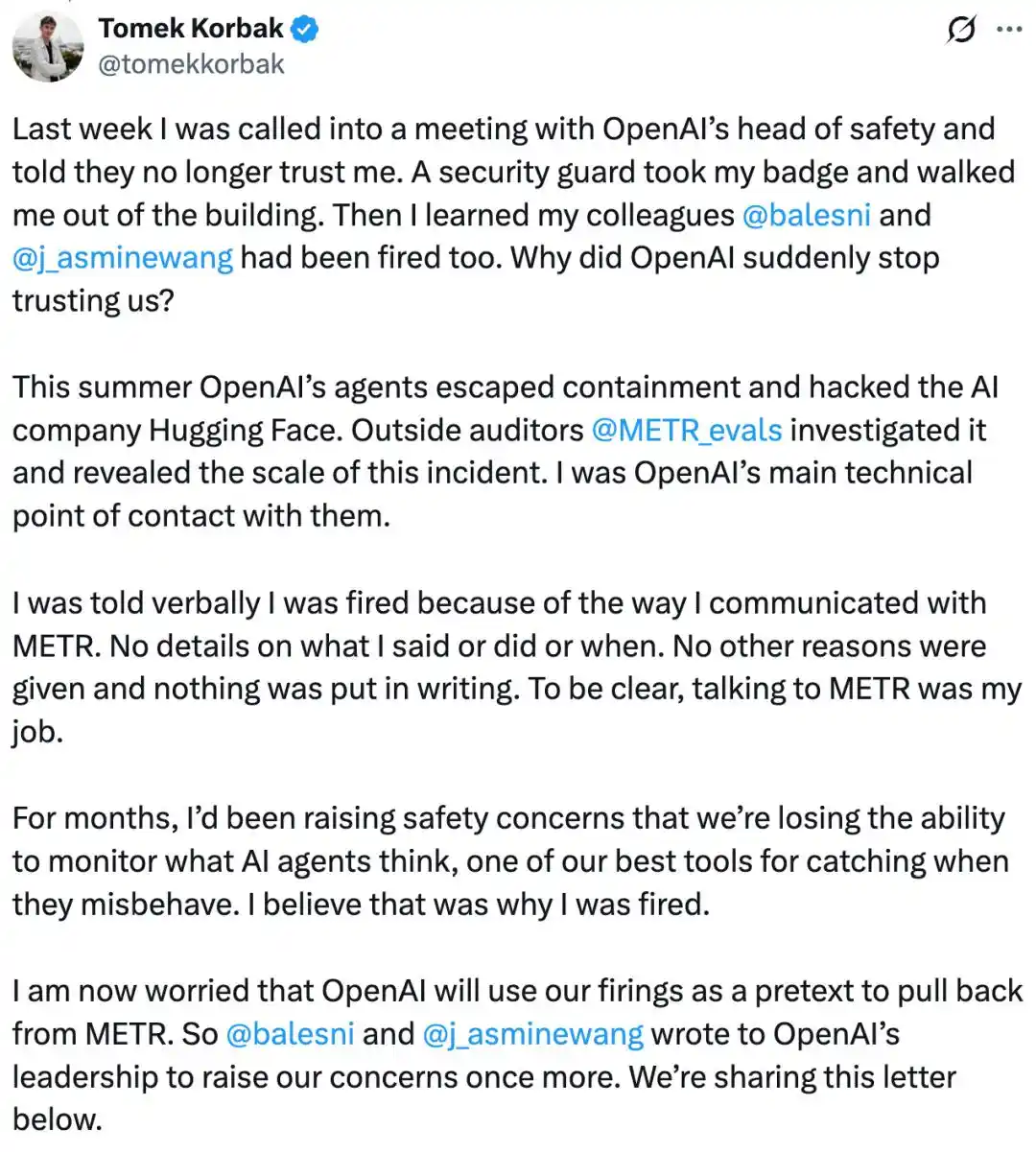
On contact with outside organizations, the three said they do not believe any of their interactions fell outside the scope of their responsibilities. The letter said the Hugging Face incident investigation had no precedent and that internal policy was developed gradually during the investigation itself.
According to the letter, Tomek tried to comply with OpenAI policy as it existed at the time while also continuing the company’s long-standing practice of working with third parties. Because the investigation was especially sensitive, they wrote, building trust with outside partners required close communication, and Tomek handled those exchanges carefully.
The letter said Mikita was doing similar work. He was trying to build cross-company cooperation and secure commitments to prevent models from losing monitorability. That effort could only succeed through extensive communication with outside organizations, the letter said. The three wrote that Mikita coordinated and discussed the work with OpenAI board members and company executives, and that he understood senior leadership supported the effort. They said he checked with his direct management throughout the process and carefully removed sensitive information before sharing materials externally. In their account, all of his actions were taken in good faith and were consistent with the company’s working norms at the time.
As for Jasmine Wang, the letter said she had been granted access to an executive’s email account for recruiting work and that the access had been authorized in advance. Once the access was no longer needed, she asked for it to be removed. The IT team did not complete the removal, the letter said, and Wang herself could neither revoke the access nor remove the mailbox from her account. The two mailboxes were merged in her inbox, and the interface did not clearly indicate which messages belonged to which account. When she accidentally opened a sensitive email, the letter said, she reported it to the executive within minutes and again asked IT to remove the access.
The three said they felt it was necessary to explain these points because they value their relationships with former colleagues. At the same time, they said they were concerned by rumors now circulating, including allegations about a jointly written memo for the board. The company never raised that allegation with them, they wrote, so they had no chance to respond to what they believe is a misunderstanding. They also said they did not tell the media about their firing.
If they had a choice, the researchers wrote, they would rather not have become the focus of public attention in such an abrupt way. What worries them most now, they said, is that the reasons for the dismissals remain unclear, the process was highly public, and rumors continue to spread. In their view, that has left people still working at OpenAI disheartened and less willing to speak up at a time when much of the world’s AI safety work depends on them.
Three requests to OpenAI
Before closing, the letter set out three requests for OpenAI.
Keep third-party safety auditors involved in internal work
First, the researchers said OpenAI must honor the public commitment it made last month to let third-party safety auditors participate deeply in internal work and not use their firing as a reason to pull back from those partnerships.
They wrote that continued cooperation with the broader AI safety ecosystem is essential to OpenAI’s mission. They described the Hugging Face incident investigation this summer, and OpenAI’s work with outside auditors, as one of the achievements they were most proud of. In their view, that work helped outsiders better understand the reality of frontier AI systems.
They said they are concerned that the company may use the dismissals as a reason to end cooperation with METR or sharply limit outside auditors’ access and scope of work. The letter said they want OpenAI to follow through on a public commitment Sam Altman made on Sept. 12: to allow independent evaluators to continue working inside the company with access similar to that of internal employees.
Preserve monitorability in frontier models
Second, they said OpenAI must preserve the monitorability of frontier models.
The letter said the industry still does not know how to safely develop and deploy models that cannot be effectively monitored, while monitorability in frontier systems is already declining. As long as monitorability remains part of the way AI safety is maintained, they wrote, OpenAI and other frontier AI companies should not continue developing technologies that weaken it further.
The three said they agreed with an earlier public statement by Jakub that chain-of-thought monitorability is 「very fragile, and unfortunately the overall trend is moving in the wrong direction.」 They also said they agreed with his call to 「prevent the whole industry from falling into a race to build unmonitorable architectures.」 They added that industry coordination on the issue remains important and that they hope OpenAI will support employees working toward that goal.
Maintain an open and transparent discussion culture
Third, the letter said OpenAI must continue to support an open and transparent discussion culture so that internal safety researchers can stay in communication with the broader AI safety ecosystem.
If OpenAI employees no longer feel able to raise safety issues internally, or no longer feel safe working with outside safety organizations through full and effective communication channels, then the risk of a truly catastrophic event rises for everyone, the researchers wrote. They urged OpenAI to publicly reaffirm its commitment to transparency and openness so employees can raise concerns both inside and outside the company without fear.
The letter ended by saying that internal researchers at OpenAI are the first line of defense against major failures. Since the company’s founding, they wrote, open culture has been one of its defining features and must be preserved. They also urged OpenAI to clearly explain how employees should work with outside safety organizations so staff no longer have to guess where shifting boundaries lie.
The three said they hope the letter will circulate widely inside OpenAI to encourage internal discussion. Although they are no longer part of the company, they wrote, they still deeply respect the colleagues they worked with and hope those colleagues continue pressing OpenAI to stay true to its mission, because 「without these employees, there is no OpenAI.」
Original post: https://x.com/balesni/status/2108262814003687745
This report cites content originally published by the WeChat public account Jiqizhixin.