

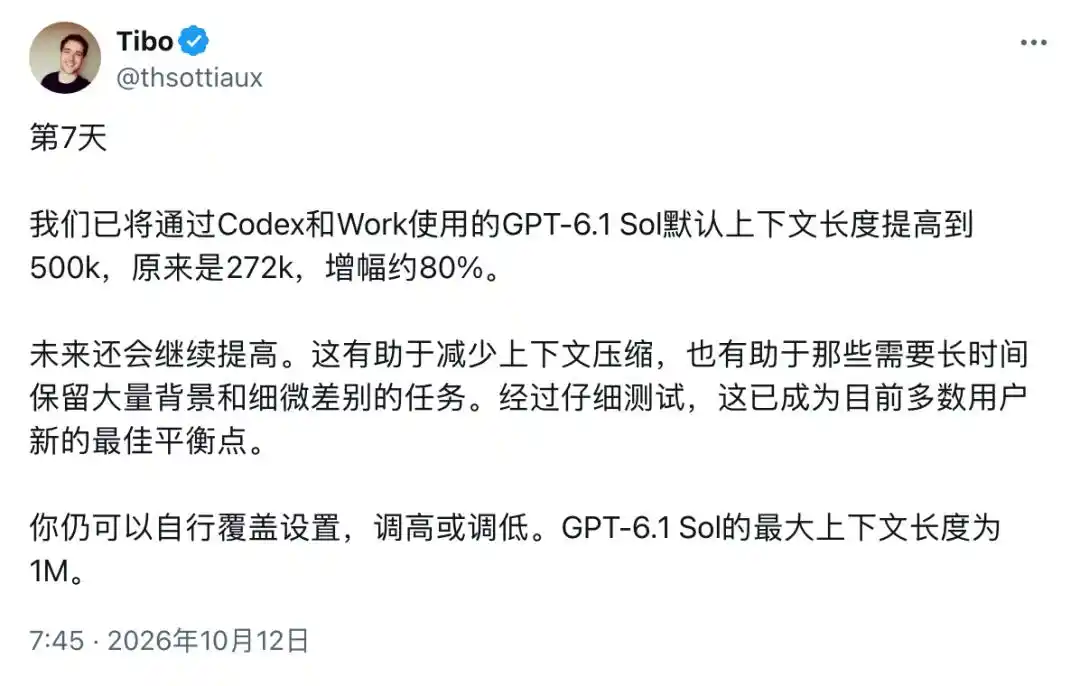
OpenAI has increased the default context window for GPT-6.1 Sol in Codex and ChatGPT Work from 272k to 500k, a jump of about 80%. Tibo also said that when users run GPT-6.1 Sol through subscription credits, there is no extra charge for long context. API calls, however, are still billed under the API pricing schedule.
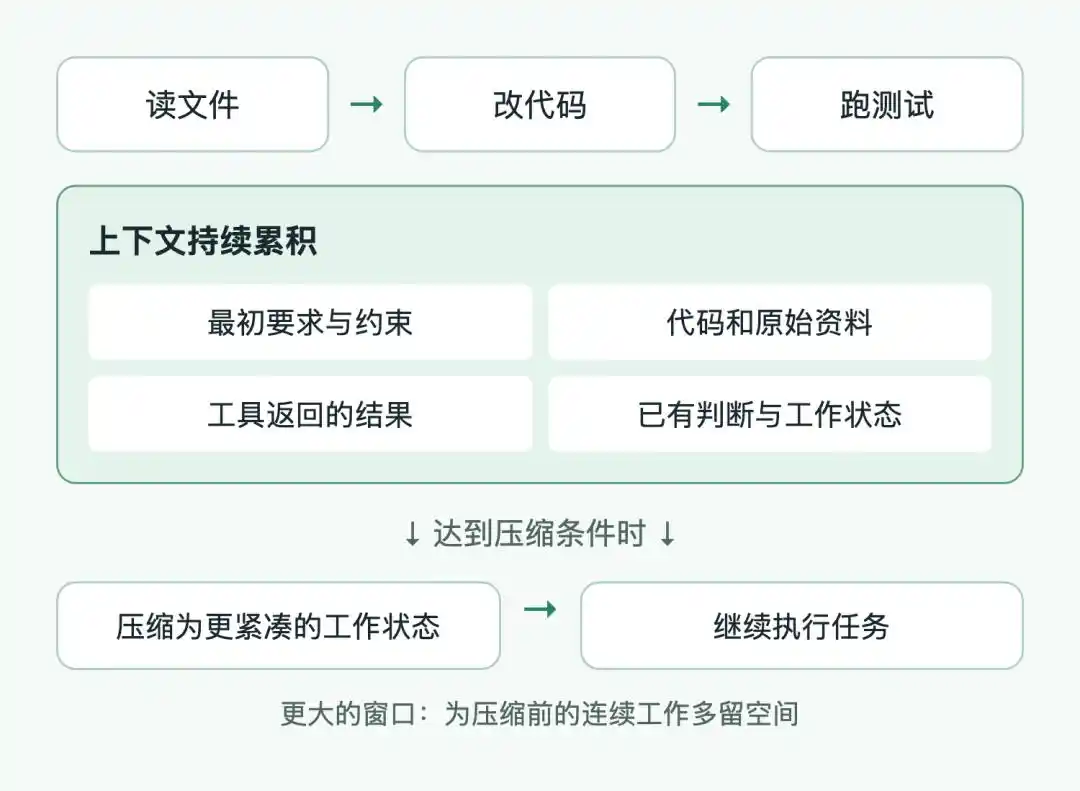
The update addresses a long-running frustration for developers working on extended coding tasks: waiting for context compression. When the model reads files, edits code, and runs tests, the code, errors, and instructions all take up space in the context window. Once the window gets close to full, the system has to compress earlier dialogue and work history before it can continue.
Developers had already been pushing for a larger default window
Before the 500k default was released, developer Lasse had already complained about slow compression in Codex. He said a single context compression could leave him waiting for as long as two minutes. Two days before the update, he manually set the window to 500k, posted a status screenshot, and called on OpenAI to fix the slow compression problem.

For developers, the issue is not just latency. After compression finishes, they still need to check whether the model dropped an earlier requirement. The article gives one example: if the original instruction said an interface had to remain backward compatible, and the model changed more than a dozen files so the new feature worked but the legacy interface broke, the developer would have to go back and fix it manually.
Tibo said the larger window should reduce compression and allow the model to retain more detail in long tasks. In practice, that means fewer interruptions and fewer times users need to repeat the same instruction.
No surcharge does not mean lower credit usage
Developers are also watching whether a larger context window will cause subscription credits to drain faster. The source says OpenAI raised product context from 272k to 372k in July for GPT-5.6 Sol, but later moved it back to 272k after subscription usage was deducted more heavily than expected.

At the time, developer Theo guessed that usage beyond 272k might have been charged at double the rate. Tibo said that was not the case, adding that subscriptions did not carry a long-context fee then either. Instead, the higher usage came from repeated reads of a larger amount of cached material.
If a user only types 「continue」, the agent still needs to bring along the files it read earlier, the test results, and the original requirements in order to keep working on the code. Those same materials may be read again during tool use and later reasoning steps. Cached content is cheaper to read because it has already been processed, but each read still counts toward usage. Once both the amount of content and the number of reads increase, the total consumption rises as well.

That means waiving the long-context surcharge does not guarantee that a given task will consume fewer subscription credits. Developers may want fewer compression pauses, but they do not want their credits to run out before the project is finished.
Some developers questioned whether this counts as a real upgrade
After the announcement, developer Mhmd Hammoud pushed back in the comments, asking: 「Now changing a config counts as a real upgrade?」 The question reflects a broader concern. If the change only raises a default setting without improving the underlying experience, some developers may not see it as a meaningful product upgrade.
Still, OpenAI is not only pointing to a theoretical maximum. GPT-6.1 Sol now has a 500k default window, and users on subscription credits no longer face an extra long-context charge. OpenAI’s framing is that longer tasks should involve less compression and preserve more detail.

Compared with Claude, the default is still lower, though GPT-6.1 Sol can also reach 1M
Whether 500k is enough also invites comparison with Claude Code. According to the article, Opus 5.5 and Sonnet 5.5 in Claude Code already have a default context window of 1M, which is twice the new default in Codex.
That said, GPT-6.1 Sol can also go up to 1M if the user raises the setting manually. OpenAI set the default at 500k because testing suggested that level suited most users better.
The article also draws a distinction on pricing. For those Claude models, API usage within 1M is billed at the standard token rate, with no higher unit price for a longer context window. What OpenAI removed this time was the long-context surcharge within subscription credits, while API pricing remains separate. The billing scope being discussed is not the same on the two sides.
Even a 1M window can still fill up
A larger window does not eliminate the limit. The article says Claude Code uses an automatic compression point of about 967k for these two models. As the limit approaches, it first removes older tool outputs from the context, such as records left by reading files or running commands. If that still does not free enough space, it summarizes the conversation while keeping the current requirement and the key code so the task can continue.
Subtasks such as file lookup can also be handed off to a sub-agent with its own context. Once the lookup is done, the sub-agent returns a summary. That lets the main agent continue with the result instead of carrying the full search process inside the main conversation.

OpenAI also said the default window will continue to increase over time. For developers, though, the core issue is not the headline number by itself. It is whether coding with AI means fewer waits for compression and fewer times they have to say, again, that a requirement was already stated earlier.
The source material cited a post from Tibo on X at https://x.com/thsottiaux/status/2109430343346581527?s=20. The original article also said the piece came from the WeChat public account Xinzhiyuan, written by Moses and Taozi.



