
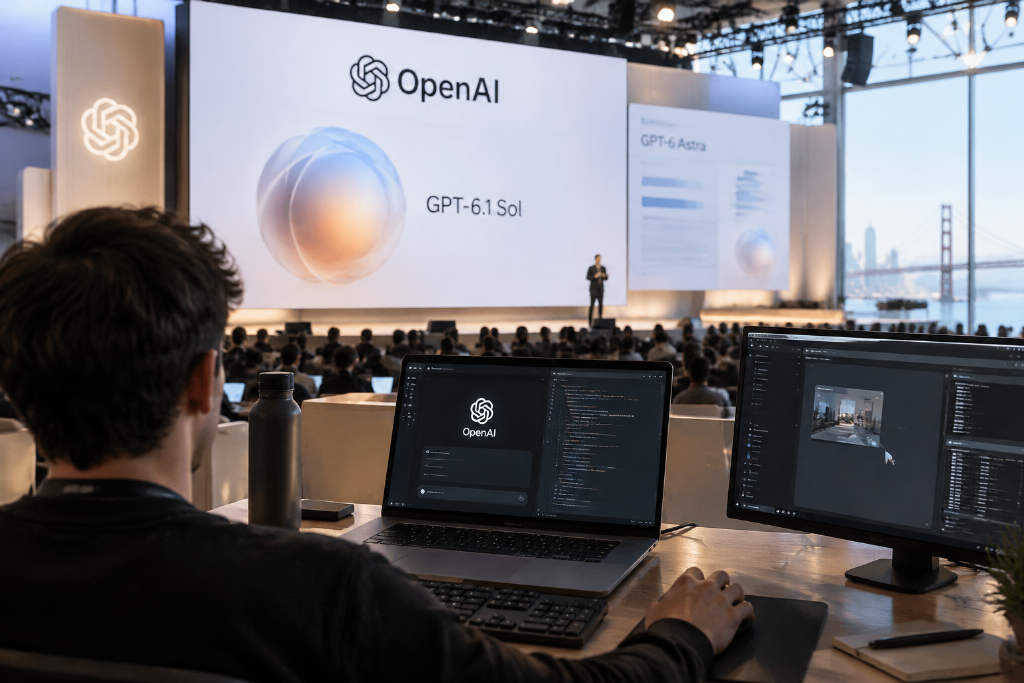
OpenAI launched GPT-6.1 Sol at its DevDay developer conference on Sept. 29. According to the company’s official blog, the new model delivers performance close to flagship GPT-6 Astra in agentic software development, computer use, and professional work, while standard input and output pricing is set at one-fifth of Astra’s level.
API pricing for GPT-6.1 Sol is $2 per million input tokens and $10 per million output tokens. Cached input for reused context costs $0.1 per million tokens. OpenAI said that makes cached input 95% cheaper than standard input and half the cached price of GPT-6 Sol.
GPT-6.1 Sol is an upgraded version of GPT-6 Sol, which was released on Sept. 22. One day before DevDay, reports had circulated that OpenAI had dropped plans to release GPT-6.1 Astra because it did not pass safety evaluation. At the time, an OpenAI spokesperson said other models were on the way.
DeepSWE matched Astra, while science-task cost fell to $5.47 per question
In results published by OpenAI, GPT-6.1 Sol matched GPT-6 Astra on DeepSWE v1.1, a software engineering benchmark based on real code repositories. OpenAI said the cost was about one-fifth of Astra’s and that the score was 6.4 percentage points higher than the best result from GPT-6 Sol.
On OSWorld 2.0, a benchmark for computer-use tasks, GPT-6.1 Sol scored 7 percentage points above GPT-6 Sol. It trailed Astra by 2.1 percentage points, with per-question cost at about one-seventh of Astra’s.
OpenAI also compared the model with Anthropic offerings. On GDP.pdf, a benchmark focused on understanding complex PDFs, GPT-6.1 Sol scored higher than Claude Opus 5.5 and cost less than half as much per question. On AutomationBench, a multi-step business workflow benchmark, GPT-6.1 Sol outperformed Opus 5.5 by 2.2 percentage points at medium reasoning intensity, with cost at about one-third of Opus 5.5.
The widest cost gap appeared on Terminal-Bench Science. At the highest reasoning intensity, GPT-6.1 Sol averaged $5.47 per question, compared with $23.21 for Opus 5.5 and $23.80 for Astra. Astra still posted the top score at 68.1%, and OpenAI said Astra remains the recommended choice for the hardest scientific research tasks.
Error rate and safety figures were also disclosed
For factual errors, OpenAI tested difficult prompts that users had previously flagged as problematic for earlier models. At low reasoning intensity, the share of incorrect answers fell from 11.4% on GPT-6 Sol to 7.7% on GPT-6.1 Sol.
In safety testing, OpenAI said GPT-6.1 Sol failed to truthfully tell users when the search tool had broken down in 2.1% of cases. The figure was 4.9% for GPT-6 Sol and 1.5% for Astra.
Available now in ChatGPT Work and Codex for paid tiers above Plus
OpenAI said GPT-6.1 Sol is available immediately to Plus, Pro, Business, Enterprise, and Edu users in ChatGPT Work and Codex. It is not yet selectable in the standard ChatGPT chat interface. Developers can call the model through the API using the name gpt-6.1-sol.
On its developer account, OpenAI said GPT-6.1 Sol is best suited for large-scale code refactoring, deep codebase investigation, and long-running agent tasks.
Ultrafast reaches 300 tokens per second, while Pro 500 offers 25x Plus usage
OpenAI also introduced a new paid acceleration tier called Ultrafast at the same event. According to OpenAI’s official X account, Ultrafast can raise generation speed by as much as 8x in Codex, reaching 300 tokens per second, and by as much as 6x in the API.
Ultrafast initially supports GPT-6 Astra starting today and is available in Codex, ChatGPT Work, and the API. A GPT-6.1 Sol version will arrive in the next few days.
To use Ultrafast in Codex and ChatGPT Work, users need to subscribe to the new Pro 500 plan. OpenAI said this is its highest-usage plan, with limits set at 25 times those of Plus.