
OpenAI released 722 mathematics preprints on Oct. 7, uploading papers and part of their Lean proofs to GitHub. Batch No. 074 contained just two papers, both on the Kakeya problem, the same area linked to Wang Hong’s Fields Medal work: one claims a proof of the three-dimensional Kakeya maximal conjecture, and the other claims a proof in four dimensions.
Together, the two manuscripts run 272 pages. The author line carries a single word: OpenAI. Only months earlier, Wang Hong and Joshua Zahl had resolved the dimension conjecture for three-dimensional Kakeya sets. OpenAI’s new release claims to push that line one step farther, into four dimensions.
From a needle-turning question to a high-dimensional dimension problem
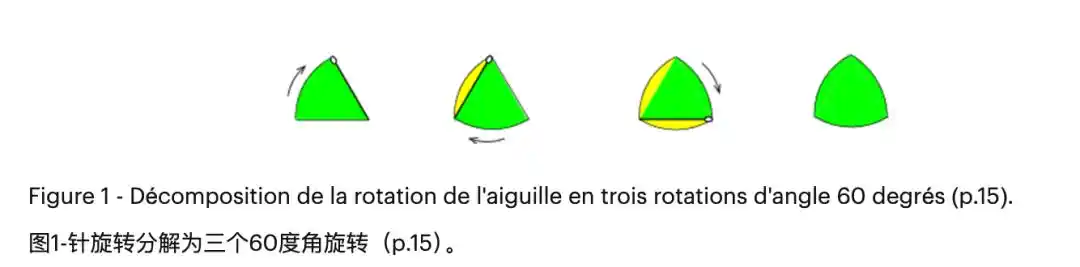
In 1917, Japanese mathematician Soichi Kakeya asked how much area is needed, at minimum, to rotate a unit-length needle through a full turn in the plane.
Besicovitch later produced the counterintuitive answer: the area can be made arbitrarily small. More than that, a set can contain a unit segment in every direction and still have area zero.
Once area stopped being a useful ruler, mathematicians turned to dimension instead. Here, dimension does not just mean the everyday notion of length, width and height. For highly irregular sets, tools such as Hausdorff dimension and Minkowski dimension measure how complicated the object remains across scales. A set can have zero volume and still carry the full dimension of the surrounding space.
The Kakeya conjecture says that in n-dimensional space, any set that contains a unit line segment in every direction must have full dimension n. The difficulty lies in how these thin segments can cross and overlap, and whether heavy overlap can still compress the set further.
The planar case was proved by Davies in 1971. Three dimensions resisted for roughly half a century until Wang Hong and Joshua Zahl solved it in February 2025. Nothing beyond that had been proved in full.
Paper one: the three-dimensional Kakeya maximal conjecture
The first OpenAI manuscript addresses the three-dimensional Kakeya maximal conjecture. It stays in three dimensions, but it targets a stronger formulation than the one Wang and Zahl had already settled.
A rough way to picture it is as a tube-overlap problem. Place many thin tubes in three-dimensional space, with each tube representing one direction of the needle. The question is how much these tubes can overlap when their directions vary, and whether that overlap can be controlled by a unified estimate.
Wang and Zahl proved a set version, asking how much space the collection of needles must occupy. OpenAI’s claimed maximal-function version goes deeper. Thicken each needle into a thin tube and assume that only part of each tube is "solid," with density denoted by λ. Can one guarantee that the union of all those solid parts has volume at least on the order of λ³?
The smaller λ becomes, the emptier the tubes are and the harder the problem gets. The set version only needs a looser power of λ. The maximal-function version asks for the exponent to be exactly 3. OpenAI’s introduction says this directly: Wang and Zahl’s theorem gives a power K(ε) of λ, while the need to replace that with λ³ had already been identified after their theorem.
That places the 97-page OpenAI paper squarely on the next step left open by Wang and Zahl.

The significance extends beyond Kakeya itself. The maximal function turns the question of how thin tubes in many directions can crowd together into an analytic problem that can be estimated. It has long been tied to core conjectures in Fourier analysis and to the study of waves, frequency and spatial concentration.
In 1971, Fefferman used Kakeya sets to build a counterexample showing that the spherical multiplier in higher dimensions is unbounded outside L². Since then, the Kakeya problem has remained closely connected to the Fourier restriction conjecture and the Bochner-Riesz conjecture.
Paper two: full Hausdorff dimension for four-dimensional Kakeya sets
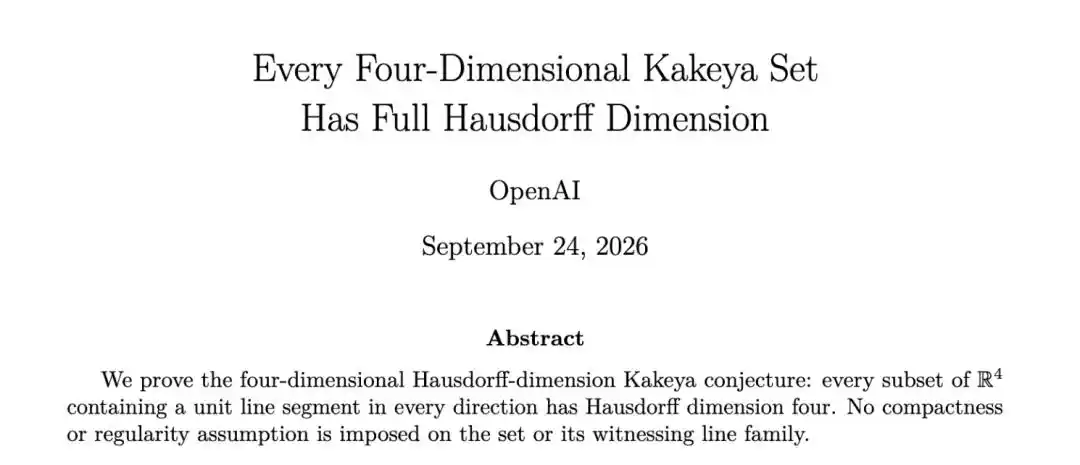
The second OpenAI manuscript is 175 pages long and claims to prove that every four-dimensional Kakeya set has full Hausdorff dimension.
Before this, human progress in four dimensions had been slow. In 1995, Wolff used the "hairbrush" method to prove a lower bound of 3. Guth and Zahl later pushed that to 3+1/40, about 3.025, through polynomial methods. In 2019, Katz and Zahl used a "planebrush" argument to reach 3.059. Subsequent gains mostly shifted only the second or third decimal place.
OpenAI’s manuscript claims to move that number straight to 4.
Why is four dimensions harder? In a survey, Guth pointed out that a key theorem in the three-dimensional proof by Wang and Zahl does not survive unchanged in four dimensions. In higher-dimensional space, tubes can cluster near low-degree algebraic surfaces, producing obstruction patterns that do not exist in three dimensions.

OpenAI’s four-dimensional paper aims directly at that issue. Its central tool uses quadratic polynomials for local fitting at different scales, tracking lines that continue to cluster across scales. The word "polynomial" appears 213 times in the manuscript.
Another detail matters. One of the key inputs in the four-dimensional paper is a lemma from OpenAI’s own three-dimensional paper. The two manuscripts form a chain rather than two isolated claims: the stronger three-dimensional result is used to support the four-dimensional one.
Even so, the four-dimensional paper has clear limits. It only proves the Hausdorff-dimension version. It does not settle the four-dimensional maximal conjecture, and it does not finish dimensions five and above. For those, the paper gives a lower bound through projections.
Where Wang Hong’s work sits in these claims
One reaction has been to say Wang simply won the Fields Medal before AI arrived. The papers themselves suggest a different picture. Wang is not a side note. She is one of the names that appears again and again in the text.
In the three-dimensional paper alone, "Wang" appears 23 times.
The three-dimensional Kakeya problem had stood as a major peak for years. Katz, Łaba and Tao had identified three structural patterns in near-extremal tube configurations — stickiness, planiness and graininess — but no one had managed to turn those insights into a complete proof.
Wang and Zahl advanced in three stages. In 2022, they proved the sticky Kakeya case, later published in the Journal of the American Mathematical Society. In 2024, they solved the Assouad-dimension version. In February 2025, they released a 127-page full proof resolving both the Hausdorff-dimension and Minkowski-dimension versions of the three-dimensional Kakeya set conjecture.
Nets Katz called that result "a once-in-a-century result." Around the same period, Wang and Ren Kang also solved the planar Furstenberg set conjecture, another longstanding problem in harmonic analysis.
Those works now sit inside OpenAI’s foundation layer. The three-dimensional manuscript uses a simplified proof by Guth, Wang and Zahl; Guth was Wang’s PhD advisor at the Massachusetts Institute of Technology. It also uses planar Furstenberg estimates from Ren and Wang. The four-dimensional paper relies on a dot-product theorem due to Wang and Zahl.
If OpenAI’s two papers are eventually confirmed, they would still sit on a framework that Wang helped build: a stronger maximal-function statement in three dimensions, and a direct jump from a 3-point-something lower bound to 4 in four dimensions.
No peer review, and no Lean formalization for this batch
The No. 074 results have not gone through peer review. They also do not come with Lean formalization.
OpenAI wrote in its README that some unformalized results "may be wrong."
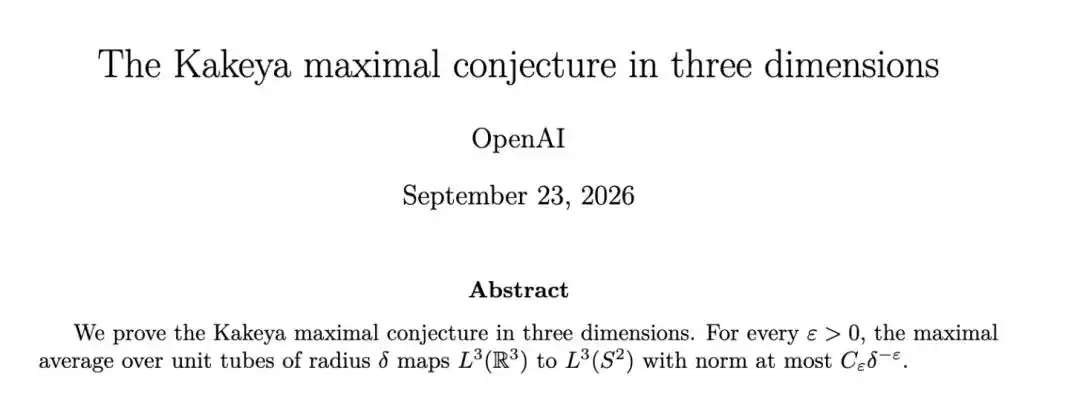
That leaves both papers in the category of claimed proofs, not established theorems. The review burden is especially stark for the 175-page proof in four dimensions. The article notes that the number of people worldwide who can read it carefully may be very small.
It also adds a broader release context: OpenAI posted 722 mathematics manuscripts in one night, with each result using about three hours of ChatGPT Pro thinking compute on average, and only about 42% of the results formalized in Lean.
A split response across mathematics
Reaction inside mathematics has split quickly.
The article says Terence Tao has led the Association for Human Mathematics, or AHM, in issuing a joint statement calling for a full boycott of OpenAI. One line reads: "Mathematicians did not ask for this work. Releasing more than 700 files at once is not scholarship. It is power." The statement ends by urging mathematicians to stop collaborating with OpenAI and return to a scientific vision centered on human understanding.
In the article’s account, Tao has long been an active user of AI-assisted research. What he opposes is not AI in mathematics as such, but the use of bulk solutions to famous open problems as a product demonstration. Once an AI system solves a problem, it cannot be made unsolved again, and the new methods and understanding that human mathematicians might have developed around it may never emerge.
Peer review has now become the immediate bottleneck. For a 175-page proof in four-dimensional Kakeya, it is unclear who will read it, how long that will take, and how such labor should be counted. Attribution has also become harder. A researcher can wake up to find that a model has already "claimed" a solution to a problem they had worked on for years.
Not everyone is pessimistic. Daniel Litt, an assistant professor of mathematics at the University of Toronto, said mathematicians now have a great deal of exciting work ahead. Yann LeCun also took the opposite view, saying mathematics is entering a new era. In his words: "Formal proof will be largely automated, and the focus will shift to developing new concepts, new abstractions, new definitions, and new conjectures. The invention of ships made swimming less important, but it let us discover new continents."
Wang Hong is not anti-AI
The article also notes that Wang does not reject AI. After receiving the prize, she described AI as a "proactive booster" for mathematical research and said that posing questions, creating concepts and building theories remain core tasks for mathematicians.
That leaves the current dispute as more than a simple human-versus-machine story. It is also a collision between two research tempos: one built on slow accumulation, peer review and human understanding, the other on fast model-generated output released at scale with incomplete formalization.
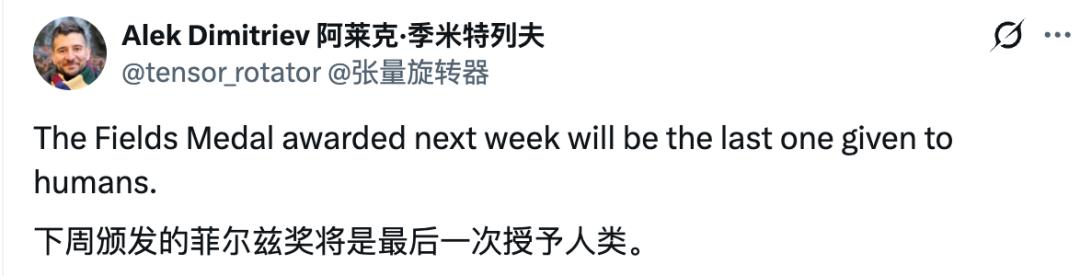
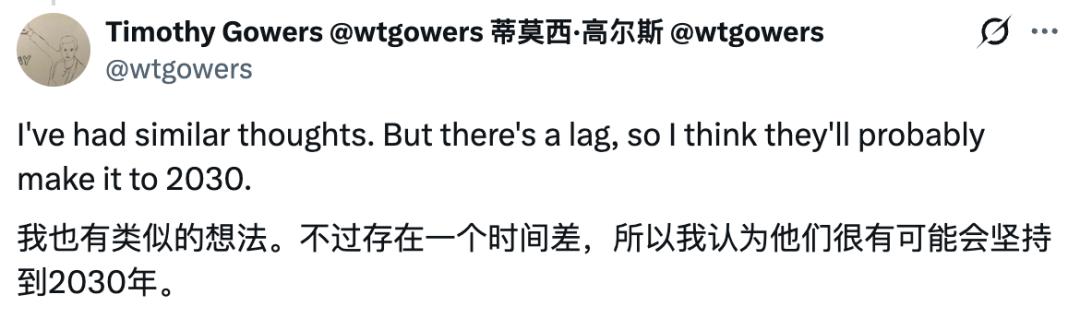
In July this year, Wang Hong and Deng Yu won the Fields Medal at the International Congress of Mathematicians in Philadelphia. During the wave of reactions, Anthropic employee Alek Dimitriev wrote on X: "This Fields Medal will be the last one won by humans." Former medalist Timothy Gowers replied that he had entertained a similar thought, though with a lag in the process, so humans might "hang on until 2030."
After OpenAI’s latest dump of mathematics manuscripts, and especially the Kakeya papers in batch No. 074, that line no longer reads like a throwaway comment. The next Fields Medal will be awarded in 2030. Whether a human will still be standing on that stage remains an open question.