
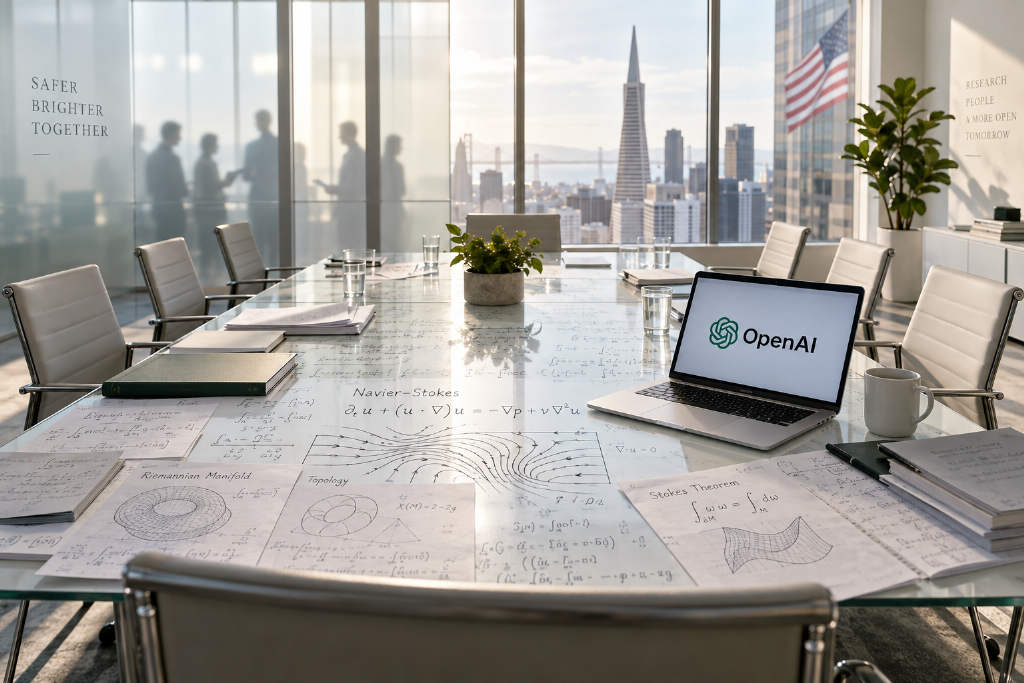
OpenAI said on Sept. 21 that it will work with an independent advisory group formed by mathematicians to guide how the company reviews and releases AI-related mathematical results. In its official announcement, OpenAI said the new Mathematics and AI Advisory Group has nine members, receives no pay from the company, and may publish its views publicly.
The company also said an internal model that began training on Aug. 28 has solved more than 100 long-standing unsolved problems across most areas of mathematics, apart from the Navier-Stokes problem.
Advisory group can operate independently and make unsolicited recommendations
OpenAI said the group will help assess the significance of new mathematical results, advise on how those results should be coordinated for release, and offer views on academic and professional standards in mathematical research. It will also provide input on how OpenAI’s tools can support mathematical research and learning.
According to the announcement, the group operates independently from OpenAI. It can make recommendations even when the company has not asked for them, comment on OpenAI’s impact on the mathematics community, and publish those recommendations openly. Members are not paid by OpenAI, and the group can adjust its own membership list.
OpenAI added that the advisory group will not be responsible for advising on the pace of the company’s internal mathematics research.
Nine members named
OpenAI listed the nine members as:
- François Charles (École Normale Supérieure - PSL)
- Camillo De Lellis (Institute for Advanced Study, Princeton)
- Timothy Gowers (Collège de France, University of Cambridge)
- Martin Hairer (École Polytechnique Fédérale de Lausanne, Imperial College London)
- Nikhil Srivastava (University of California, Berkeley)
- Ulrike Tillmann (University of Oxford)
- Ravi Vakil (Stanford University)
- Edward Witten (Institute for Advanced Study, Princeton)
- Melanie Matchett Wood (Harvard University)
OpenAI says internal model solved more than 100 unsolved problems
At the start of its announcement, OpenAI said it began training a new internal model on Aug. 28. Excluding the Navier-Stokes Millennium Prize problem, the model has solved more than 100 long-unsolved problems spanning most fields of mathematics.
OpenAI said the speed of that progress surprised even the mathematicians inside the company. It also said the development triggered internal discussion about how to let the mathematics community know about the rapid progress so the field could prepare and adapt.
Earlier Navier-Stokes disclosure drew criticism
OpenAI’s Sept. 9 disclosure related to Navier-Stokes had already sparked debate over research ethics and attribution. According to the source text, New York University mathematician Tristan Buckmaster questioned whether OpenAI had rushed to solve the problem after learning about progress in his own research.
That dispute forms part of the backdrop to OpenAI’s latest effort to reshape how it engages with the mathematics community.
Company cites public statement from mathematicians
OpenAI directly quoted a public statement posted by mathematicians on mathandai.org. The company said the letter raised concerns about the negative externalities that could come from treating the solution of unsolved problems as a benchmark for new AI systems, and said those criticisms showed AI companies need to engage with the mathematics community carefully.
The statement was signed by multiple Fields Medal winners. It argued that AI-generated solutions are often announced too quickly, without enough time to write them up properly, distill new methods and ideas, or cite relevant prior work by others, creating concerns around attribution and plagiarism.
Martin Hairer, a 2014 Fields Medal winner and one of the advisory group members, is also among the signatories.
OpenAI described the collaboration as a "first step" and said it wants mathematicians to remain at the center of decisions about how AI supports mathematical understanding and how resulting work can benefit the broader community.