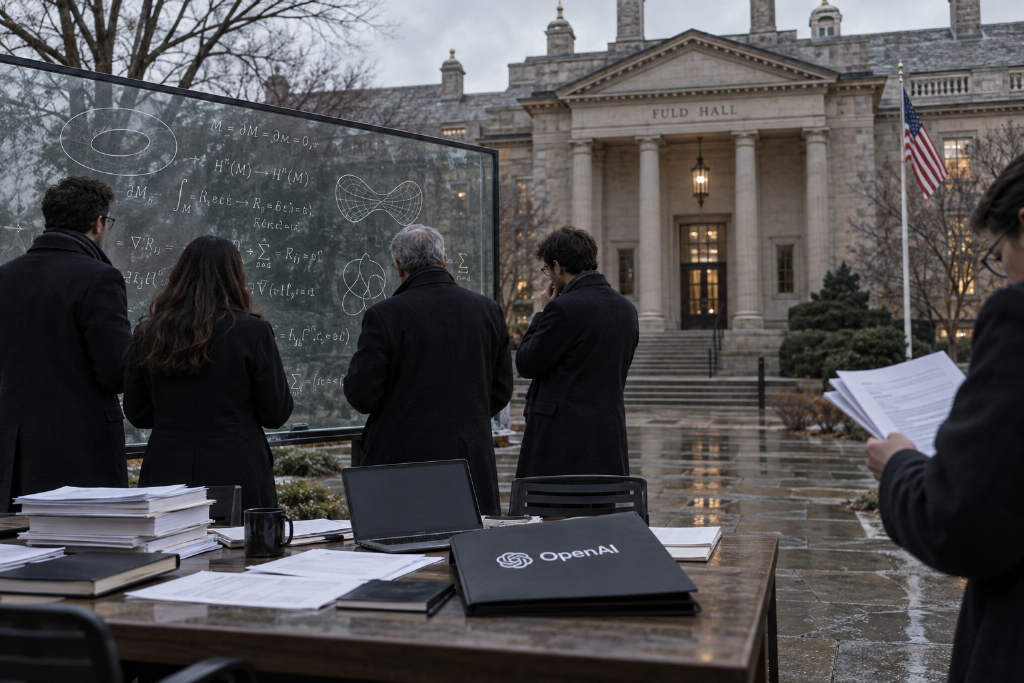
OpenAI has set up a Mathematics and AI Advisory Group, hosted by the Institute for Advanced Study in Princeton, as it says one of its internal research models has already solved more than 100 long-standing open problems across multiple areas of mathematics. The company said its previously disclosed work on the Navier-Stokes Millennium Prize problem also came from the same model, though most of the results have not been published.
The first cohort has nine members, including Fields Medal winners Timothy Gowers, Martin Hairer, and Edward Witten. OpenAI said the group will review the significance of the findings, how they should be released, and the academic norms surrounding publication. Members will not be paid by OpenAI, may criticize the company publicly, and can publish independent recommendations.
At the same time, OpenAI said the panel will have no decision-making authority and will not weigh in on the pace of the company’s internal mathematics research. The move comes as a direct response to criticism from mathematicians, after 25 Fields Medalists including Terence Tao, Ken Ono and Peter Scholze signed a statement arguing that AI companies are turning major mathematical problems into benchmarks in ways that are already harming mathematical research.
OpenAI has created a Mathematics and AI Advisory Group hosted by the Institute for Advanced Study in Princeton. The company said a model still under internal research has solved more than 100 long-standing open problems spanning several areas of mathematics.
OpenAI also said its previously disclosed research on the Navier-Stokes Millennium Prize problem came from the same model. Most of those results have not yet been published. The new advisory group will assess the importance of the findings, how they should be released, and the academic norms tied to publication.
First group includes three Fields Medal winners
The initial group has nine members, including Fields Medal winners Timothy Gowers, Martin Hairer, and Edward Witten.
According to OpenAI, members of the panel will not be paid by the company. They may criticize OpenAI publicly and can issue recommendations independently. The group does not have decision-making power, however, and it will not take part in setting the pace of OpenAI’s internal mathematics research.
Move answers criticism from mathematicians
OpenAI framed the step as a direct response to recent dissatisfaction in the mathematics community. Earlier, 25 Fields Medal winners including Terence Tao, Ken Ono and Peter Scholze signed a joint statement saying AI companies are treating the solution of major mathematical problems as a benchmark, a trend they said has already begun to harm mathematical research.
That statement also acknowledged that large models have advanced quickly in recent months and can now solve important unsolved problems across several fields. But, it said, mathematics places greater value on the new concepts, methods, and understanding that emerge from such work.
This article was originally published by Bit.Fan. For more cryptocurrency news and market insights, visit www.bit.fan. Disclaimer:
The market information, project data, and third-party content displayed on this platform are for industry information sharing only and do not constitute any form of investment advice or return commitment.
Cryptocurrency trading carries high risks. Users should fully assess their risk tolerance and make independent decisions. All profits, losses, and legal responsibilities are borne by the users themselves.