

“They completely destroyed my field of research.”
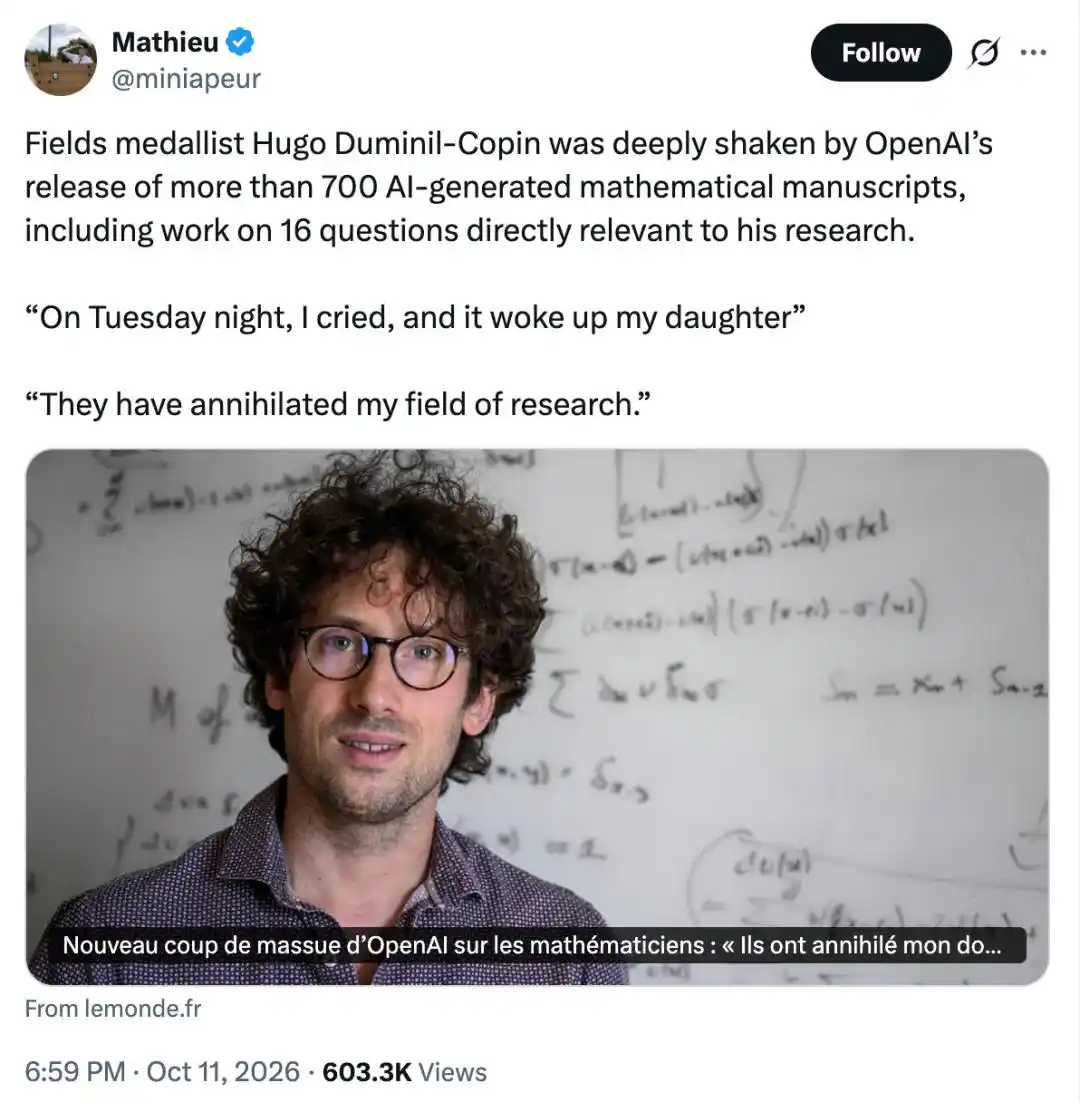
That was how 2022 Fields Medal winner and French mathematician Hugo Duminil-Copin reacted after OpenAI released a large batch of AI-generated mathematical work. In another remark, he said, “On Tuesday night, I cried, and I woke up my daughter.”
The trigger was OpenAI’s recent publication of more than 700 mathematics manuscripts generated by artificial intelligence. Among them were 16 problems tied to directions Duminil-Copin has worked on for years.
722 manuscripts published on Oct. 6
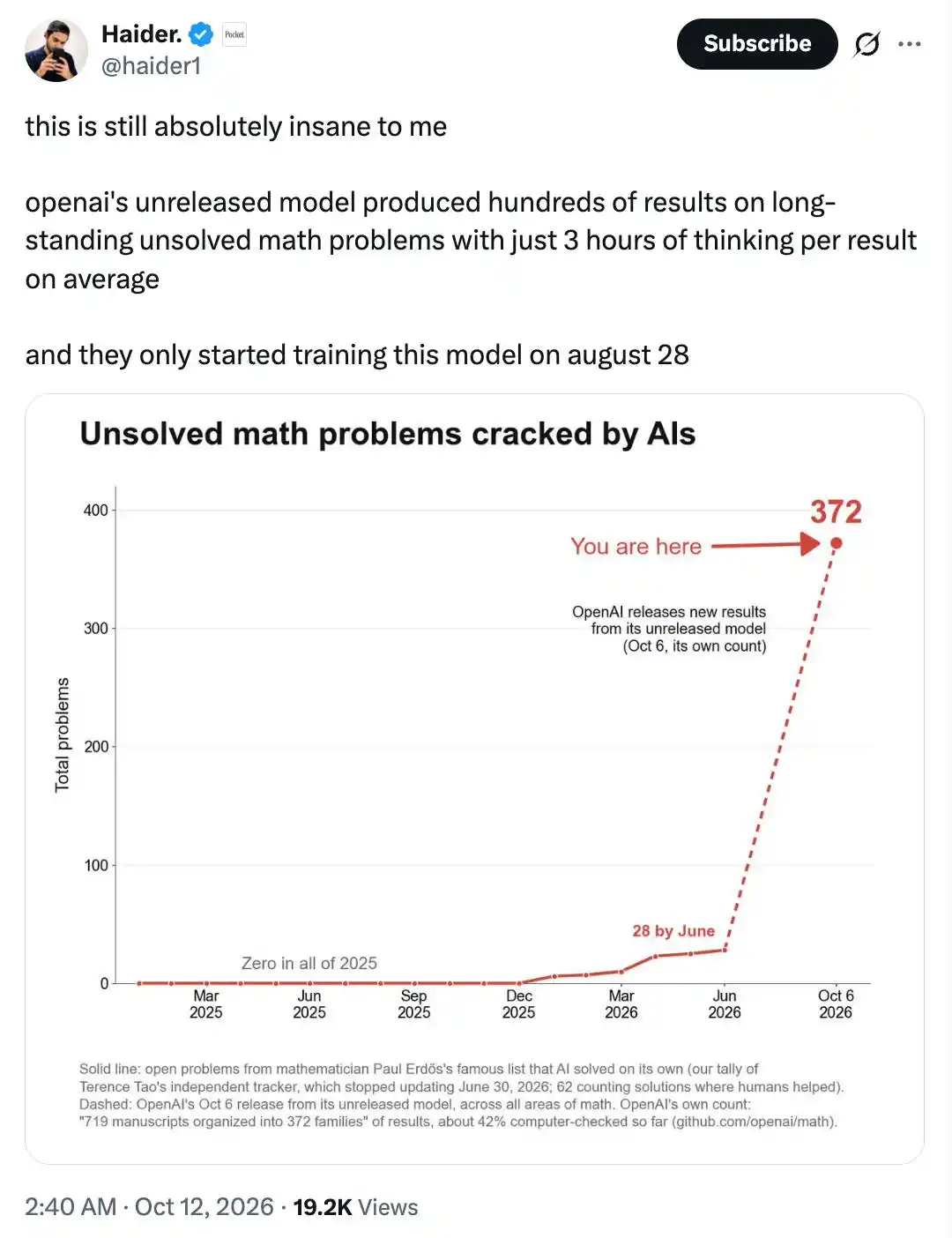
On Oct. 6, OpenAI published 722 mathematics manuscripts on GitHub. They were grouped into 372 result families, with each family potentially including a core proof, supporting arguments, corollaries, and alternative proofs.
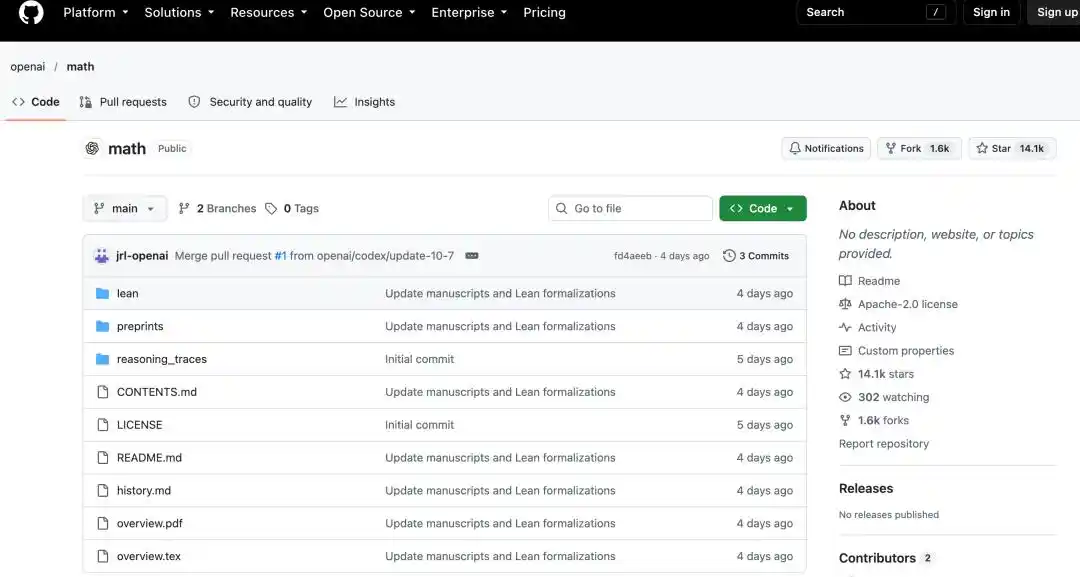
According to the disclosed details, the batch included 377 new proofs. About one-third involved major conjectures that attract broad attention in mathematics. Another third carried significant value inside their own subfields. The rest were smaller results or variants of existing proofs.
OpenAI said the vast majority of the manuscripts were generated by the same unreleased internal model. Training for that model began on Aug. 28. The average compute used per result was described as roughly equivalent to about three hours of ChatGPT Pro reasoning.
Some mathematicians called it “carpet bombing”
Before this release, Duminil-Copin had compared the impact of AI-generated proofs to a “nuclear explosion.” In his framing, each time AI solves a major hard problem, the map of mathematics takes a hit and the space left for human exploration shrinks.
After OpenAI released hundreds of results at once, some mathematicians described the move as “carpet bombing.” For researchers who have spent years in a narrow area, the shock is not limited to one theorem being solved first. It is the possibility that a whole stretch of research territory can be covered in a very short period.
Passing Lean checks does not settle every question
After the manuscripts went public, several mathematicians said some of them may not actually establish the conclusions they claim.
One point of dispute is the role of Lean-based formal verification. Even if a proof passes Lean’s formal checks, that only shows the internal logic of the formalized statement holds together. It does not automatically guarantee that the formal statement matches the original argument described in the natural-language manuscript.
Two days after publication, OpenAI withdrew three papers that contained errors. That left 719 manuscripts in the repository.
The debate goes beyond final proofs
The episode has reopened a broader question: how should the value of mathematical research be measured?

The report argues that the value of mathematics has never been limited to the final proof. In the process of searching for one, researchers introduce new concepts, build new tools, and uncover links between different areas. Even failed attempts can open a path into another problem.
Duminil-Copin has said that while working on a conjecture in probability theory, he went through many failed attempts. Those failures produced a large number of new ideas, which later fed into other research and led to discoveries he had not anticipated at the outset. If AI delivers the proof directly, that exploratory stretch may be skipped.
Twentieth-century mathematician William Thurston had reflected on something similar. After he proved a set of theorems quickly, the surrounding line of research gradually lost attention. As researchers moved away, the intuition, experience, and communication networks built inside that field also began to fade. In his view, mathematical knowledge lives not only in papers, but also in the minds of researchers and within the academic community itself.
Graduate students and postdocs may face the sharpest pressure
The report says younger mathematicians are likely to feel the impact first.
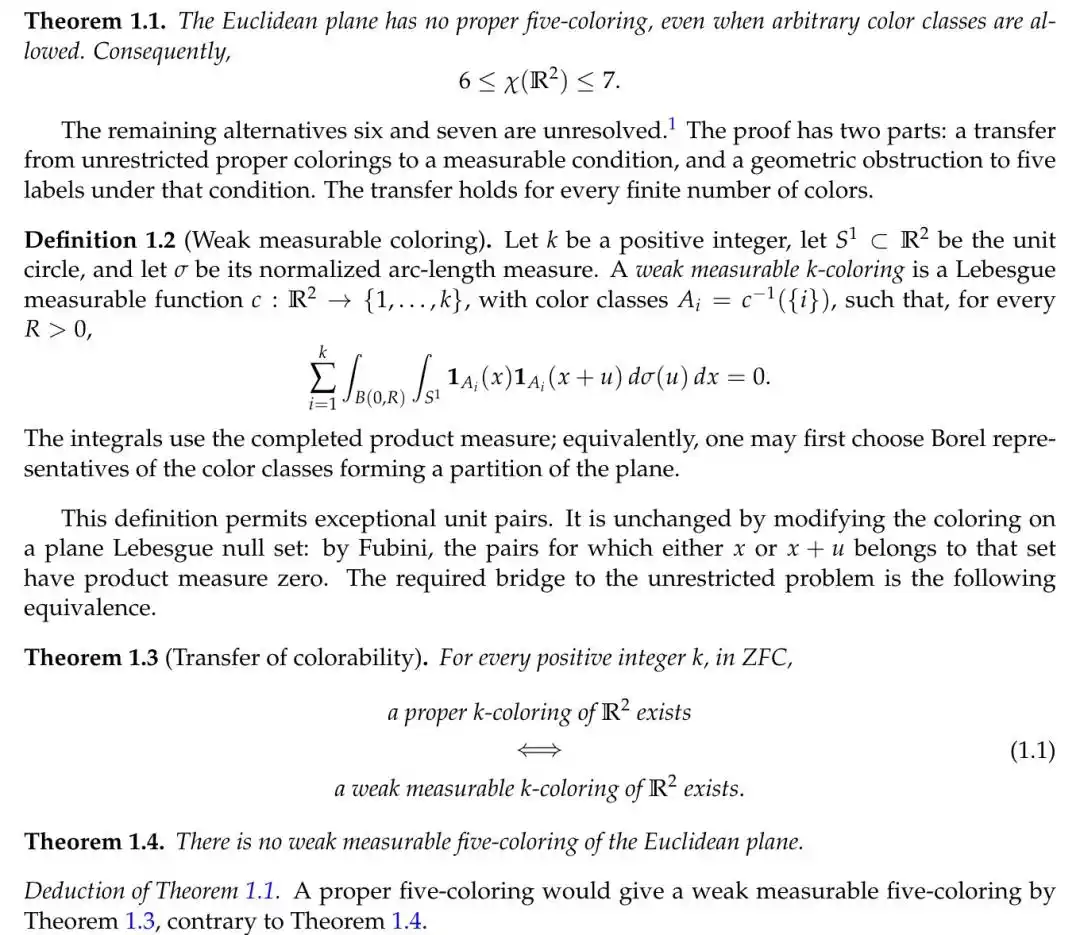
In the past, advisors would often choose a problem for a graduate student that could likely be solved in a few months. Through repeated attempts, students trained their intuition and gradually learned how to handle more abstract and more difficult work. Problems that once served that training function may now be completed quickly by models.
Mathematicians with stable positions may be able to switch directions. PhD students and postdocs do not have the same amount of time. Their dissertations, jobs, and career prospects often depend on a small number of research problems. If AI gets there first, years of accumulated work may lose much of its value.
Open exchange may also come under pressure. Mathematicians are used to sharing unfinished ideas in conferences, emails, and discussions. If AI companies can gather those clues and then direct models to attack them at scale, researchers may become less willing to discuss ideas in public. Duminil-Copin said he worries that the culture of free exchange on which mathematics depends is starting to fracture.
“Alien mathematics”
Another shift appeared in reviews of one AI-generated proof. A user said the model combined two ideas that had rarely been linked before. The proof was fully correct and stood up to scrutiny, but the line of thought felt unfamiliar. Some people called this kind of result “alien mathematics.”
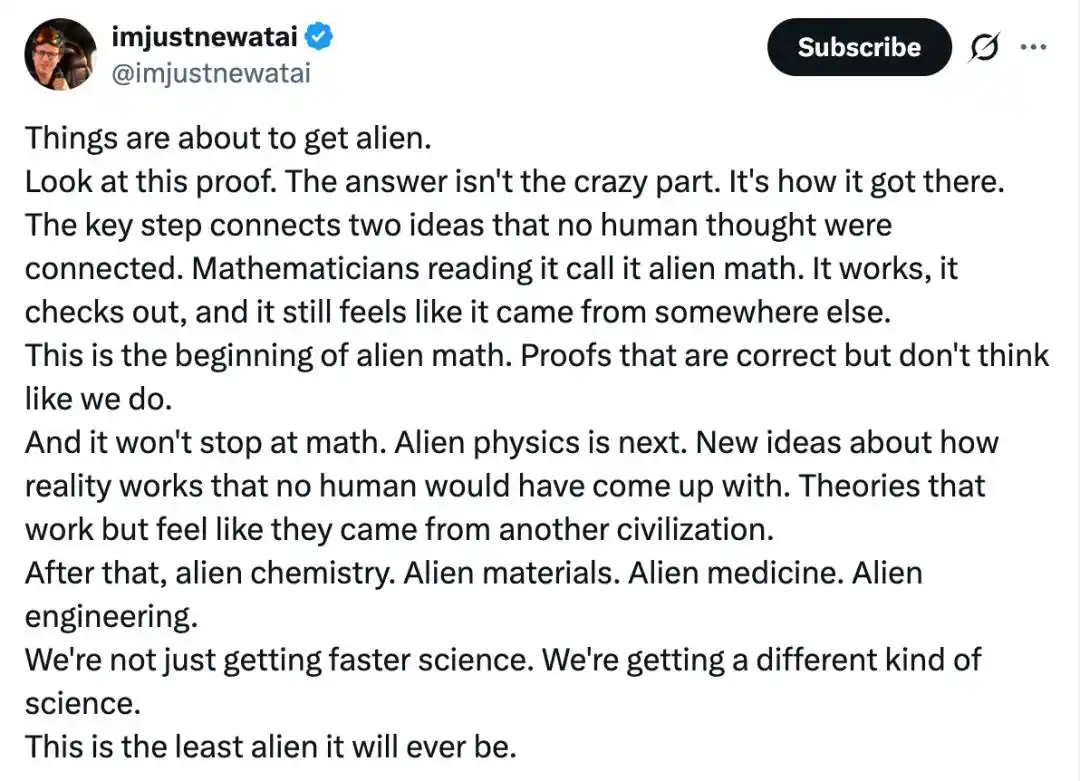
That user said similar patterns could soon appear in physics, chemistry, materials science, medicine, and engineering. The way science produces results is changing, and new research paths may no longer follow established human habits of thought.
Today may already be the least “alien” moment science will see.
Reference links mentioned in the source include The Atlantic and several X posts. The original Chinese article was published by MarsBit and credited to the WeChat account “机器之心” (ID: almosthuman2014), written by Yang Wen.



