
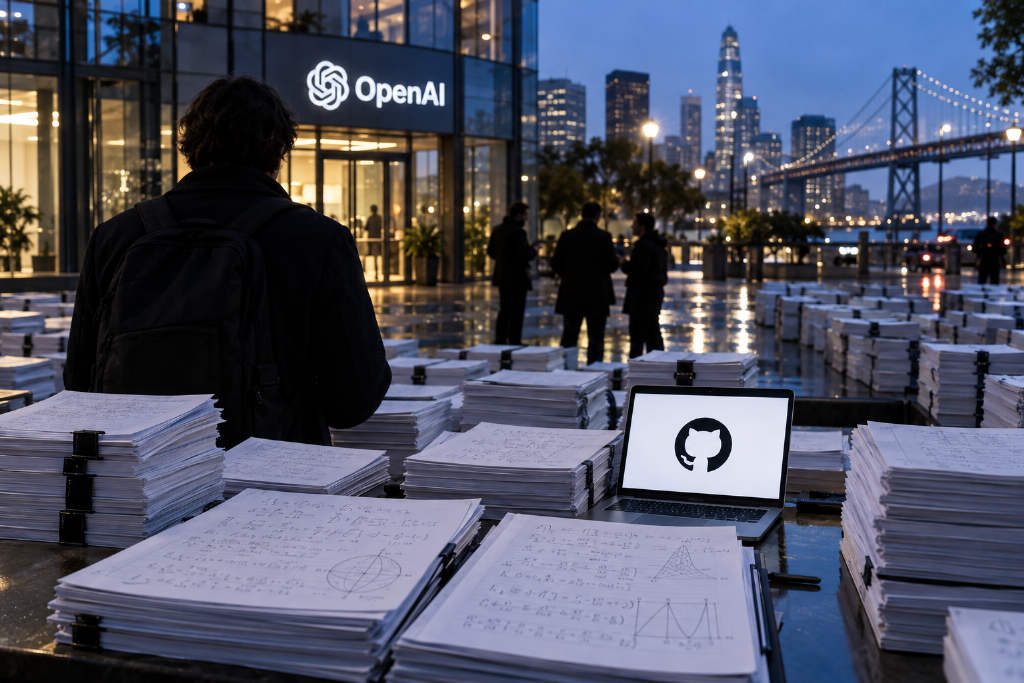
OpenAI published 722 AI-generated mathematics manuscripts on GitHub on Oct. 6 Eastern Time, less than five hours after WIRED ran a report describing broad criticism from mathematicians over the company’s approach to advanced math research.
The release immediately sharpened a dispute that had already moved beyond model performance. The core questions now are how mathematical results should be delivered to researchers and how credit should be assigned when AI systems produce work on long-standing problems.
From expensive runs to a large GitHub release
In September, OpenAI said it used more than 10,000 AI agents when it tackled the Millennium Prize problem Navier-Stokes, which is tied to equations describing fluid motion. The company estimated the compute bill for that effort at several million dollars.
This time, the repository README says the average result required compute roughly equal to three hours of ChatGPT Pro usage. That drop in cost has shifted attention toward disclosure standards rather than raw capability alone.
The repository went live the same day as the report
According to the report, OpenAI gathered about 40 mathematicians in August to discuss what should happen if AI systems surpass humans in mathematics. Participants later said the company suggested its models had already solved hundreds of long-unsolved problems. They also said OpenAI indicated it would not release everything at once and asked for feedback on publication methods.
OpenAI spokesperson Lindsay McCallum told WIRED the company was "not aware" of any such promise.
At the time WIRED published its story, McCallum said OpenAI’s new internal model had solved more than 100 long-unsolved problems in addition to Navier-Stokes, and that the company had "not set a publication timeline." But at 6 p.m. Eastern Time that same day, OpenAI put the work on GitHub and issued an official announcement.
The README says the repository contains 722 manuscripts grouped into 372 related papers. Many manuscripts include formalizations in Lean, a proof language that can be checked by computer, though not every manuscript does.
The README also says some results that have not yet been formalized may contain mistakes and will be corrected as quickly as possible.
Researchers say advisory guidance was ignored
Northwestern University mathematician Bryna Kra told WIRED that participants in the August meeting had asked OpenAI not to rely on blog posts or social media posts to disclose results. Instead, they wanted papers that mathematicians could absorb, evaluate, and use. Her assessment was direct: "It seems that this advice was ignored."
The independent advisory group AGMAI is housed under the Institute for Advanced Study in Princeton. Its nine members are unpaid. Based on feedback from more than 600 mathematicians, the group issued recommendations dated Sept. 29 calling for math results to be stored in an academic repository not controlled by any AI lab. It also asked for each result to disclose the model name, prompt, reasoning summary, time spent, and compute cost, and said mathematical results should not be used as marketing material.
OpenAI’s release differs on several of those points. The manuscripts were posted under the company’s own GitHub account, and the announcement said OpenAI is still looking for a community-hosted option that would meet the guidelines. The company disclosed average compute usage and 10 reasoning summaries, but it did not provide prompts for each individual result.
Reproducibility and attribution remain contested
According to Scientific American, an OpenAI spokesperson said the company takes the guidelines seriously but is not bound by them. The spokesperson also said nearly every result came from a single prompt given to a single AI agent.
MIT mathematician Andrew Sutherland said claims of that kind should be treated as unverified until the model is released and the results can be reproduced.
WIRED also reported that when OpenAI worked on Navier-Stokes in September, it moved large numbers of AI agents onto the problem after hearing rumors that someone else was getting close to a solution. New York University mathematics professor Tristan Buckmaster questioned whether OpenAI had rushed to publish first. He said his private collaboration with Anthropic employee Levent Alpöge had not yet been published, even though both were using OpenAI tools to assist their work.
The anxiety, some say, is about companies rather than AI itself
The "mob-like" description cited in the report came from New York University visiting mathematician Nestor Guillen. OpenAI said it "disagrees with that characterization." Guillen then said the anxiety is becoming more common among his colleagues and is "not directed at AI, but at AI companies." In his view, a large part of that anxiety comes from power being concentrated in one place.
Mathematicians interviewed for the story said mathematics has become a showcase for both OpenAI and Anthropic. With both companies preparing large IPOs, they said, the race to release results has pushed aside the traditional process for publication and attribution.
People who have spoken with OpenAI employees told the outlet that several staff members believe the technology has brought mathematics to an endpoint. McCallum answered that OpenAI "does not think the future of mathematics is settled."
Not every mathematician opposed the public release
Some researchers argued that making the work public was the right move. University of Toronto mathematician Daniel Litt told Scientific American that he saw no reason a company should be expected to keep answers secret from everyone else.
The advisory group responded the same day, saying its role does not amount to endorsing either the released results or OpenAI’s process. Public release, it said, is only the beginning of understanding what the results mean, and whether the recommendations were followed should be judged by the mathematics community itself.
Kra helped draft the Leiden Statement, which has been signed by more than 4,000 mathematicians and calls on AI companies to meet the standards of the mathematics field. She said OpenAI’s actions do not match that statement. What she wants is better disclosure, enough to make the results trustworthy in her eyes. As she put it: "This is a frightening time, but it is also a deeply exciting time."