
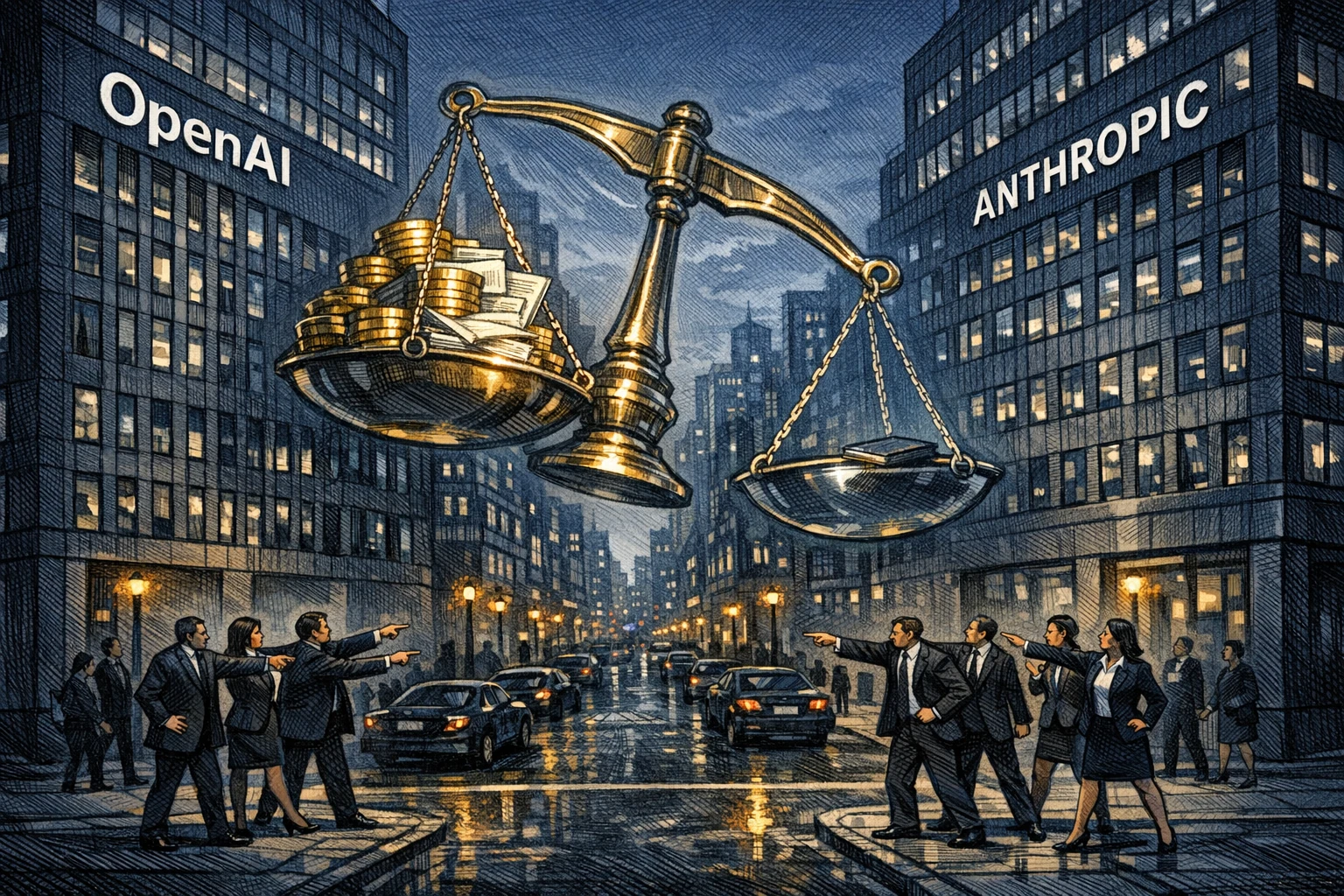
OpenAI Chief Revenue Officer Denise Dresser sent a four-page internal memo to all employees on April 13, directly accusing rival Anthropic of padding its publicly claimed $30 billion annualized recurring revenue (ARR). According to details obtained by The Verge, Dresser estimates that roughly $8 billion stems from different revenue recognition methods, making the two companies' figures incomparable.
Gross vs Net: The Accounting Split Behind $8B Gap
The memo states that Anthropic books cloud resale revenue from partners like Amazon and Google on a "gross" basis, including channel fees before deductions. OpenAI, by contrast, records Microsoft revenue share on a "net" basis. Dresser argues that if Anthropic used the same methodology, its comparable ARR would be around $22 billion, below OpenAI's self-reported $25 billion. Anthropic has not publicly responded to the specific numbers as of press time.
The difference between gross and net accounting is technically valid under GAAP, but with billions in valuation tied to growth narratives, the $8B gap could shift market pricing logic. Both companies are reportedly considering IPOs this year, forcing investors to confront divergent revenue methodologies.
Five Priorities: New Model to DeployCo
The financial dispute is just the overture. Dresser devoted most of the memo to OpenAI's competitive deployment in Q2, listing five priorities: a new model codenamed "Spud" for the enterprise layer; positioning Frontier as the default agent infrastructure; expanding distribution through the newly announced Amazon partnership; cross-product sales integration; and building a deployment engine called DeployCo.
The memo also hints at OpenAI's shifting relationship with Microsoft. Dresser described Microsoft as "limiting" OpenAI's market coverage to some degree, and the new Amazon tie-up is designed to fill that gap.
Compute Bottlenecks and Narrative War
Dresser's criticism extends beyond finance: she claims Anthropic faces throttling and degraded service availability due to compute shortages. She characterizes Anthropic's strength in developer and coding scenarios as a "narrow entry point"—a potential weakness as AI applications expand beyond engineering teams into broader enterprise workflows.
The sharpest words target brand messaging: Dresser wrote that Anthropic's image is built on "fear and restriction," contrasting with OpenAI's self-positioning as "democratizing power." OpenAI CEO Sam Altman echoed the sentiment in February, publicly calling Anthropic's products "expensive and only for rich customers."
Dresser ended the memo by urging employees to view OpenAI as a unified platform company, not a collection of siloed product lines. Her closing line: "This market is ours—it depends on whether we can win it."