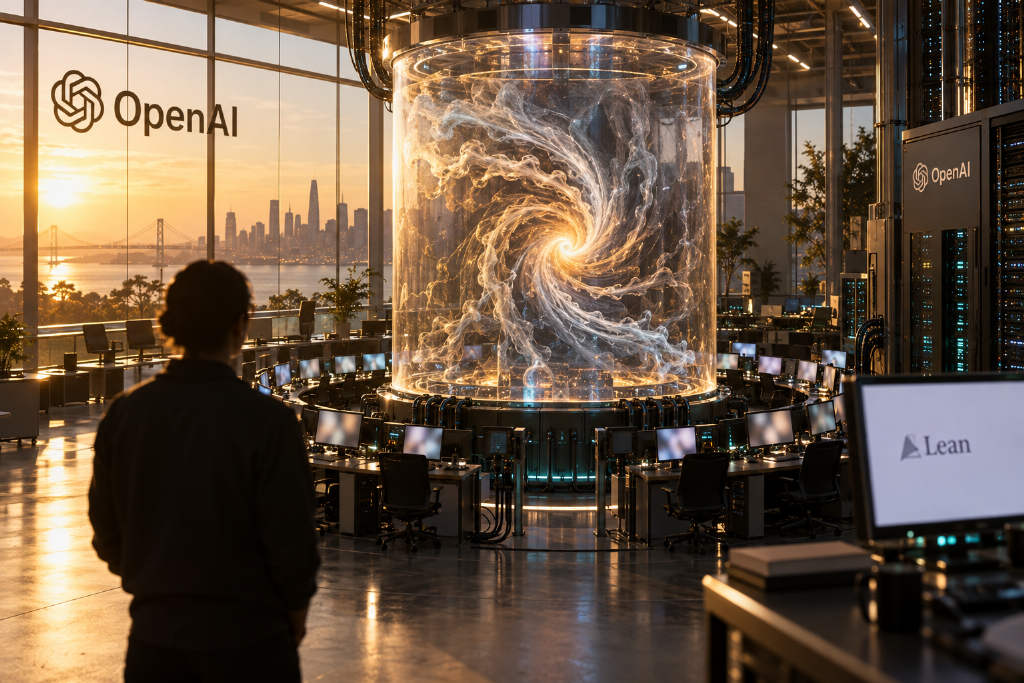
OpenAI said on Sept. 8 that its internal multi-agent system had successfully proved that a three-dimensional incompressible Navier-Stokes equation can develop a finite-time singularity, a result it described as solving the long-standing problem. The company said the proof was produced by an internal model stronger than GPT-6 Astra, with an initial result reached on Sept. 5 and then checked through 17 hours of formal verification in Lean. According to OpenAI, the proof shows that under smooth external forcing, a stationary fluid can evolve into an inward-spiraling and stretching vortex structure whose energy stays finite while velocity grows without bound, matching the "C" and "D" cases in the Millennium Prize problem. OpenAI also disclosed the scale of the run, saying the process used about 10,000 concurrent agents, sent roughly 2.7 million messages, and consumed about 130 billion output tokens. It added that the effort was inspired by rumors of parallel work by Anthropic employee Levent Alpöge and New York University professor Tristan Buckmaster, and said the two sides reached different results on the Euler regularity problem.
OpenAI said on Sept. 8 that its internal multi-agent system had successfully proved that a three-dimensional incompressible Navier-Stokes equation can form a finite-time singularity, which it described as solving the century-old problem.
The company said the proof was driven by an internal model more capable than GPT-6 Astra. It reached an initial result on Sept. 5, followed by 17 hours of formal verification in Lean.
OpenAI said the proof shows that, under smooth external forcing, a stationary fluid can evolve into an inward-spiraling and stretching vortex structure. In its description, the energy remains finite while velocity grows without bound, corresponding to the "C" and "D" cases in the Millennium Prize problem.
The full solving process used about 10,000 concurrent agents, sent about 2.7 million messages, and consumed about 130 billion output tokens.
OpenAI also acknowledged that the attempt was inspired by rumors of parallel work by Anthropic employee Levent Alpöge and New York University professor Tristan Buckmaster. It said the two sides differed in their results on the Euler regularity problem: OpenAI proved the case without external forcing, while the other side proved the case with external forcing.
This article was originally published by Bit.Fan. For more cryptocurrency news and market insights, visit www.bit.fan. Disclaimer:
The market information, project data, and third-party content displayed on this platform are for industry information sharing only and do not constitute any form of investment advice or return commitment.
Cryptocurrency trading carries high risks. Users should fully assess their risk tolerance and make independent decisions. All profits, losses, and legal responsibilities are borne by the users themselves.