
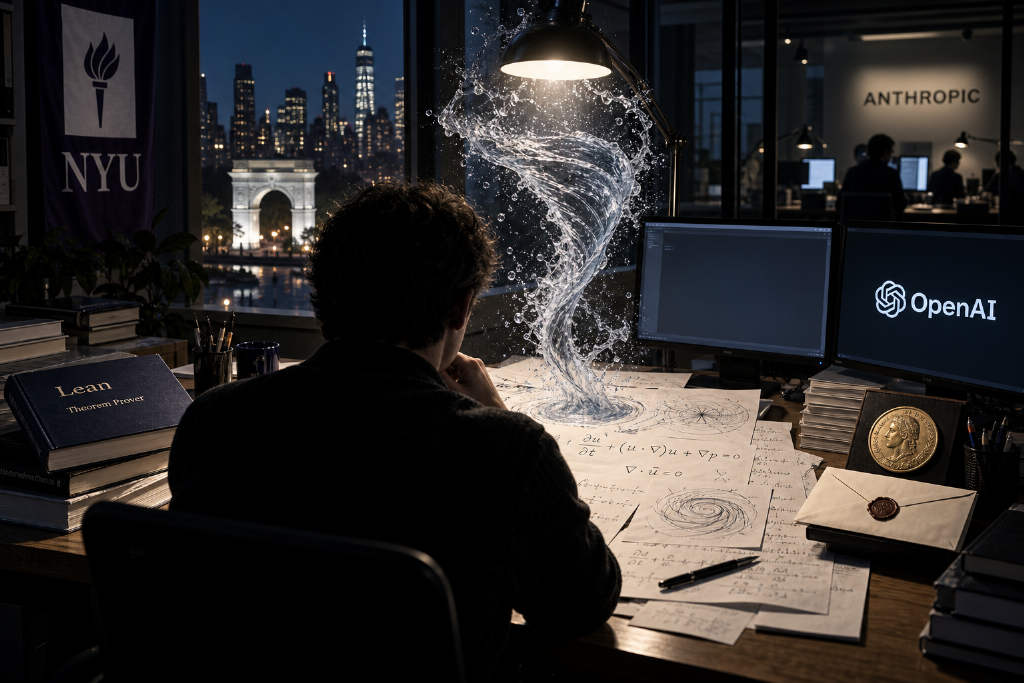
OpenAI said Sept. 8 that an internal AI model had produced a proof related to the Navier-Stokes equations, one of the most prominent open questions in mathematical research. The announcement drew an immediate challenge from Tristan Buckmaster, a mathematician at New York University, who said he and Levent Alpöge of Anthropic had already found a related solution and accused OpenAI of mishandling the release.
The Navier-Stokes equations describe how fluids move. OpenAI said its work showed that the equations can “blow up,” a point at which the mathematics predicts infinite speed, even though such a state cannot occur in nature. The problem is one of seven Millennium Prize Problems established by the Clay Mathematics Institute. Each carries a $1 million prize.
OpenAI says thousands of agents worked in parallel
OpenAI said the result took 88 hours and involved roughly 10,000 coordinating AI agents. The agents were copies of its models working on the proof in parallel. The resulting work was checked with Lean, software that verifies a proof one step at a time.
In its public statement, OpenAI described the work as a solution to the Navier-Stokes Millennium Prize Problem, which it called one of the deepest questions at the frontier of mathematics. The company said the proof was produced by a group of agents using an OpenAI next-generation model that was significantly more capable than GPT-6 Astra.
Buckmaster says his project began nearly a year earlier
OpenAI may not have been the first group to reach a solution. Hours before the company’s announcement, Buckmaster published a four-page statement presenting a different account.
Buckmaster said he and Alpöge had spent nearly a year using AI models to pursue proofs concerning fluid blow-up. He said they had produced a solution by Aug. 22. On Sept. 3, after rumors circulated that Anthropic had solved a major mathematical problem, Buckmaster told a mathematician at OpenAI about the project. He stressed that the work was personal and unaffiliated with either company.
Three days later, during a call, OpenAI’s Sébastien Bubeck told Buckmaster that an internal model had already generated a 100-page proof for forced Navier-Stokes. Buckmaster said it used the same narrow approach as his project, a direction he described as one that almost nobody else was pursuing.
According to Buckmaster’s statement, Bubeck then gave him two options. OpenAI could publish the day after Buckmaster’s team, or Buckmaster could write the paper alone, leaving Alpöge off the author list because he worked at a rival lab. Buckmaster said that after he chose to go public, Bubeck asked: “Why would you ruin your career?”
Buckmaster also quoted Bubeck as saying: “If you don’t want me to be nice, then I don’t have to be nice.” Buckmaster later published papers containing his findings, with Alpöge credited as a researcher. OpenAI did not credit either mathematician in its own announcement. It did, however, acknowledge in a quote post that it could not “rule out that de-identified data derived from their usage of our products helped improve our models.”
OpenAI and its executives reject the account
Bubeck, OpenAI and CEO Sam Altman all reject Buckmaster’s description of the events. In a follow-up post, Bubeck shared messages proposing a coordinated release with Alpöge and offering OpenAI’s prompts. He said he had acted in good faith.
“I hope it’s clear from the message that we came in with the best possible intentions,” Bubeck wrote. “I never ever asked for Levent to be removed from authorship of his own work.”
Altman defended Bubeck, saying he “acted with integrity and generosity throughout.” Altman said OpenAI initially believed the other team had also solved the full problem and wanted to collaborate on a joint release. After learning that the team had solved Euler rather than full Navier-Stokes, OpenAI offered Buckmaster’s group the chance to publish first.
In a separate statement, OpenAI said it had never seen the pair’s work before publication and had accessed no specific user data. The company did not explicitly rule out the possibility that de-identified data had helped improve its models.
The competing results have not received full independent review
Fields Medalist Terence Tao called the underlying mathematics from Buckmaster and Alpöge a “remarkable achievement.” The dispute is the second AI-mathematics story involving the same two labs this week. Days earlier, Anthropic said Claude had produced a computer-checked proof of Fermat’s Last Theorem.
The most advanced result from Buckmaster and Alpöge, and the version closest to the actual $1 million problem, remains unpublished pending a final Lean check. No one outside OpenAI has independently reviewed the company’s 100-page proof.