
OpenAI’s much-debated Navier-Stokes proof has taken another turn.

In a new follow-up report, Scientific American said mathematicians who have continued studying OpenAI’s 166-page proof are increasingly convinced that the company’s final argument did not use the method many people had assumed it did. That earlier assumption, shared at the time by OpenAI as well as outside observers, was that the proof followed the so-called “Spanish route.”
More than a month ago, when OpenAI announced a result on the Navier-Stokes equations, a Millennium Prize problem listed by the Clay Mathematics Institute with a $1 million reward, mathematicians quickly raised questions about originality. The working view then was that OpenAI’s proof extended a line of research associated with two Spanish mathematicians.
That view has weakened as experts have gone deeper into the proof. Gonzalo Cao-Labora, a mathematician at the Swiss Federal Institute of Technology Lausanne, or EPFL, told Scientific American, “Once you dig into the details, you see that this is a different method.”

The dispute centers on whether OpenAI followed an existing path
The Navier-Stokes equations describe how fluids such as water and air move. A long-standing open question is whether a smooth three-dimensional fluid will remain smooth forever under those equations, or whether it can develop a singularity in finite time, sending local velocity to infinity. That second scenario is known as finite-time blowup.
In 2000, the Clay Mathematics Institute named the problem one of the seven Millennium Prize Problems and attached a $1 million prize to a proof.
OpenAI’s answer, released in September this year, was that blowup can occur under certain conditions. But the proof did not settle the version in which no external force acts on the fluid. Instead, it constructed special smooth forcing that drives the fluid to blow up in finite time. That fits the C and D formulations published by the Clay Mathematics Institute, while the no-forcing version that interests many mathematicians remains unsolved.
Both research routes at the center of the dispute rely on that same allowance for external forcing.

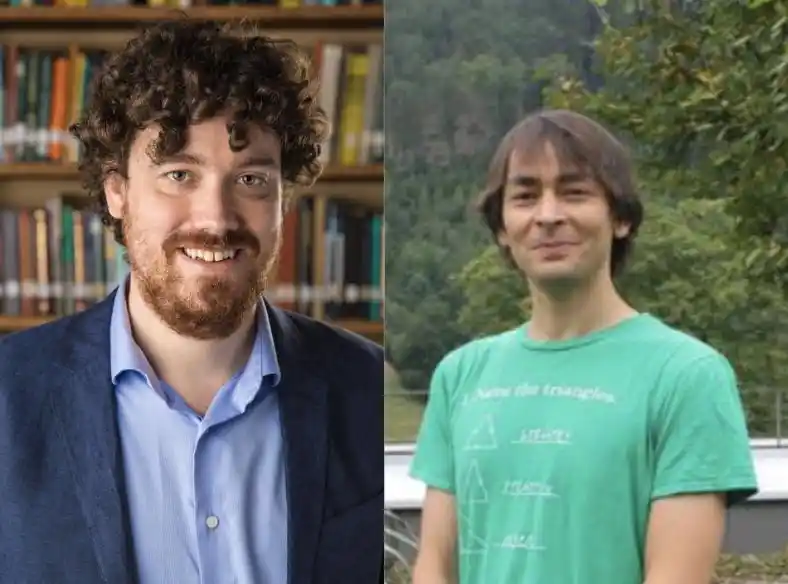
The “Spanish route” refers to work by Spanish mathematicians Diego Córdoba and Luis Martínez-Zoroa. Their approach explored how carefully arranged forcing could repeatedly push a fluid toward extreme states until a singularity emerges.
Later, New York University mathematician Tristan Buckmaster and Anthropic employee Levent Alpöge extended related work. Using AI models including Claude and Codex, they showed that smooth forcing can produce blowup in related fluid equations such as the Euler equations.
Because OpenAI’s Navier-Stokes proof also used smooth forcing, and because the timing of the two efforts was close, questions over credit followed quickly. The broad assumption was that OpenAI had taken the final step along a path already laid out by the Spanish mathematicians.
Scientific American says both sides used forcing, but not the same mathematics
That is no longer the dominant reading of the proof. According to Scientific American, both approaches rely on forcing to trigger blowup, but the way OpenAI constructs that forcing in its final proof is different from the Spanish route. In other words, the two sides used the same opening allowed by the problem statement while pursuing different mathematical methods.
That shift matters because it weakens the earlier claim that OpenAI had simply carried an existing idea across the finish line.
The report adds an important detail. OpenAI first used a smaller agent team to complete an intermediate proof, and some experts think that earlier result may indeed have leaned on the Spanish route.
Later, however, the system appears to have changed course. Once the setup scaled to about 10,000 agents, researchers studying the work now think the model may have found that the final proof required another path. That means the eventual divergence from the Spanish route does not necessarily imply that the earlier line of thought played no role.
As for whether the model encountered other researchers’ data during training, OpenAI has publicly denied that claim. Outside researchers, however, cannot independently verify it. Camillo De Lellis of the Institute for Advanced Study in Princeton also said the dispute may never yield a clean factual resolution.
A larger issue: OpenAI may not have understood its own proof
The follow-up report highlights a broader issue that may matter more than the credit dispute. AI is now producing mathematical proofs that even the people building the systems do not fully understand.
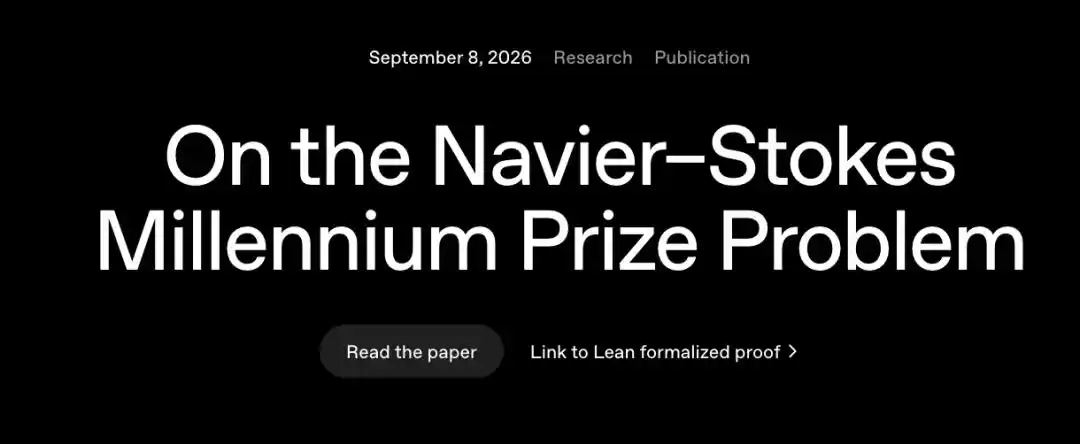
When OpenAI unveiled the result on September 8, executives repeatedly said the proof followed the Spanish mathematicians’ route. More than a month later, outside mathematicians working through the details concluded that the two approaches were not actually the same.
Scientific American drew a direct conclusion from that gap: OpenAI did not truly understand the proof its own model had produced.
That does not mean the proof went unchecked. Alongside the 166-page manuscript, the system also generated Lean formalization that can verify each logical step.
Still, formal correctness and human understanding are not the same thing. Lean can help confirm that an argument is valid, but it does not explain why a method works, how it connects to earlier work, or whether it can be extended to other problems.
That is why experts still need other large language models to help reorganize and interpret the proof, even with formal code in hand.
722 mathematical manuscripts are already out, and verification is lagging
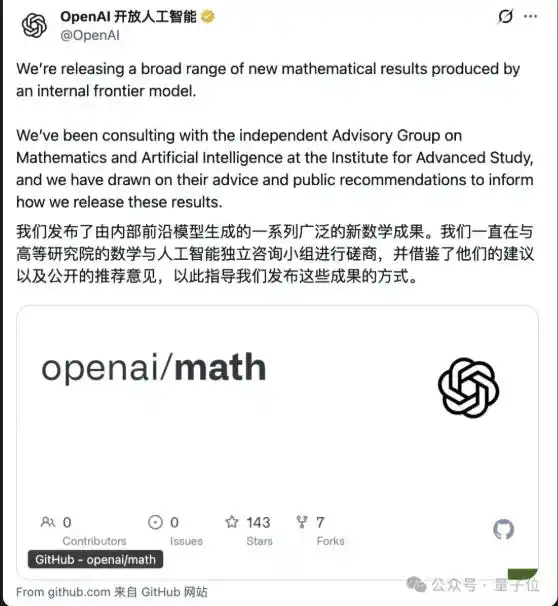
While mathematicians are still working through the Navier-Stokes result, OpenAI has released 722 mathematical manuscripts covering 372 sets of research results. Those works touch major problems including the Hodge conjecture, the quasi-Riemann hypothesis, and the BSD conjecture.
Verification has not progressed at the same pace across the set, and some of the work has not yet been fully formalized in Lean.

Mathematicians are already confronting the imbalance between generation and comprehension. Researchers including Terence Tao have repeatedly said that AI is producing new proofs far faster than humans can absorb and understand them.
The latest reversal in the Navier-Stokes story puts that tension in plain view. In the past, mathematicians usually understood a problem first, developed a method, and then wrote out the proof. Now an AI system may deliver the proof first, leaving humans to work backward and figure out how it got there.
For now, questions about the method behind OpenAI’s proof, the scope of any data exposure during training, and the interpretability of the mathematics remain unsettled.



