
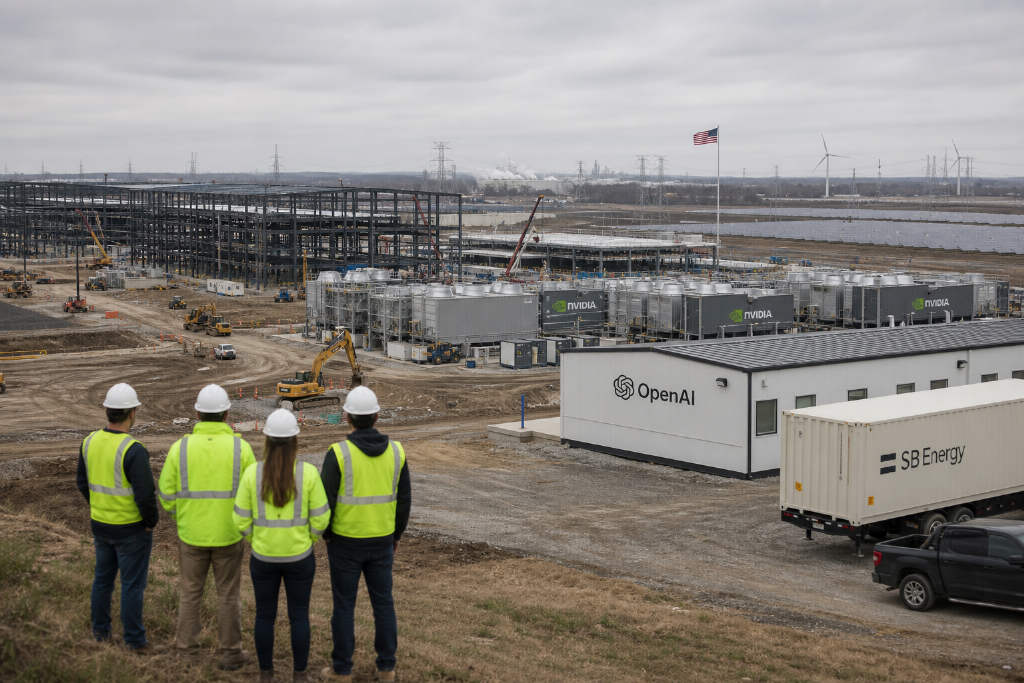
OpenAI, Nvidia and SB Energy confirm a major US data center project
OpenAI, Nvidia and SB Energy, the SoftBank-backed power developer, have confirmed a collaboration to build a large data center in the United States. SB Energy will develop and operate the site, OpenAI will be the customer, and the data center will run on Nvidia computing infrastructure.

The most closely watched part of the deal is Nvidia’s role. The company is not only a chip supplier. It is also providing backup for OpenAI’s long-term lease, with a maximum obligation of $105 billion, while also investing directly in the project.
The PORTS-Pike campus in Ohio is planned for at least 10GW of new power
The project is located at the PORTS-Pike campus in Ohio. The plan calls for at least 10GW of new renewable power capacity, with the completed site expected to host about 8GW of AI factory capacity and exclusive Nvidia computing infrastructure.
Construction will come in two phases. The first phase is planned at 4.25GW, including an initial 800MW that is expected to enter service in 2028 and rely mainly on existing AEP Ohio infrastructure. Additional power plants, transmission lines and other grid assets still need to be built before the campus can reach its target scale.
Nvidia may also back another 3.75GW of capacity if future demand justifies it, although that part still faces uncertainty around infrastructure and permits, and Nvidia is not required to lease all of it.
SB Energy and SoftBank plan to invest at least $4.2 billion in new regional grid infrastructure. SB Energy will build, own and operate the data center, while OpenAI will use capacity as it is completed and delivered.

OpenAI’s 20-year lease and Nvidia’s $105 billion guarantee
OpenAI has signed a 20-year lease with SB Energy. Under the agreement, OpenAI will start paying rent only after the relevant capacity is completed and available for lease.
Locking in long-term capacity gives OpenAI a way to secure future computing supply in advance, but it does not mean Nvidia is paying OpenAI’s rent for two decades. Nvidia’s maximum payment obligation is set at $105 billion, mainly tied to land, power and data center infrastructure costs.
The structure is a residual-value guarantee. If OpenAI stops leasing, SB Energy must look for a replacement tenant; if no new lease is found, the assets may be sold. Nvidia only steps in if those measures still fail to cover the agreed minimum value.
That means the $105 billion guarantee is linked to the residual value of completed data center assets. It will phase in as construction and deployment progress, roughly covering the 2028 to 2030 period, and Nvidia’s actual exposure should decline as OpenAI pays rent and more capacity comes online.
Nvidia is willing to do this because the exposure still sits behind a real asset. Even if OpenAI later reduces usage, the completed computing capacity can still be leased to cloud providers, enterprises, AI labs and startups.
Jensen Huang says AI factories now need land, power and shells up front
On the same day, Jensen Huang published an explanation of why Nvidia is taking part in projects like this. His view is that AI factories now need far more than chips. In the past, advanced chips, packaging, memory and networking were the main inputs for AI infrastructure. Now land, power and data centers must also be secured ahead of time.

Huang said large cloud providers and investment-grade companies usually have balance sheets large enough to sign long-term contracts and build infrastructure themselves. Frontier AI labs may not.
Their training and inference demand can grow quickly, and revenue may rise with it, but locking in decades of land, power and data center capacity requires stable cash flow and strong financing ability, which many AI labs do not yet have.
Huang wrote that their growth is constrained not by algorithms or customer demand, but by the availability of compute. Nvidia’s move into data center infrastructure — land, power and shell, or LPS — is meant to address that bottleneck. But he also said the company will only choose a small number of sites with clear, long-term demand.
Huang said each generation of Nvidia AI factory systems deployed at PORTS-Pike could correspond to about 1.5 million Nvidia GPUs, or roughly $150 billion to $200 billion in Nvidia revenue. In his framing, the 20-year agreement is really about locking in the infrastructure that will host Nvidia’s systems over time, not a fixed order for one GPU generation.
OpenAI’s long-term commitments then expand the opportunity further. Huang said OpenAI’s existing and planned commitments correspond to about 12GW of Nvidia computing capacity. If PORTS-Pike continues to expand, that figure could rise further. At that scale, OpenAI-related deployments could represent about $600 billion in Nvidia compute value by 2030.
Off-balance-sheet commitments across Big Tech are approaching $3 trillion
The PORTS-Pike story is not just about Nvidia and OpenAI. Over the past two years, AI companies and large technology firms have been building data centers at a rapid pace, but an increasing share of that infrastructure is not being bought outright. Instead, it is being locked in through leases, long-term procurement agreements, joint ventures and other financing structures.

The Wall Street Journal recently reviewed the latest filings of nine major tech companies — Alphabet, Amazon, Microsoft, Meta, Oracle, Nvidia, Broadcom, SpaceX and AMD — and found that their AI-related off-balance-sheet commitments now total about $3 trillion.
That figure is far larger than the roughly $600 billion they spent on capital expenditures over the past year. Meta’s Hyperion data center is one example. The Louisiana site spans an area equal to 1,700 football fields and is being built by a joint venture backed by a Blue Owl Capital-managed fund. Meta is a minority partner and the tenant, with its rent helping provide cash flow to bondholders.
Until rent starts being paid, that obligation does not fully appear on Meta’s balance sheet. As of June, Meta disclosed $347 billion in undisclosed lease commitments, including the Hyperion project.
As of June, Meta had already leased the Hyperion data center in Louisiana, but rent had not started, and the lease obligation was not yet fully reflected on its balance sheet.
Across the nine companies, unpaid lease commitments totaled about $1.2 trillion, roughly four times the amount disclosed a year earlier. Purchase commitments and other contractual obligations came to about $1.9 trillion.
Alphabet saw a particularly sharp jump. As of June 30, its purchase commitments and contractual obligations reached $811 billion, up from $332 billion three months earlier. Alphabet said those obligations mainly involved technology infrastructure, inventory and agreements to secure data center power supply. Some of the energy contracts run as far as 2054, but Alphabet did not explain why the total rose by nearly $480 billion in just one quarter.

The risk is not limited to data center leases and chip purchases. Some companies have also committed to buying other companies’ stock or guaranteeing other tenants’ leases. Nvidia itself has pledged $27 billion in equity investments between April 26, 2026 and the end of fiscal 2027.
Debt is another pressure point. Some tech companies have already turned more frequently to the capital markets for borrowing. In the latest earnings reports from Alphabet and Amazon, free cash flow turned negative and capital spending exceeded cash generated from operations.
Alphabet, Amazon and Meta are projected to swing to negative cash flow for the rest of 2026 and into 2027. Those numbers still do not fully capture the cash pressure that future trillions of dollars in off-balance-sheet commitments could create. Many purchase commitments and long-term leases cannot be canceled easily. If AI demand falls short of expectations, the bills still have to be paid. In that case, these giants would have to cut other spending or borrow more to keep building the infrastructure.
A Morgan Stanley accounting analyst warned in a report in April that as off-balance-sheet commitments become more frequent, larger and more complex, it will become harder for investors to judge a company’s true leverage.
PORTS-Pike now sits at the front of that trend.
