
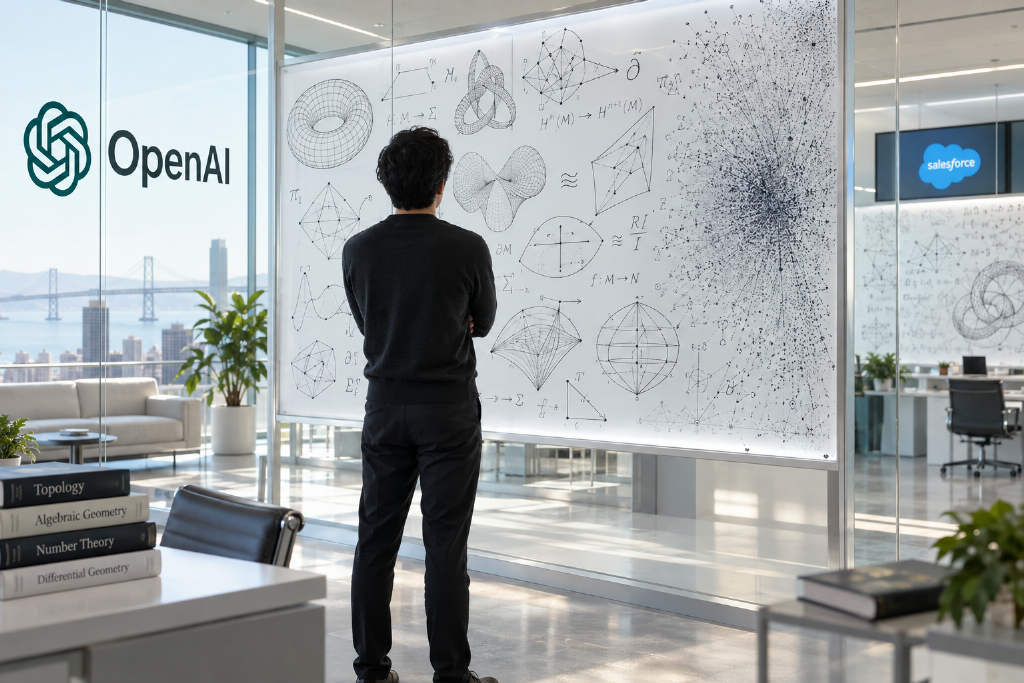
OpenAI CEO Sam Altman shared new details about the company’s internal model roadmap in a conversation with Salesforce CEO Marc Benioff, and he framed the progress around math skill, not the usual benchmark charts.

Altman said, "GPT-5.5 is roughly at the level of an ordinary math professor. GPT-5.6 can roughly stand alongside the top 1% to 2% of math professors in the world." Then he went a step further. OpenAI, he said, has another internal model after Astra, and that post-Astra system "can already solve difficult problems that even the world’s very best mathematicians cannot crack."
Altman described a three-tier jump in math capability
In the original report, Altman’s comments were framed as a change in how OpenAI judges scientific reasoning. No more school-test comparisons. No more olympiad-style measuring sticks. The new comparison point is human scholars at the very top of the discipline.
Under that lens, GPT-5.5 was put around the level of a typical math professor. GPT-5.6 was placed near the top 1% to 2% of math professors worldwide. And the post-Astra model? It was described as moving past even that tier.

The report also said the internet response was split. Some readers treated the claim as stunning. Others were skeptical, reading it as marketing talk and pointing to leaked chat records. Their argument: AI may be taking in ideas from human mathematicians rather than producing them on its own. Those reactions appeared in the source report as commentary around Altman’s remarks.
Brockman said OpenAI made major progress on another Millennium Prize Problem
OpenAI President Greg Brockman also made a separate public comment, saying, "We have also made major progress on another Millennium Prize Problem."
The report tied that remark to earlier claims about the Navier-Stokes equation. According to the source text, OpenAI used at least $15 million in compute to generate a 166-page proof, and that proof passed strict verification in Lean.

Set against that background, Brockman’s mention of another Millennium Prize Problem drew even more attention. The source listed the five unsolved Millennium problems like this:
- P versus NP
- The Riemann Hypothesis
- Yang-Mills existence and mass gap
- The Hodge Conjecture
- The BSD Conjecture
The original article singled out P versus NP as the most alarming possibility. It then explored what it might mean if AI were to prove P=NP. It also mentioned rumors that OpenAI could be close to solving either the Hodge Conjecture or the BSD Conjecture, though the report offered no extra evidence for those claims.
Scott Aaronson wrote that the singularity has already begun
At almost the same moment, University of Texas at Austin professor and theoretical computer scientist Scott Aaronson published a long essay titled The Age of Miracles and Terror.

The source described Aaronson as someone who had spent years skeptical of AI doomer arguments. It said that 20 years ago he brushed off warnings about AI taking over the world and argued that people should wake him only when AI could solve Millennium math problems. In this new essay, the report said, that stance changed hard.
Aaronson wrote, "As I see it, the singularity has already arrived... In the years I have left, I will probably never prove another theorem. Because the world no longer 'needs' me to prove one. If I keep doing mathematics, it will be only for my own amusement or that of others, the way humans play chess."
He also publicly acknowledged AI risk writer Eliezer Yudkowsky, saying, "You were right in your prediction about the greatest challenge facing civilization, and I and the others were wrong."

The report also pulled out a personal section from Aaronson’s essay. He wrote that when he put his children to bed at night, he felt a spasm in his stomach and wondered what kind of future they would have, and what they were learning now that would still matter in that future. He also said his 13-year-old daughter joked that if she wanted to become a mathematician, it looked like she had about two weeks left.
The report said AI is reshaping mathematics and peer review
Aaronson’s essay, as summarized in the source article, ran through a string of recent results completed with AI help or solved entirely by AI. The examples included a counterexample to the Jacobian conjecture produced by an Anthropic researcher using an AI model called Fable during the World Cup final, a major improvement to bounds on the Grothendieck constant in Riemannian geometry, a full formal verification of Fermat’s Last Theorem in Lean, and progress in quantum computing that included a proof of Watrous’s disentanglement conjecture and a proof of perfect completeness for QMA.
Aaronson compared today’s academic mood to a siege scene from The Lord of the Rings. The source quoted him saying that talking to journal editors or conference chairs now feels like talking to the humans of Gondor or Rohan as they strengthen the walls and get ready for an assault by 50,000 orcs. His point was blunt: human reviewers have no real option except to use AI to review papers, because without it the defenses would fall apart at once.

The article then turned to the questions this raises. Who gets credit for future papers? What does mathematical research even mean if humans can no longer understand the proofs? And is the human job being cut down to proofreading and translation?
The source also said that 25 Fields Medal winners led by Terence Tao had released an open letter. According to the report, the letter did not ask for AI to be shut down. Instead, it asked whether mathematics was about to lose its human character as a community built on understanding, insight, and communication across generations.
The source described a talent shift toward AI safety and alignment
In its final section, the original article described what it called a talent exodus across Silicon Valley and top universities. It said many gifted physicists and mathematicians, including Mike Winer of the Institute for Advanced Study in Princeton, were abandoning traditional academic tracks and moving into AI safety and alignment work.

The reason given in the source was stark. For these researchers, deriving formulas on a blackboard no longer feels like the main task. The more pressing job, as the article put it, is making sure this emerging "machine god" does not treat humanity like a bug to be erased the moment it wakes up.
The report cited two reference materials: Altman’s conversation with Marc Benioff on YouTube and Scott Aaronson’s blog post. It also said the article originally came from the WeChat account Xinzhiyuan and was written by Aeneas.