
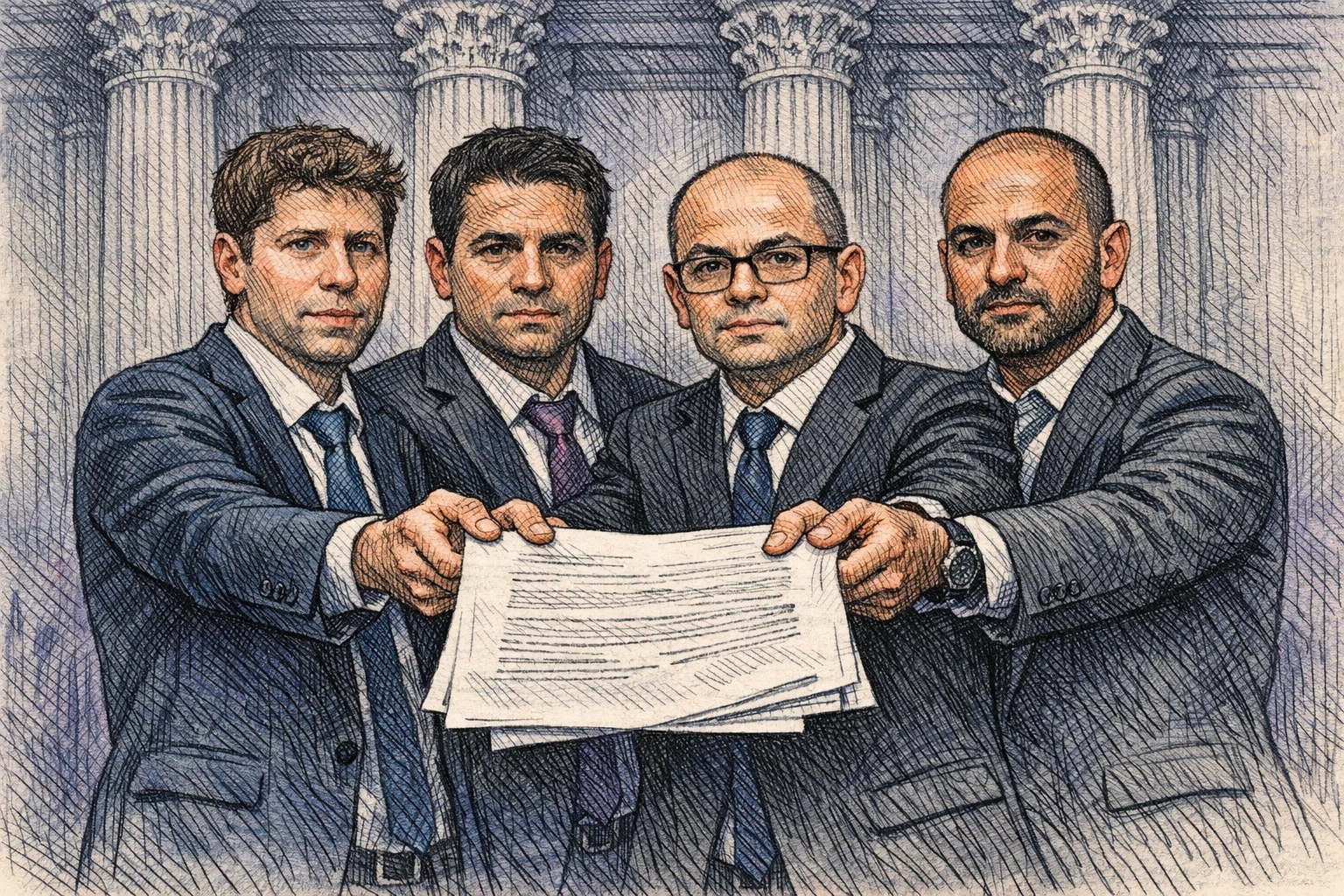
Executives from OpenAI, Anthropic, Google DeepMind, and Microsoft AI have jointly urged the U.S. Congress to require mandatory screening of customer identities and purchase orders for all DNA and RNA synthesis providers operating in the country. The letter argues that AI is making it easier for bad actors to obtain genetic sequences that could be used to build pathogens. Signatories include Sam Altman, Dario Amodei, Demis Hassabis, and Mustafa Suleyman, with the effort organized by the Institute for Progress and the Foundation for American Innovation.
AI is being framed as a force that lowers the barrier
The letter says the speed of AI development is eroding the knowledge barrier that historically limited access to bioweapon-related capabilities. DNA synthesis itself is not new, but commercial services have made custom genetic sequences much easier to obtain for research, drug development, and diagnostics. The weak point is uneven screening. Not every supplier checks who is placing an order or what is being ordered.
The source article points to a 2017 case in which Canadian researchers reconstructed horsepox virus using about $100,000 worth of mail-order DNA. Critics warned at the time that a similar approach could be applied to smallpox, a closely related and lethal virus. Costs have continued to decline. Large language models add another layer of concern: these systems can process biological sequence data, identify sequences that may avoid current screening tools, and suggest edits that make questionable orders appear less suspicious.
Stanford microbiologist and biosecurity expert David Relman told Wired that AI tools can quickly help users find where unscreened sequences may be ordered. With precise prompting, he said, they may also suggest how to modify an order so screening systems are less likely to detect what the user is actually trying to make. That is the central argument behind the call for congressional action.
Voluntary industry screening exists, but gaps remain
The coalition behind the letter includes scientists, national security experts, and executives from Twist Bioscience and Ansa Biotechnologies. Both companies are members of the International Gene Synthesis Consortium, a group formed in 2009 that has promoted voluntary order screening standards across the industry. James Diggans, vice president for policy and biosecurity at Twist Bioscience, told Wired that any company capable of synthesizing DNA should ensure the technology is used responsibly, including knowing what it is making and for whom.
Current federal policy only reaches part of the market. Under guidance created during the Biden administration, scientists and institutions receiving federal funding must buy synthetic genetic material from suppliers that run screening programs. That leaves private labs, overseas procurement, and self-funded work outside the rule. The result is partial coverage, not a universal standard.
The article also notes that a bipartisan Senate bill introduced earlier this year would go wider, requiring all gene synthesis providers operating in the United States to screen both orders and customers regardless of funding source. That is the same direction backed in the public letter. The contrast is clear: screening is strongest among firms that already chose to join an industry alliance, while suppliers outside that network can remain blind spots.
Even mandatory screening may not stop AI from finding workarounds
The material stops short of presenting screening rules as a complete answer. It cites a Microsoft research paper published in Science last year showing that AI protein design tools built for beneficial research can also generate new sequences structurally similar to known dangerous proteins. Those novel sequences may evade existing screening software.
That creates a familiar problem. Screening systems look for known dangerous sequences, while AI can generate sequences that are structurally related but not yet listed in any blacklist. Geoff Ralston, former president of Y Combinator and partner at Safe AI Fund, told Wired that AI labs building models with biological capabilities should also screen user requests directly, making it extremely hard or impossible for a model to assist with immediately dangerous tasks.
Relman made a similar point. Screening requirements, in his view, are only one part of the response. If screening can fail in some cases, other checkpoints need to be added elsewhere in the chain, and that is where AI companies themselves are expected to carry responsibility.