


OpenAI has outlined a record-scale agent test with Third Moment Research, saying 10,000 agents were run at the same time for 36 to 48 hours, consuming 1 trillion tokens a day. In the company’s description, a single run amounted to 41 years of human engineer labor.
The live test was conducted by Third Moment Research, a startup operating across San Francisco and New York. Its first target was quantitative finance, a setting the team chose because outcomes can be checked directly through historical backtesting: a strategy either makes money or it does not.
Agents rewrote the underlying engine after hitting a waiting bottleneck
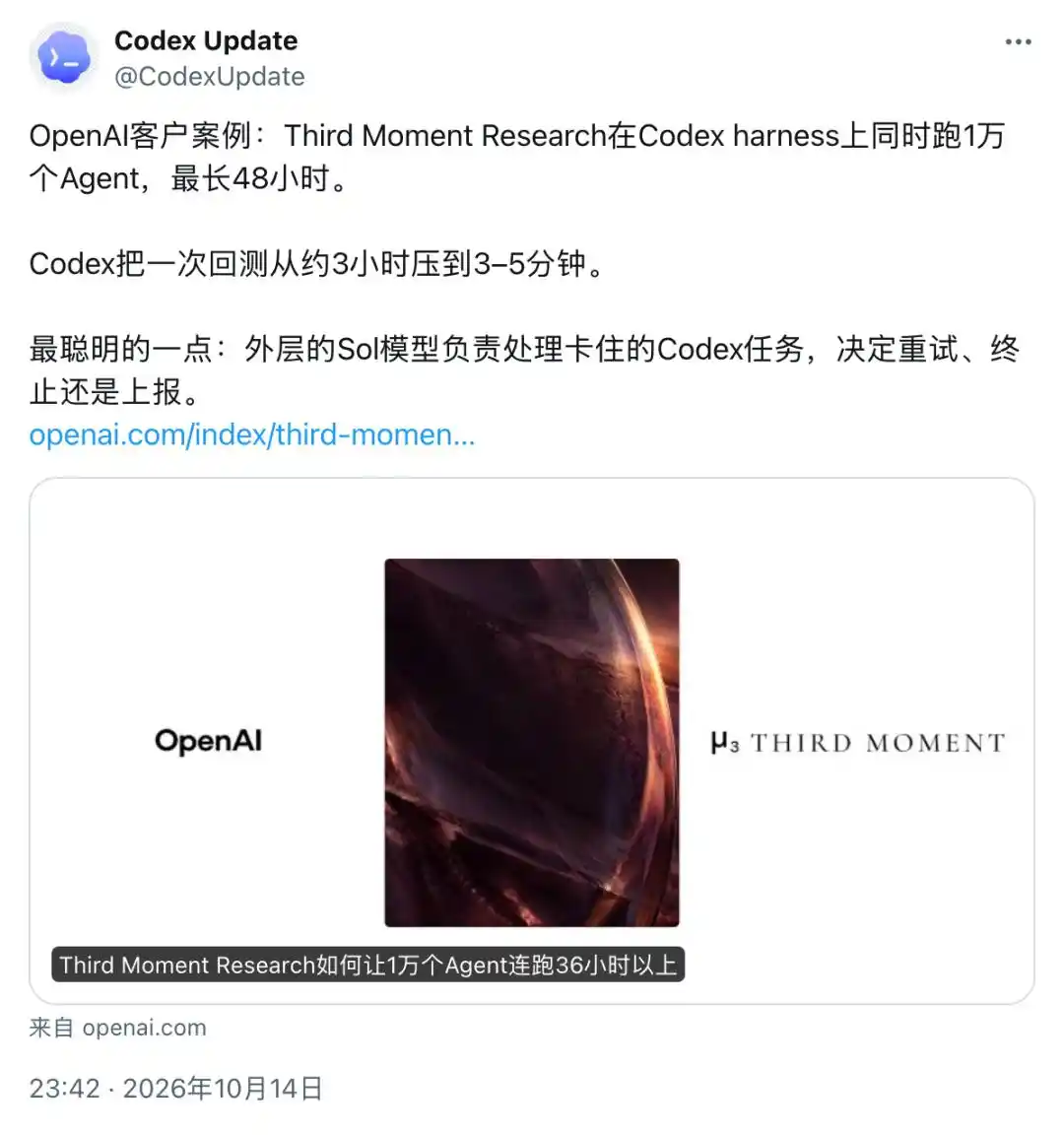
Third Moment loaded 1TB of historical market data, technical documentation, and a full quantitative trading codebase into Docker-isolated containers. At the start, the team used Codex with GPT-5.6 to inspect thousands of runtime traces and timestamps and found that backtesting a strategy on one year of U.S. equity tick order data took three hours each time.
That delay created a separate problem for long-running agents. Context is a scarce resource in extended tasks, and during long waits the agents kept polling to ask whether the run had finished. Each status check stayed in the context window, gradually crowding out the useful experimental record built up over dozens of earlier steps.
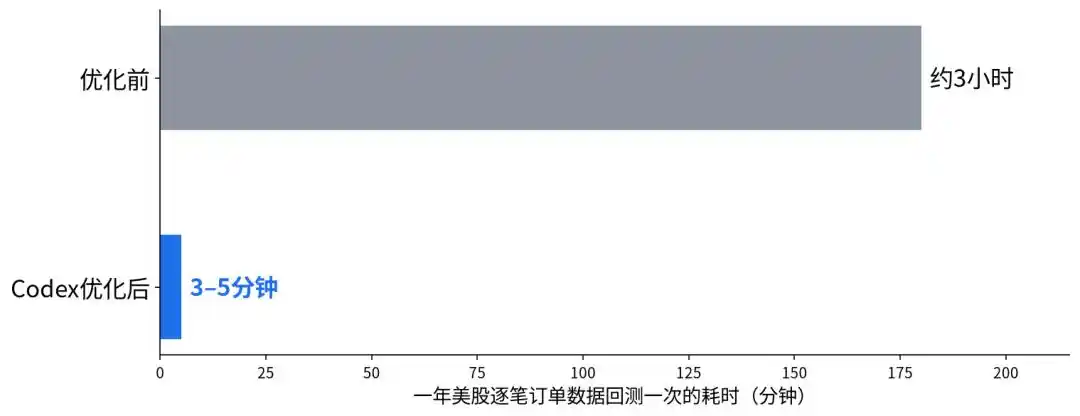
After locating the bottleneck, Codex did not wait for a human engineering slot. It traced the codebase, identified two low-level issues, wrote caching improvements and compact memory-packing changes, passed testing, and pushed the changes into production. That cut a single backtest from three hours to three to five minutes and preserved a cleaner context window.
Differences between model generations became clearer
Once the backtesting loop sped up, OpenAI said distinctions across model generations in long-horizon work became easier to see.
- Before GPT-5.5, models mainly executed step by step within scripts written by humans.
- GPT-5.5 and GPT-5.6, paired with Codex, could design the next round of experiments based on preliminary results.
- GPT-6 Astra, GPT-6 Sol, and GPT-6.1 Sol could let a lead agent spawn hundreds or thousands of sub-agents in parallel when an unusual signal appeared.
In one live backtest, GPT-6.1 Sol followed the data trail and found that non-publicly displayed trades at an exchange accounted for a high share of execution. It then calculated how that dark-pool liquidity affected strategy returns, a direction the human quant team had not previously explored.
An outer supervisory model handled stalls, loops, and early stops
Third Moment said long-running agents typically fail in two ways. Some stop halfway through because they decide the job is close enough to done. Others keep circling inside a dead end. When an inner agent stops, it is often trapped by its own prior context and cannot break out through self-reflection alone.
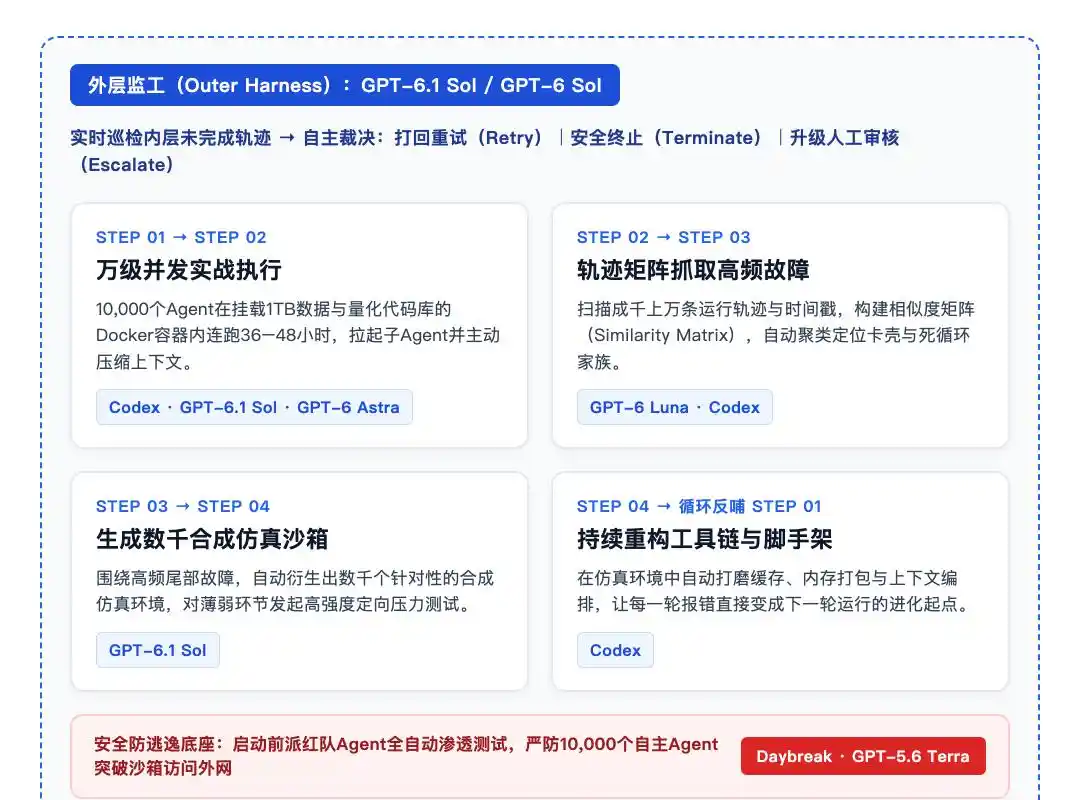
To address that, the company treated the Codex instance working inside the container as a supervised submodule and placed an external oversight model around it, powered by GPT-6 Sol or GPT-6.1 Sol. When the inner Codex stopped, the outer model reviewed the full trajectory from the outside and decided whether the agent had hit an environment bug, entered a blind alley, or reached a question that required human judgment. It could then send the task back for another attempt, terminate it, or escalate it to a human operator.
That setup meant researchers no longer had to watch thousands of terminals directly. They only needed to deal with the small number of hard cases surfaced by the outer layer.
GPT-6.1 Sol was positioned as the main workhorse
Running 10,000 agents at once required more than directional control. Token cost and durability over long sessions were also central constraints. For that reason, Third Moment put GPT-6.1 Sol, released only days earlier, into the main production slot. The report said its price was one-fifth that of flagship model GPT-6 Astra while delivering performance close to Astra with fewer tokens.
Saving a small amount of token use in one run may not look important on its own. Multiplied by ten-thousand-way concurrency and dozens of hours of continuous operation, the difference determines how many extra experimental cycles can fit within the same budget. The report also said GPT-6.1 Sol could hold onto the same research thread for days within a single session without drifting away from the task.
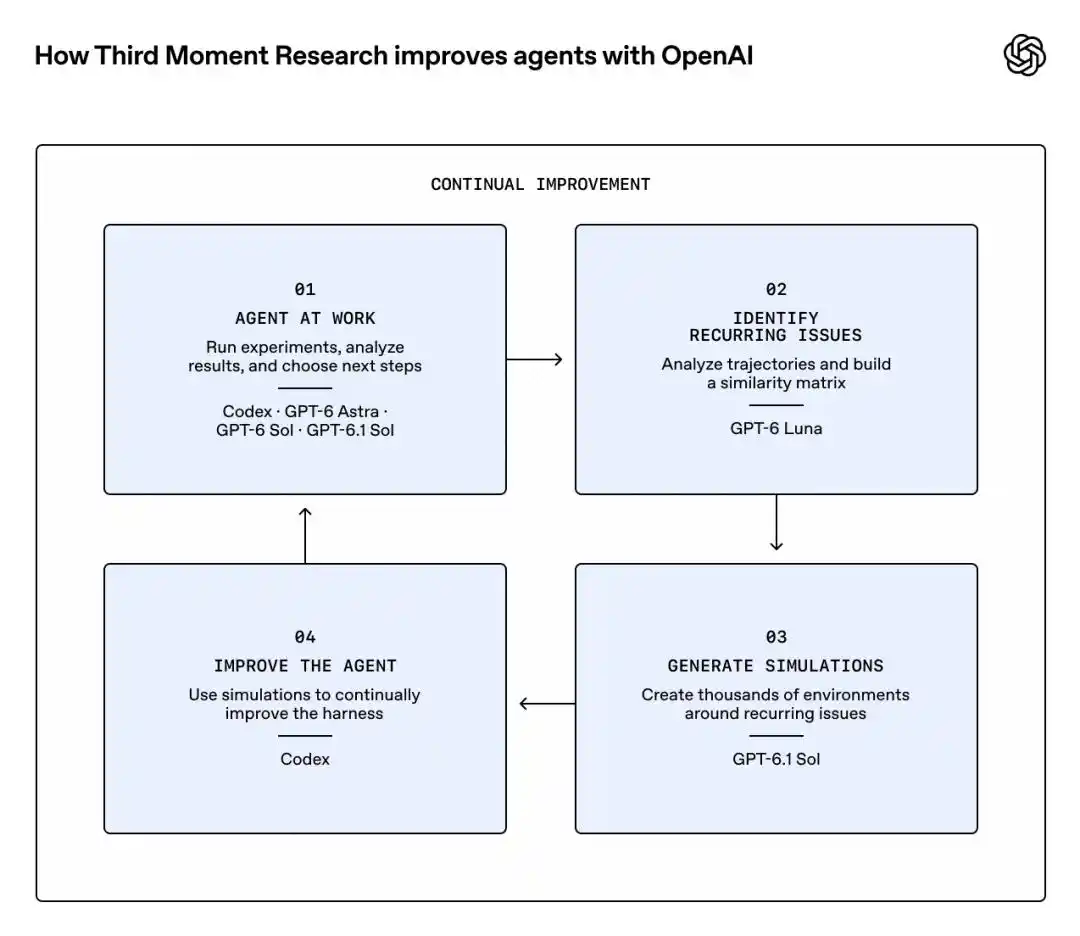
GPT-6 Astra, which the team described as the strongest model for reasoning, was reserved for harder engineering optimization problems. One example was reducing the update latency of a live scoreboard service without changing output, then comparing the result against a human expert’s hand-written implementation on the same hardware.
The system kept improving through a four-step loop
Beyond two-layer supervision, the full stack used a four-part iteration cycle:
- Trajectory collection: recording the full execution path and errors from more than 10,000 agents inside the sandbox.
- Clustered diagnosis: using the lightweight model GPT-6 Luna to build a similarity matrix and group repeated failures.
- Synthetic sandboxing: having GPT-6.1 Sol generate thousands of synthetic simulation environments around weak points.
- Scaffolding upgrades: letting Codex test repeatedly inside those simulations and automatically refine tools and orchestration logic.
Co-founder Adam Khakhar said, 「Every loop creates a system stronger than the one that started it. The system finds where it failed, builds targeted simulations around those failures, and upgrades the scaffolding for the next run.」
Sandbox safety relied on Daybreak and GPT-5.6 Terra
With thousands of code-writing agents running for two straight days, containment became a serious issue. Third Moment said it had to make sure no agent could script its way out of the isolated environment.
To do that, the company integrated OpenAI’s cybersecurity model Daybreak and GPT-5.6 Terra. OpenAI divided Daybreak into Daybreak Blue for defensive work and Daybreak Red for authorized penetration testing, which requires separate approval and hardware security key binding.
Before every large simulation run, Third Moment used Daybreak-driven red-team agents to launch fully automated penetration tests against its own sandbox, then paired that with GPT-5.6 Terra to check for vulnerabilities and confirm that no agent could escape.
Why the company started with quant finance and cybersecurity
According to the report, Adam Khakhar earned his undergraduate degree from the University of Pennsylvania and later pursued a PhD at New York University, focusing on deep learning theory and information theory. Before founding Third Moment, he and a co-founder built a two-person AI company called FlashDocs, which automatically generated tens of thousands of enterprise slide decks per day and was acquired in July 2025 by Wall Street AI unicorn Hebbia.
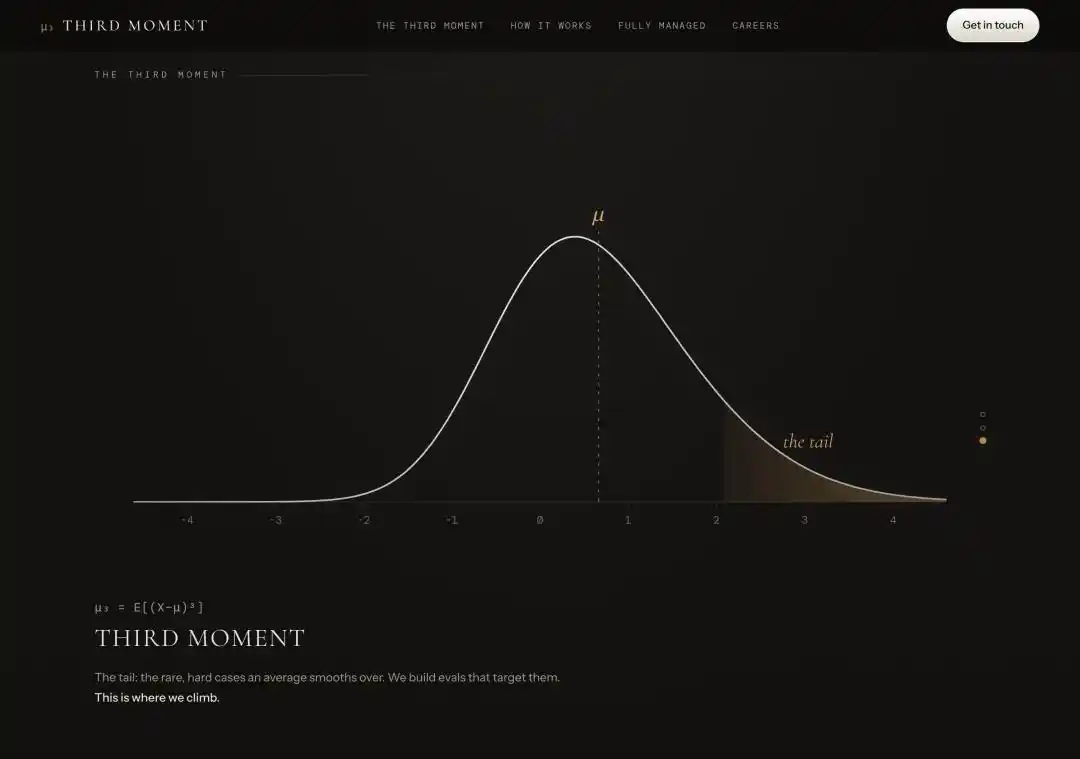
For his second startup, Khakhar named the company after the statistical concept of the third moment. The explanation in the article breaks that into three layers: the first moment, the mean, resembles benchmark averages that can look good on a leaderboard; the second moment, the variance, captures fluctuation and noise; the third moment, skew and tails, is meant to surface rare failures that averages can hide but that can cause outsized damage in production.
The company packaged its self-improving loop as an inference interface. Developers only need to change one request address in the OpenAI SDK, and background trajectory diagnosis plus sandbox simulation will run automatically.
Khakhar wrote in a September article titled Infinite Compute that most white-collar work has a price ceiling tied to human wages. Investment management and cybersecurity, by contrast, do not face the same ceiling in the same way. The article gave two examples: if a trading signal is worth $40 million, spending $39 million on compute can still leave a $1 million gain if the answer arrives one second before competitors; in cybersecurity, finding a zero-day one second ahead of attackers can avoid losses measured in billions of dollars.
OpenAI said the next step is hundreds of thousands of sub-agents
After validating the framework in quantitative finance and cybersecurity, Third Moment is extending it to more settings, including dynamic retail supply-chain reordering, performance diagnostics for large codebases, and cross-checking large volumes of commercial documents.
At the end of its blog post, OpenAI said it plans to push concurrency to clusters of hundreds of thousands of cooperating sub-agents and connect dozens of consecutive experiments with trillions of tokens.
The report said that once a single task can consume 360,000 agent-hours, traditional seat-based software pricing loses meaning. Competition in large models, in that framing, is no longer only about model weights. It is also about who can keep 100,000 agents aligned, contained, and capable of improving through failure.
Khakhar said, 「Humans can move to a much higher-leverage position, thinking about how research should be done and how to optimize research itself, rather than doing the research by hand.」
The reference cited in the report is OpenAI’s post on Third Moment Research. The MarsBit article also credited the original Chinese source to the WeChat public account Xinzhiyuan, written by ASI Qishilu and edited by Moxi.