

A Hacker News post from an anonymous user put a blunt question back into circulation: if AI models are already this capable, why doesn’t OpenAI just start 100 companies of its own? The user, ex-aws-dude, admitted the headline was exaggerated. The real question was narrower and sharper: if frontier models are now strong enough to do serious work, why is OpenAI still making money by selling tokens instead of building applications itself and capturing end-market profit?
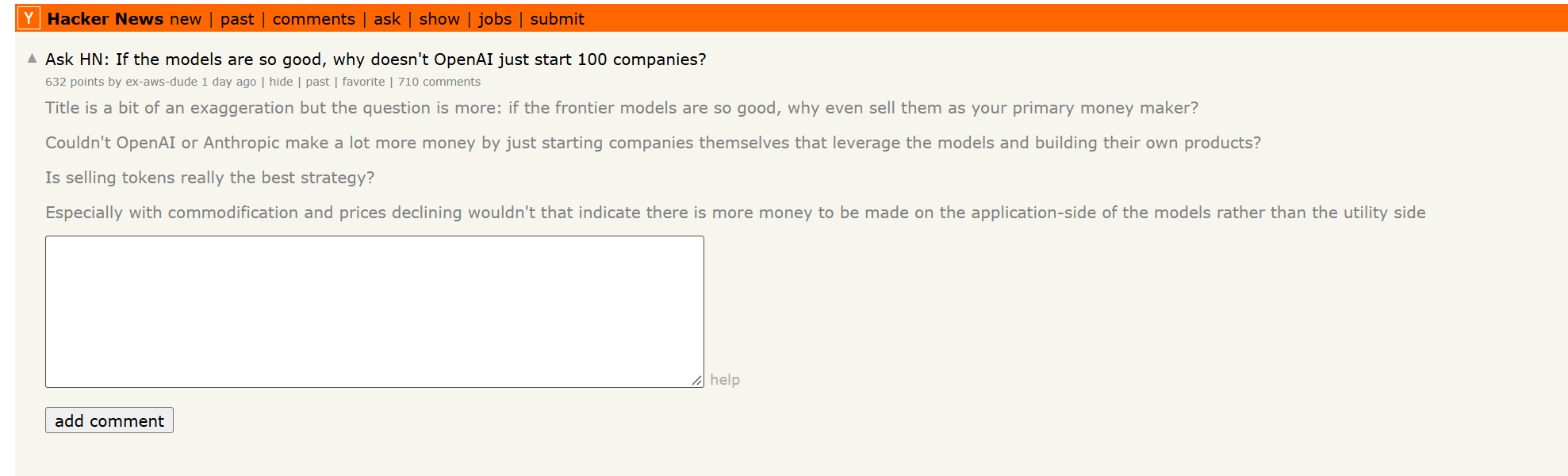
The comment thread split quickly. One side argued that models are already powerful enough to replace large amounts of labor and that the real profit pool sits at the application layer. The other side said running a company is much harder than writing good software and that AI still cannot do it. As the debate unfolded, both camps drifted toward the same conclusion: the issue is not only whether models are smart enough. It is whether anyone is willing to let them carry responsibility for outcomes.
Model capability is no longer an abstract claim
The article starts with benchmark data. OpenAI said GPT-5.5 scored 82.7% on Terminal-Bench 2.0, compared with 75.1% for GPT-5.4 and 69.4% for Claude Opus 4.7. On OSWorld-Verified, GPT-5.5 scored 78.7%, above the human baseline. GDPval was presented as another useful reference point: across 44 occupational tasks, GPT-5.5 reached or exceeded industry-expert level on 84.9% of them, up from 83.0% for GPT-5.4.
The piece then moves beyond benchmarks. At Goldman Sachs’ Communacopia conference in September 2026, OpenAI Chief Financial Officer Sarah Friar cited two enterprise customers. She said Canva’s code was "100% from OpenAI" and that the platform generates billions of images each week. She also said Travelers had expanded its AI claims assistant from eight states to nationwide coverage in two months.
Those examples are presented as evidence that the systems are no longer confined to lab demos. In the article’s framing, the models can already write production-grade code, handle structured professional tasks, and execute efficiently inside clearly defined boundaries.
The harder problem is judgment, not raw intelligence
Hacker News commenters, according to the article, converged on a fairly consistent view of what large models still lack: judgment and long-horizon autonomy. Judgment here does not mean filling in a known answer. It means deciding what to do when information is incomplete and the consequences are irreversible.
One user summarized the state of models in 2026 this way: they are good at executing ideas that have already been defined and bounded, but they do not see the whole picture and they lack foresight and creativity. That led to a more pointed restatement of the original question: if the models are so good, why can’t they run a company themselves?
The answer offered in the article is that running even one company is harder than the headline suggests. Success requires much more than writing good software. A business has to judge markets, manage cash flow, deal with regulation, handle customer complaints, and make bets under uncertainty. None of those tasks comes with a standard answer, and mistakes carry financial consequences.
That is the line the article keeps returning to. The boundary is not the intelligence task itself. It is who is accountable for the result.
Codex pricing changes reflect that boundary
OpenAI’s own product decisions are used as evidence. In April 2026, Codex moved from billing based on estimated messages to billing strictly aligned with API token usage. The change first covered Plus, Pro, and other individual and enterprise users, then expanded later in April to education, healthcare, government, and other channels.
OpenAI also introduced a Codex-only seat with no fixed monthly fee, billed purely by token usage and with no rate limits.
A third-party calculation of Codex credits found that one credit equaled $0.04, and that the Sol tier’s 750 credits mapped to $30 per million output tokens. The conclusion quoted in the article was that the pricing was "neither a discount nor a premium" and effectively prepaid the API price list.
In practical terms, the article says, Codex stopped looking like an all-you-can-eat subscription and started looking like a metered service. It cites one developer’s calculation: over the previous 30 days, he had consumed $1,199.79 worth of tokens through Claude Code and $980.37 through Codex, for a combined total of $2,180.16, while paying only $200 in subscription fees. Once billing moved to usage, the notional value of the same capability expanded by nearly 11x.
The article then flips the question around. If OpenAI were fully confident in the delivery reliability of its own models, charging per task or taking a share of outcomes should, in theory, be more lucrative. Instead, it moved in the opposite direction and pushed billing down to the finest possible unit: the token. Selling by token means selling compute and access to capability, not selling the result. What the customer does with that capability, and whether the project succeeds or fails, remains the customer’s risk.
A $40 billion token business
Friar said at the Goldman conference that OpenAI’s annualized revenue run rate passed about $40 billion in July 2026. More than half of that now comes from the enterprise side, meaning enterprise subscriptions plus API revenue. Her quote in the article was: "We started the year at 60/40, but enterprise acceleration far exceeded expectations, and the two lines have now crossed."
She also said total annualized revenue grew 20% month over month from June to July, while enterprise business grew 32% over the same period.
Third-party data was presented as a cross-check. Payments company Ramp said in its third-quarter 2026 report that enterprise spending on the OpenAI API rose 82% quarter over quarter, while spending on Anthropic rose 76%.
The pricing trend matters too. GPT-5.5 was priced at double GPT-5.4: input tokens rose from $2.5 to $5 per million, and output tokens rose from $15 to $30 per million. OpenAI’s explanation was that the newer model is smarter and more token-efficient, so it needs fewer tokens to complete the same task.
The article also points to an earlier example in the opposite direction. After the Luna model cut prices by as much as 80%, usage increased by about 10x. On a rough calculation, that implied revenue at about twice the pre-cut level. Unit price fell, but total volume rose more. Revenue increased rather than declined. The piece describes this as a version of the Jevons paradox in AI: higher efficiency and lower cost do not shrink the market. They expand it.
Friar added another usage statistic with a clear commercial implication. The top 10% of customers now consume eight times as many tokens per person per week as the average customer, up from three times previously. OpenAI employees consume 33 times as many as the average customer. Her view was that "how top customers use the product today is how ordinary customers will use it two years from now." If that holds, total token consumption still has room to grow.
Codex user numbers were also cited. The article says the product grew from about 100,000 users in January 2026 to about 25 million in September. OpenAI’s own estimate put average monthly consumption per developer at $100 to $200. Even taking the midpoint of $150 and multiplying it by 25 million users implies a very large annualized figure, though the article notes that actual paid conversion and average spend would necessarily come in below that ceiling.
Outcome-based pricing is still more ambition than reality
Friar also discussed a different pricing direction at the same event. She said enterprise customers increasingly want AI systems tailored to specific needs and that OpenAI "will price based on business outcomes rather than usage." She added that the industry should evaluate models by cost per task rather than cost per token, and cited third-party data saying Astra used 68% fewer tokens than competing frontier models to reach the same result.
Placed side by side, those remarks show both where OpenAI wants to go and where it still stands today. "Will price based on business outcomes" is future tense. Codex’s latest reform, by contrast, moved billing to the smallest token-level granularity.
Outcome-based pricing requires a model that can stand behind the result, or at least deliver measurable results with consistency. Travelers’ claims assistant expanding nationwide may look close to that standard, but it sits in an insurance-claims workflow where processes are highly standardized and judgment criteria are relatively clear. In most enterprise settings, even defining the outcome is difficult. Assigning responsibility when the outcome falls short is harder still.
The article also cites a comparison from the comment thread to Apple and the App Store. No company can be best at everything, one commenter argued, and selling tokens is "risk-free money" because the platform takes a cut from every application without taking on operating risk. The article says the analogy is imperfect: Apple takes a fixed share of transaction volume, while OpenAI sells compute consumption. Still, the underlying logic is similar. If the platform stays in a position where it does not own business outcomes, its revenue can rise with the aggregate volume of downstream applications.
Advertising is presented as another area of experimentation. Friar said OpenAI’s ad business reached a $1 billion run rate seven months after launch, making it the company’s "fastest product to reach $1 billion." It now spans 40 countries, with clients including WPP and Dentsu, though AI-native ad formats have not yet launched. Against a $40 billion revenue base, $1 billion is still small. But advertising is economically closer to paying for attention or conversion than paying for tokens, which puts it nearer to outcome-linked pricing. For now, the article treats it as a side flank rather than the core model.
One commenter also argued that current API pricing may still contain an element of venture subsidy, with positive gross margins at the inference layer but losses at the company level. If that view is correct, token pricing still does not reflect the full cost base, and OpenAI’s immediate priority would be to scale token revenue rather than gamble on a pricing model that has not yet been fully proven.
HubSpot is already testing pricing tied to results
The article closes by noting that some companies are already probing the other side of the line in narrower, easier-to-measure use cases. According to a HubSpot company release, starting in April 2026, HubSpot changed pricing for its Breeze Customer Agent from $1.00 per conversation to $0.50 per successfully resolved conversation. Its Breeze Prospecting Agent shifted to $1 for each lead recommended for outreach.
HubSpot Chief Customer Officer Jon Dick put the case plainly: "Businesses are being asked to make big bets on AI, but too often they are buying potential rather than performance. Outcome-based pricing removes that risk — you pay when it works, full stop."
Even so, the article stresses that this is happening in customer service and sales lead generation, where outcomes are relatively easy to measure. That remains a long way from asking AI to run a business on a customer’s behalf.
OpenAI is selling capability, not assuming the outcome
The article’s central conclusion is straightforward. The models are already strong enough to matter in production. They are strong enough for Canva to rely on OpenAI for all of its code, strong enough for Travelers to roll out an AI claims assistant nationwide in two months, and strong enough for GPT-5.5 to match or exceed industry experts on 84.9% of 44 occupational tasks.
But there is still a layer between being strong and being able to run a company: judgment under uncertainty, commitment to outcomes, and responsibility for failure.
Selling models by token is, in that sense, a safer line. OpenAI stands on one side of it and provides capability. Customers stand on the other side and absorb the risk. The article argues that the current numbers — about $40 billion in annualized revenue, 82% quarter-over-quarter growth in API spending, and roughly 25 million Codex users — show that the line is drawn in a commercially effective place. Friar’s talk of pricing based on business outcomes describes where that line may move in the future. Codex’s shift to token billing shows where it still is today.



