


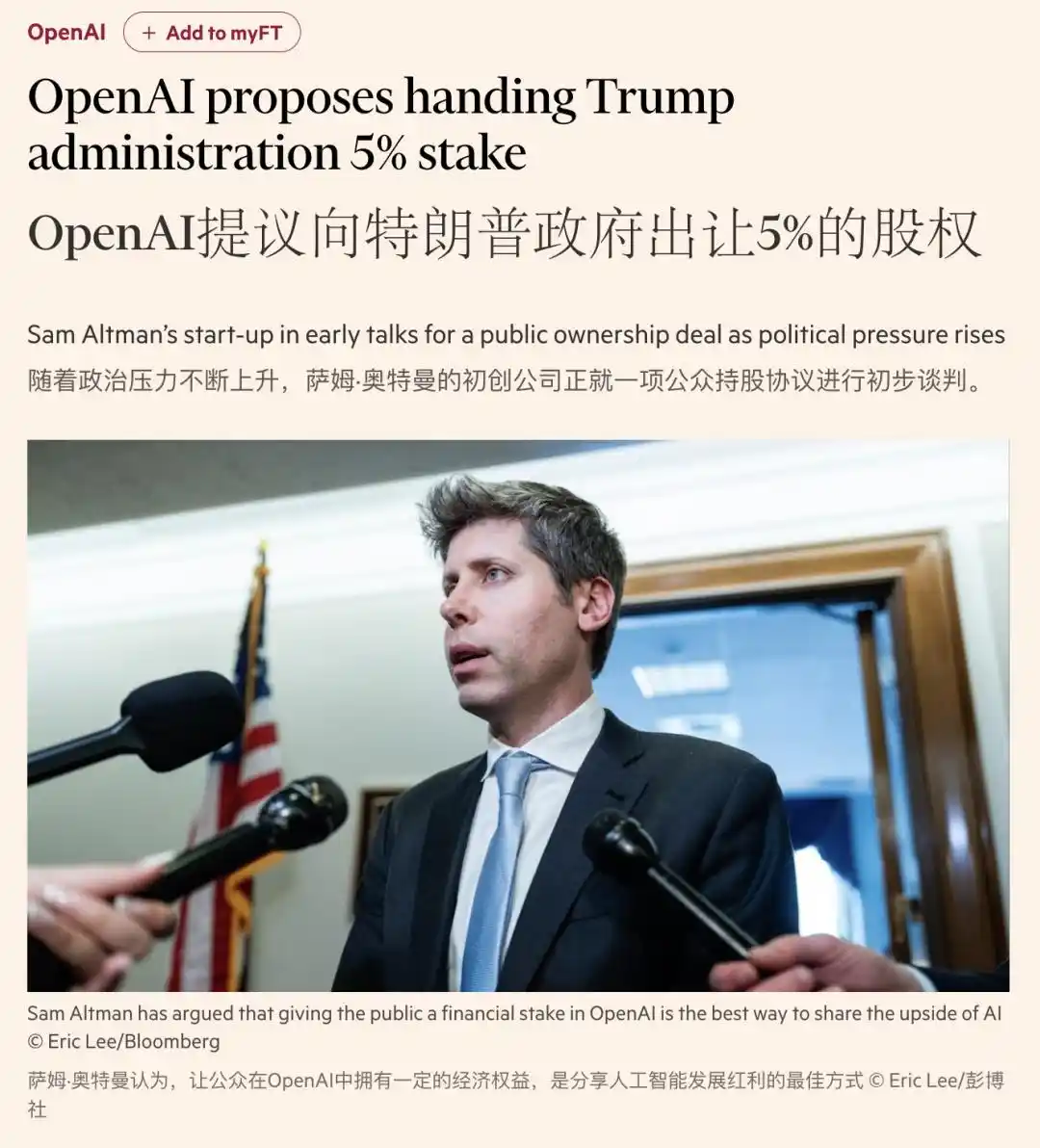
OpenAI opens early discussions with Washington over a 5% equity transfer
OpenAI has reportedly begun preliminary talks with the U.S. government about transferring 5% of the company’s equity, according to the Financial Times. Based on the company’s current valuation of roughly $852 billion, the proposed stake would be worth about $42.6 billion. The discussions are still described as conceptual, and any eventual transaction would likely require congressional action before it could be implemented.

The proposal is closely associated with CEO Sam Altman, whose central argument is that the public should have a direct economic claim on the upside created by artificial intelligence. Rather than responding to rising scrutiny with policy concessions alone, OpenAI appears to be exploring whether equity sharing could help stabilize its relationship with Washington and reframe the political debate around AI development.
The idea extends beyond OpenAI and could include other U.S. AI leaders
The reported framework is not limited to OpenAI itself. Altman has also suggested that other major American AI companies, including Anthropic, Google, and Meta, contribute the same proportion of equity to a shared public investment vehicle. The concept draws on the model of the Alaska Permanent Fund, which invests state resource revenue and distributes benefits to the public.

Under Altman’s vision, a similar structure could hold AI company shares on behalf of the government and the broader population, allowing ordinary Americans to benefit from AI-driven growth even if they have never participated in the stock market directly. The proposal has reportedly been discussed with senior U.S. officials, including Commerce Secretary Howard Lutnick and Treasury Secretary Scott Bessent.
At the same time, there is no indication that other major AI firms have shown interest in participating. That remains one of the biggest obstacles to execution. Any structure that depends on multiple direct competitors voluntarily giving up ownership on similar terms would face obvious political, legal, and strategic challenges.

A 5% proposal stands in sharp contrast to more aggressive public-ownership plans
The debate over public ownership in AI is not limited to OpenAI’s reported proposal. The report notes that Senator Bernie Sanders has also recently discussed the issue with Altman, but from a much more interventionist position. Sanders is said to favor a sovereign wealth fund model through which the public would own close to half of major U.S. AI companies.
The difference between 5% and 50% reflects two fundamentally different approaches. OpenAI’s reported plan would allow the public and the government to participate in AI wealth creation while leaving control firmly with corporate management and existing shareholders. A far larger public stake, by contrast, would give citizens a more direct governance role and potentially alter the balance of power inside the companies building frontier models.
OpenAI’s own prior policy language suggests that the company has already been thinking about broader public-benefit mechanisms. In April, OpenAI proposed a “public wealth fund” so that every citizen, including those without financial market exposure, could benefit from AI-led economic growth. In May, the OpenAI Foundation went further, saying society may need new mechanisms to give people lasting ownership and a meaningful voice in systems that create value.

Rising regulatory pressure appears to be a key driver behind the proposal
The timing of the reported proposal is notable because the U.S. AI sector is facing increasing political and regulatory pressure. According to the report, OpenAI and Anthropic have both recently faced delays tied to government review of frontier model releases, including GPT-5.6, Mythos 5, and Fable 5. Concerns over large-scale data center buildouts, labor disruption, and cybersecurity risks have also intensified across Washington.
Some lawmakers and White House advisers have already signaled support for tighter oversight of the AI industry. In that context, a government equity stake could be seen not only as a symbolic gesture, but as a strategic attempt to reshape incentives. If regulators and policymakers are also beneficiaries of the industry’s upside, the relationship between AI firms and the state could become structurally more cooperative, even if not less complicated.
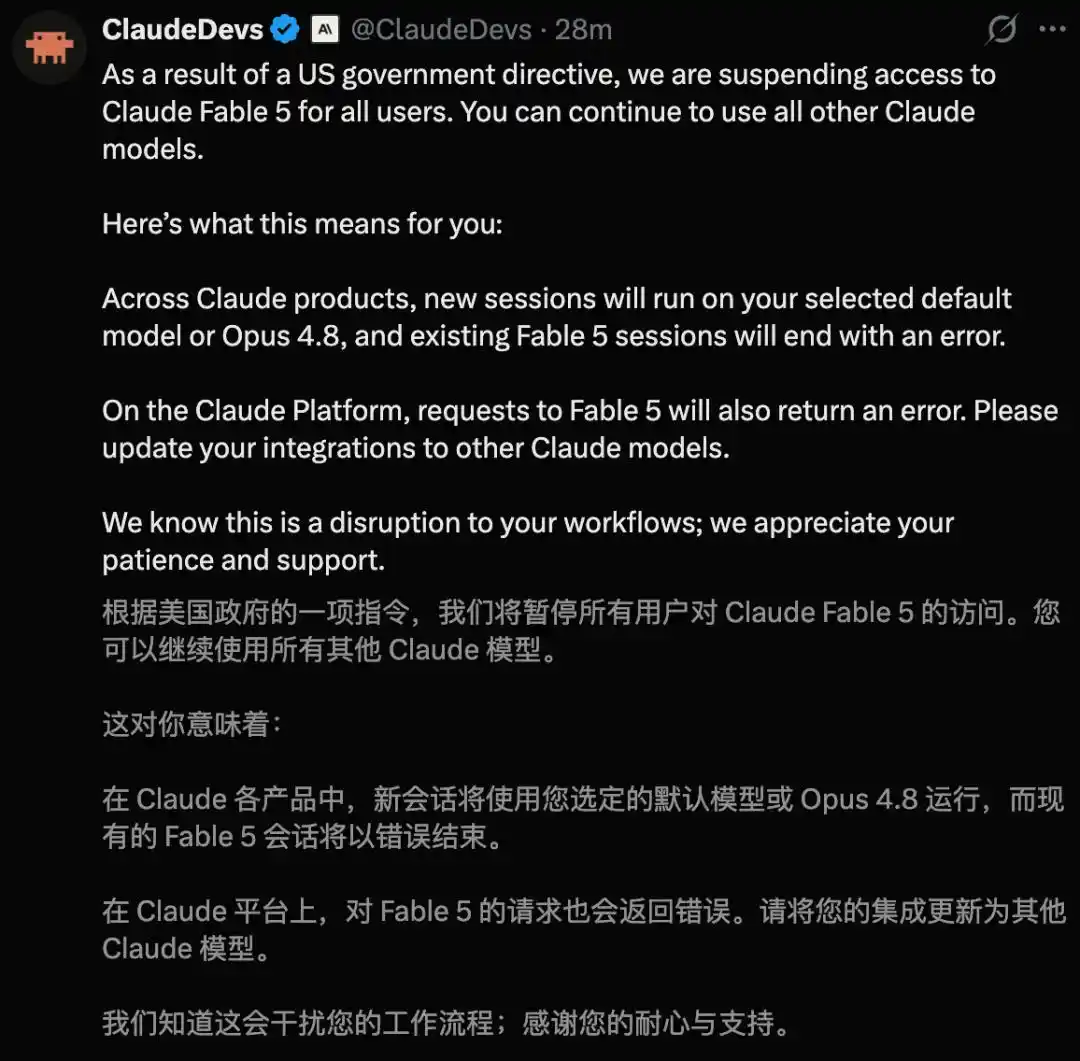
The report also points to Intel as a relevant precedent. After the U.S. government took a roughly 10% stake in the chipmaker, Washington’s posture toward the company reportedly became more supportive. For OpenAI, that example may reinforce the case for using equity as a tool to secure political alignment before any future public listing.
The issue now goes beyond regulation to the question of state ownership in AI
The implications extend well beyond balance sheets. OpenAI, Anthropic, and Google DeepMind are all competing to build increasingly advanced AI systems, with AGI remaining the industry’s most consequential long-term objective. Each major model release raises harder questions about safety testing, deployment timing, data governance, and export controls. If governments become shareholders, their influence could move from external oversight to more institutionalized involvement.

In the short term, a 5% equity transfer could help companies answer criticism about concentrated AI profits while easing some of the political pressure surrounding frontier development. But the broader debate is unlikely to stop there. Sanders’ push for much larger public ownership already shows that once the idea of government participation enters the mainstream, the argument quickly shifts from whether the state should own a stake to how much it should own.
For now, the proposal remains at a very early stage and may never be formalized. Even so, it marks a notable shift in the U.S. AI policy conversation. The central question is no longer only whether AI should be regulated more aggressively. It is increasingly whether the government itself should become a shareholder in the companies shaping the future of advanced intelligence.