
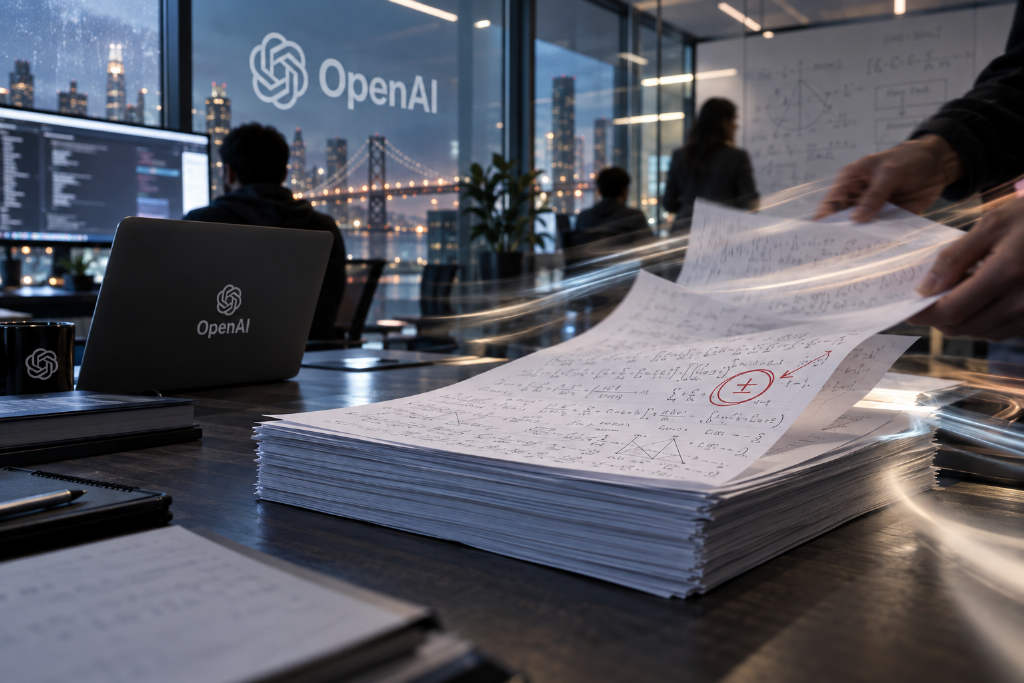
OpenAI released a batch of mathematics manuscripts generated by an internal unreleased model on GitHub on Oct. 6, then withdrew three of them the next day. According to the project’s update log, a sign error in one paper broke a key argument, which in turn invalidated two other papers that relied on the same construction.
One sign error led to three withdrawals
The paper at the center of the issue was “Algebraicity of Weil classes on split abelian eightfolds.” OpenAI said the sign error caused a stabilization-and-trace-cancellation argument to fail, and that two other papers used the same construction.
Those two papers were “Algebraicity of Kuga–Satake Correspondences for K3 Surfaces” and “The rational Hodge conjecture for products of K3 surfaces,” the latter dealing with the rational Hodge conjecture for products of K3 surfaces. The withdrawn paper pages now carry notices describing the gap and link to archived versions.
Fourteen other manuscripts were revised the same day
OpenAI also revised 14 other manuscripts that day. The changes included proof repairs, corrected propositions, and clearer statements of assumptions and dependencies. It also updated cited versions referenced by 13 papers.
At the same time, OpenAI added six new Lean formalizations. Lean is a programming language that lets a computer verify a proof step by step. Of the 719 manuscripts in the project, 300 now have their main results formalized, or about 42%.
OpenAI researcher Dan Roberts said on X that more formalized proofs would be added later, along with updates for newly discovered errata.
About 4,000 problems produced 719 manuscripts
According to the project description, the manuscripts came from OpenAI’s effort to evaluate its internal models on open research problems. The company said it took that route because performance on existing math benchmarks had already saturated.
OpenAI said most results were produced through the same pipeline, with each result using an average of three hours of ChatGPT Pro thinking compute. During the evaluation process, the model was given about 4,000 problems. The outputs were then organized by significance into 372 series and 719 manuscripts.
OpenAI also said not every result has a Lean proof, adding that “some non-formalized results may have issues.”
Release drew criticism from mathematicians
The manuscript dump also triggered criticism from parts of the mathematics community. The Association for Human Mathematics published a statement on Oct. 7, and Fields Medalist Terence Tao later reposted it on his personal blog as a guest article.
The statement was signed by the association’s communications working group. It said mathematicians had not asked for this release and criticized OpenAI’s claim that it had legitimacy from a “Mathematics and AI Advisory Group,” noting that the opening of that group’s first statement said frontier AI companies should not use internal models to test difficult problems in higher mathematics.
The statement said, “We reject OpenAI’s claim that this release advanced the field, and call on mathematicians and the public to view this publication model with appropriate skepticism.” It also said, “Releasing more than 700 files at once is not a display of scholarship, but a display of power,” and called on mathematicians to stop working with OpenAI.
Tao noted at the top of the post that it was a guest article from the association. Some commenters also said the group’s position should not be treated as Tao’s personal view.