
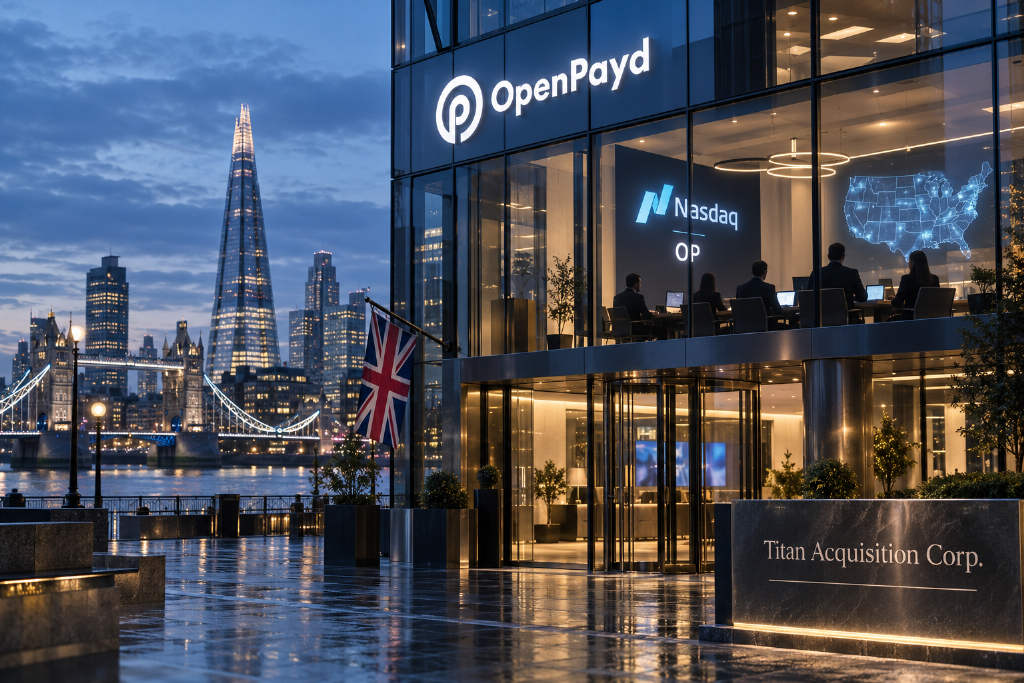
OpenPayd expects to complete its Nasdaq listing by the end of the year as it moves toward a U.S. market entry and weighs more acquisitions, CEO Iana Dimitrova told CoinDesk. The payments infrastructure company plans to go public through a merger with Titan Acquisition Corp., a transaction Dimitrova said is now in the final stage of review by the U.S. Securities and Exchange Commission.
She said the deal is still expected to close this year unless a major external disruption emerges. Before that can happen, the registration statement must become effective and Titan shareholders must approve the transaction, among other closing conditions. If completed, OpenPayd would trade under the ticker OP.
Dimitrova said the listing would help fund the company’s U.S. expansion. OpenPayd is preparing to launch its infrastructure for U.S. customers by April 2027, and it took a step toward that goal last month by bringing MSB USA Inc. and its 43 state money transmitter licenses into the OpenPayd group.
U.S. rules are opening a market for crypto-linked payments infrastructure
The U.S. has become a more attractive market for crypto companies as rules for digital assets and stablecoins continue to take shape. The GENIUS Act created a federal framework for payment stablecoins, and the SEC has proposed rules designed for some crypto assets. For companies such as OpenPayd, that creates room to sell payments infrastructure to businesses connecting traditional finance with blockchain networks, even though broader market-structure legislation is still unresolved.
Crypto firms are not all taking the same route to public markets. Stablecoin payments company RedotPay is continuing with preparations for a U.S. initial public offering after recently completing a financial audit. Others are holding back. CoinDesk previously reported that Payward, the parent company of crypto exchange Kraken, has pushed any listing to the second quarter of 2027 at the earliest.
Dimitrova said delays in U.S. digital-asset market-structure legislation were a setback, but not one that changed OpenPayd’s decision to expand there. She said the company sees opportunities in both cross-border payments and stablecoin services.
Business lines, clients and financial results
OpenPayd has integrated with Circle Payments Network for cross-border payments and has joined Fireblocks’ payments network, allowing other participants in that network to access its fiat infrastructure.
Dimitrova described the company as a 「global infrastructure platform for modern money movement」 and said 「there is no public market competitor that has the same combination of fiat and stablecoin capabilities that OpenPayd can deliver today.」
OpenPayd offers businesses access to accounts, foreign exchange, and domestic and international payments, along with infrastructure that moves funds between traditional currencies and stablecoins. Companies using its payments infrastructure include crypto exchange Kraken, market maker B2C2 and trading platform OKX.
According to an investor presentation, OpenPayd reported $73 million in revenue for the year ended April 30, 2026, up from $57 million a year earlier. It also reported $13 million in EBITDA and a net loss of $2.8 million for the latest year.
A company spokesperson said in emailed comments that the entire $2.8 million net loss was attributable to $5.8 million in one-time transaction costs related to the proposed business combination.
Listing proceeds and stock could support acquisition strategy
Dimitrova said acquisitions may take on a larger role as OpenPayd enters new markets. The company is interested in businesses that would add licenses or technology and allow it to launch faster than if it built those capabilities internally from scratch.
She said a listing would give OpenPayd access to capital as well as publicly traded shares that could be used in deals and partnerships. The company is also considering a private placement ahead of the merger to secure funding for its growth plans.
Under the announced terms of the Titan transaction, OpenPayd’s implied pro forma equity value could reach $1.1 billion.
Dimitrova said, 「Few markets can match the energy and ambition of the U.S. We want to harness that momentum to take OpenPayd from European success to global scale.」