

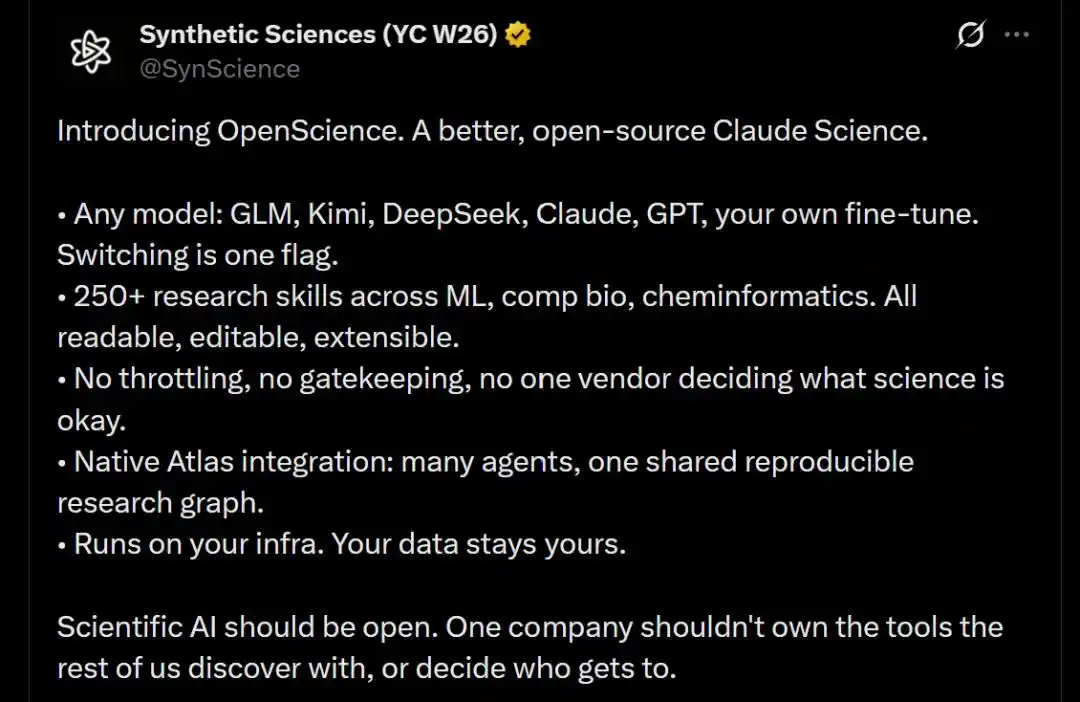
Open-source project OpenScience has been launched as a direct alternative to Anthropic's Claude Science less than a week after the latter was introduced. Built by YC-backed team Synthetic Sciences, the platform targets scientific research workflows and aims to cover the same end-to-end process, including literature retrieval, hypothesis generation, coding experiments and paper drafting, while avoiding dependence on any single model vendor. According to the project description, users can switch freely among DeepSeek, GLM, Claude, GPT and other supported models inside the same workbench.
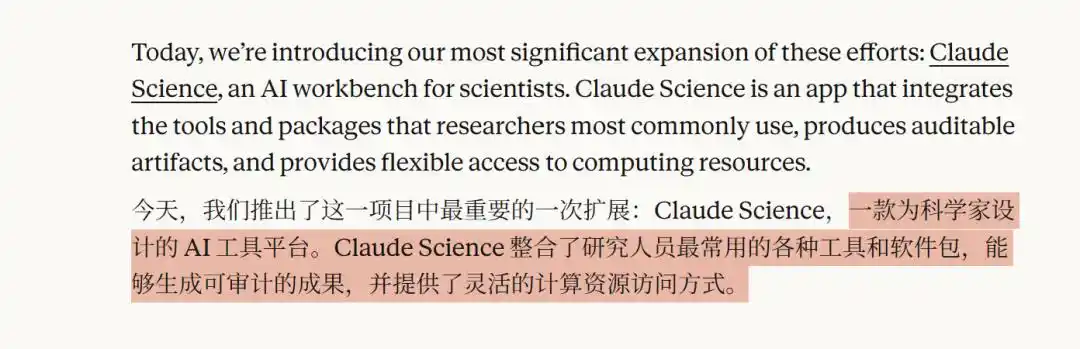
Claude Science, which Anthropic recently introduced for researchers, is designed to consolidate fragmented scientific tooling into one interface. Instead of moving across PubMed, Jupyter, R environments, remote clusters and writing tools, researchers can work from a unified platform. Anthropic said the product includes more than 60 scientific database connectors and preconfigured skill packages spanning genomics, single-cell analysis, proteomics, structural biology and cheminformatics. It also integrates Nvidia's BioNeMo Agent Toolkit, enabling access to life sciences models such as Evo 2, Boltz-2 and OpenFold3.
Claude Science combines scientific databases, agents and compute access
At the execution layer, Claude Science uses a multi-agent setup. A primary agent handles planning, specialized sub-agents process tasks in parallel, and a Reviewer Agent performs fact checking, citation verification, calculation validation and error flagging. Anthropic says the platform can natively render outputs beyond plain text, including 3D protein structures, genome browser tracks and chemical structure diagrams. Each output is paired with the underlying code, runtime environment, natural-language explanation and full conversation history.
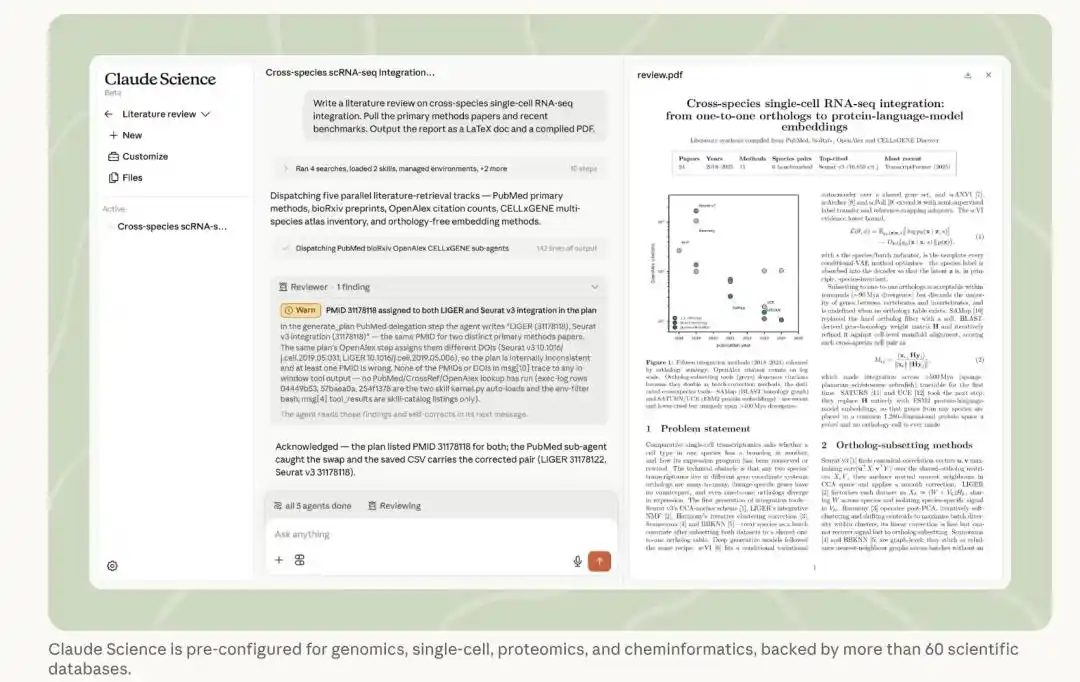
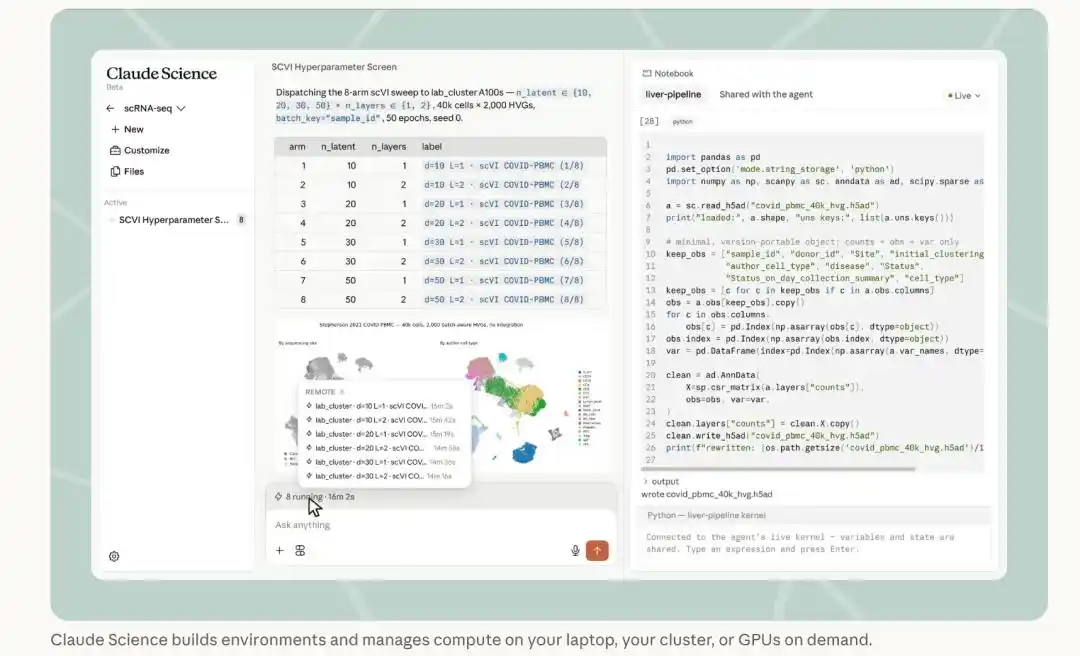
The system also supports direct editing of charts and figures through natural-language instructions, automatically updating the underlying code. On the infrastructure side, Claude Science can connect to laptops, Linux servers and HPC cluster login nodes, while also scaling cloud GPU usage through SSH or Modal accounts. Anthropic says large datasets only need to be loaded once, and sensitive data can remain inside a lab's own systems, with only the required context sent to Claude for each step.
Early users have already reported concrete use cases. Allen Institute neuroscientist Jérôme Lecoq said he built a multi-agent “computational review template” with around 20 custom skills, allowing sub-agents to read thousands of papers, extract key claims and quantitative results, and generate review sections chapter by chapter. UCSF Brain Tumor Center researcher Stephen Francis used the platform for molecular epidemiology work on glioma and germline variant analysis, saying the process was reduced to roughly one-tenth of the original time while remaining reliable under independent team validation.
Anthropic has also framed the current research capability of Claude as roughly equivalent to a second-year graduate student, echoing comments previously published by Harvard physicist Matthew Schwartz in a guest post on the company's blog. That positioning has since been incorporated into Claude Science documentation as a rough benchmark for how much supervision the system still requires.
Usage barriers created an opening for open-source competitors
Despite its capabilities, Claude Science currently comes with several access constraints. It only supports macOS and Linux, is limited to paid Pro, Max, Team and Enterprise users, and can only run Anthropic's own models within the platform. For many research teams, especially those outside the US ecosystem, those restrictions significantly narrow practical availability.

That gap is where OpenScience is trying to compete. Synthetic Sciences, the team behind the project, was founded in San Francisco in 2025 and graduated from YC's Winter 2026 batch. The company says its broader goal is to build an “AI co-scientist” platform capable of handling the full research loop, from literature review and hypothesis generation to experiment execution and manuscript writing. Its thesis is that scientific foundation models need genuine “research taste,” which cannot be achieved by scaling parameters alone and instead requires product-driven collection of high-quality research process data.
OpenScience is the first product built around that strategy. Its most important distinction from Claude Science is that it is explicitly model-agnostic. The project says users can plug in APIs from Anthropic, OpenAI, Google, DeepSeek, GLM and other providers as long as they have valid API keys. It also supports local models through Ollama, which means research data can stay on the user's machine rather than being sent to external services.
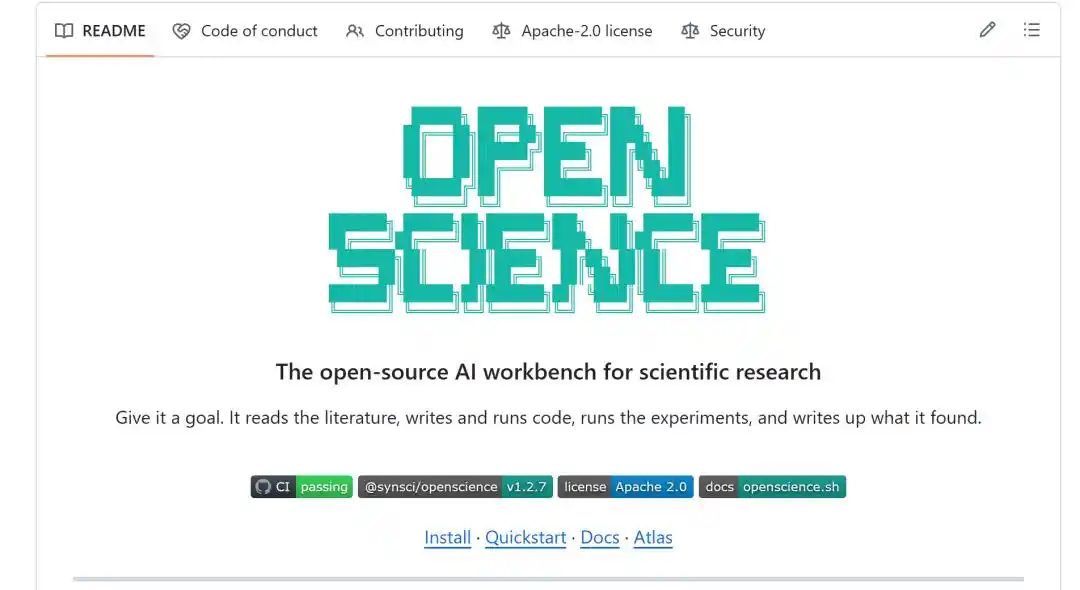
OpenScience emphasizes switching flexibility, local control and open licensing
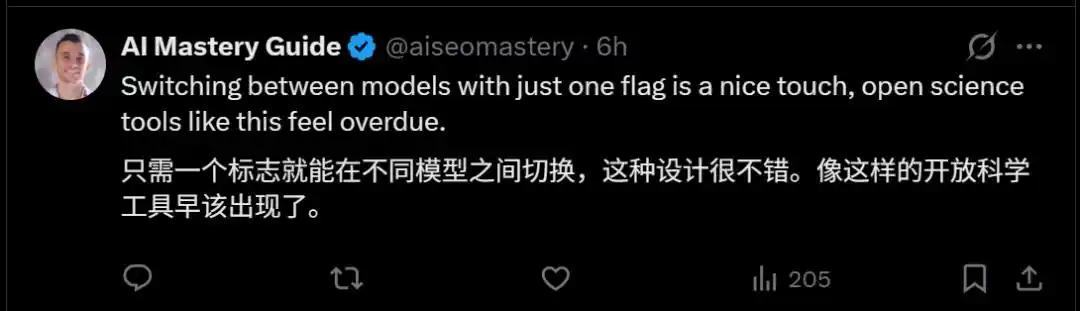
The team says API keys remain local and requests are sent directly to model providers instead of routing through an intermediate server. OpenScience also supports model switching on a per-request basis. In practice, that means one step in a workflow could use Claude while the next could run on DeepSeek or another model, without reconfiguring the environment. That design gives researchers more flexibility in balancing cost, speed, privacy and model specialization across tasks.
Feature-wise, OpenScience claims to be more aggressive in breadth than Claude Science. The project includes more than 250 research skill packages, over four times the number cited for Claude Science, covering machine learning, computational biology, cheminformatics and related fields. Those skills are also described as fully readable, editable and extensible, making them suitable for teams that want to customize workflows rather than rely on fixed vendor-managed tooling.
Installation is another core part of the pitch. OpenScience is released under the Apache 2.0 license and can reportedly be installed with a single terminal command, after which the workbench opens automatically in a browser. On first run, users choose a model source, enter an API key and begin working. For those who prefer not to manage multiple keys themselves, Synthetic Sciences also offers a hosted platform called Atlas, which supports wallet-based access to multiple frontier models, persistent research graphs and cloud compute.
However, Atlas is optional rather than required. The team says OpenScience can be used for free with a user's own keys, preserving the project's low-barrier positioning. That matters because one of the main complaints around Claude Science is not only capability access, but also vendor lock-in and pricing-linked availability.
OpenScience's GitHub page also includes an explicit disclaimer stating that the project is independent and is not affiliated with, endorsed by or sponsored by Anthropic, and that references to “Claude” are used solely to describe compatibility. The wording underscores the legal and branding caution that often accompanies open-source projects attempting to position themselves near proprietary products.
The broader significance is that scientific AI tooling is moving quickly from model demos toward integrated workbench competition. Claude Science entered the market as a vertically packaged platform for researchers. OpenScience responded almost immediately with an open-source, model-flexible and locally controlled alternative. For research institutions, labs and developers, the competition is no longer just about which model is strongest. It is increasingly about who controls the workflow, where the data lives and how easily infrastructure can be adapted to real-world research environments.