

OpenUSD, a new dollar-backed stablecoin launched on June 30 by the Open Standard alliance, has put fresh pressure on Circle’s business model by challenging the way reserve income is split across the stablecoin stack. The alliance includes more than 140 payment companies and banks, among them Stripe, BlackRock and Coinbase. Its pitch is straightforward: instead of letting one issuer retain most of the interest generated by reserves, OpenUSD sends nearly all of that income to the partner network.
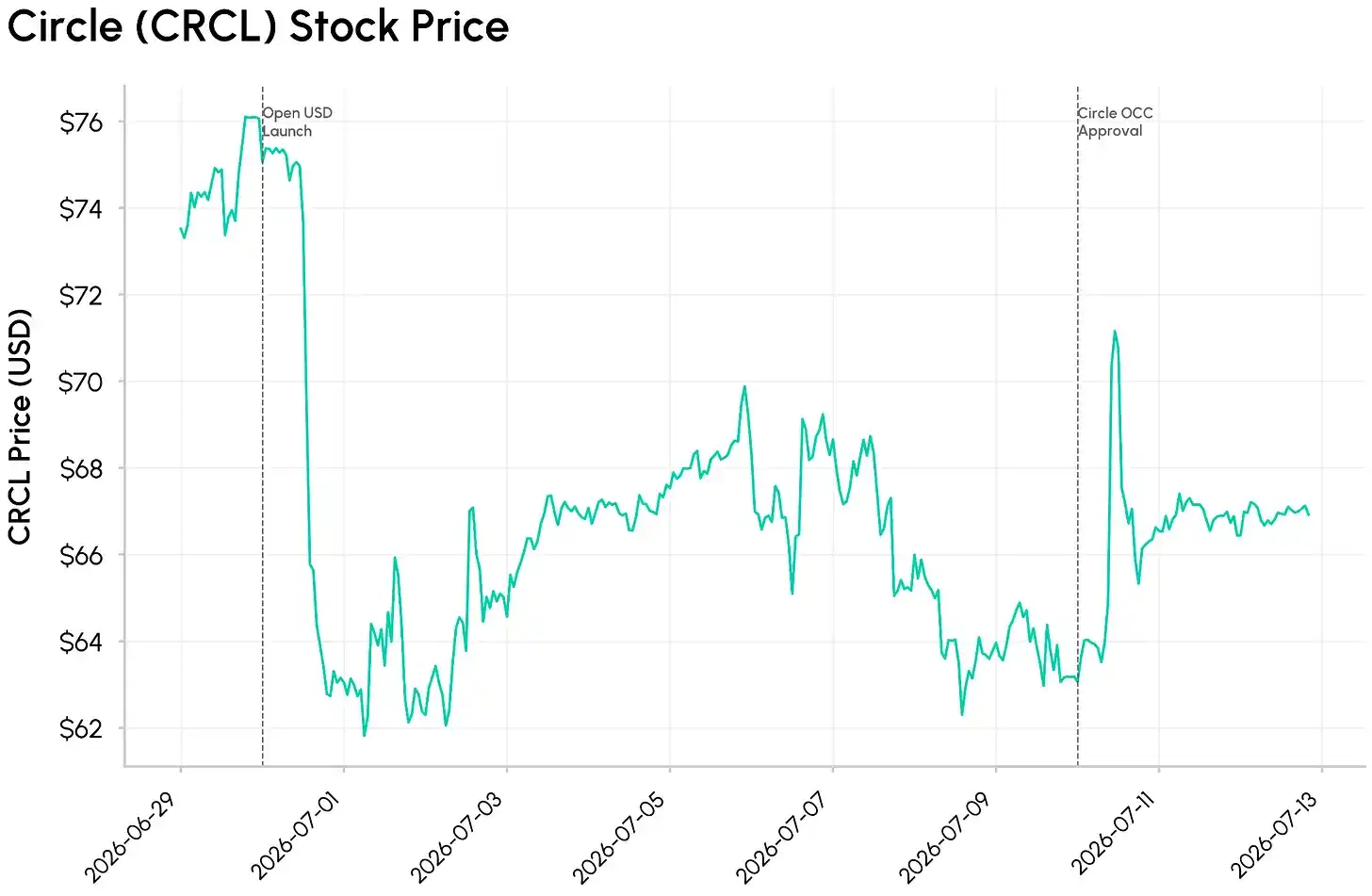
That announcement hit Circle’s stock immediately. CRCL fell 17% on June 30. The reaction was tied less to the arrival of one more stablecoin and more to what OpenUSD represents: a direct challenge to the traditional issuance model in which reserve revenue largely sits with the issuer.
OpenUSD is attacking margins, not necessarily USDC supply
The source article frames OpenUSD as a challenge to Circle’s margins before anything else. The key issue is who captures the float, meaning the interest earned on stablecoin reserves.
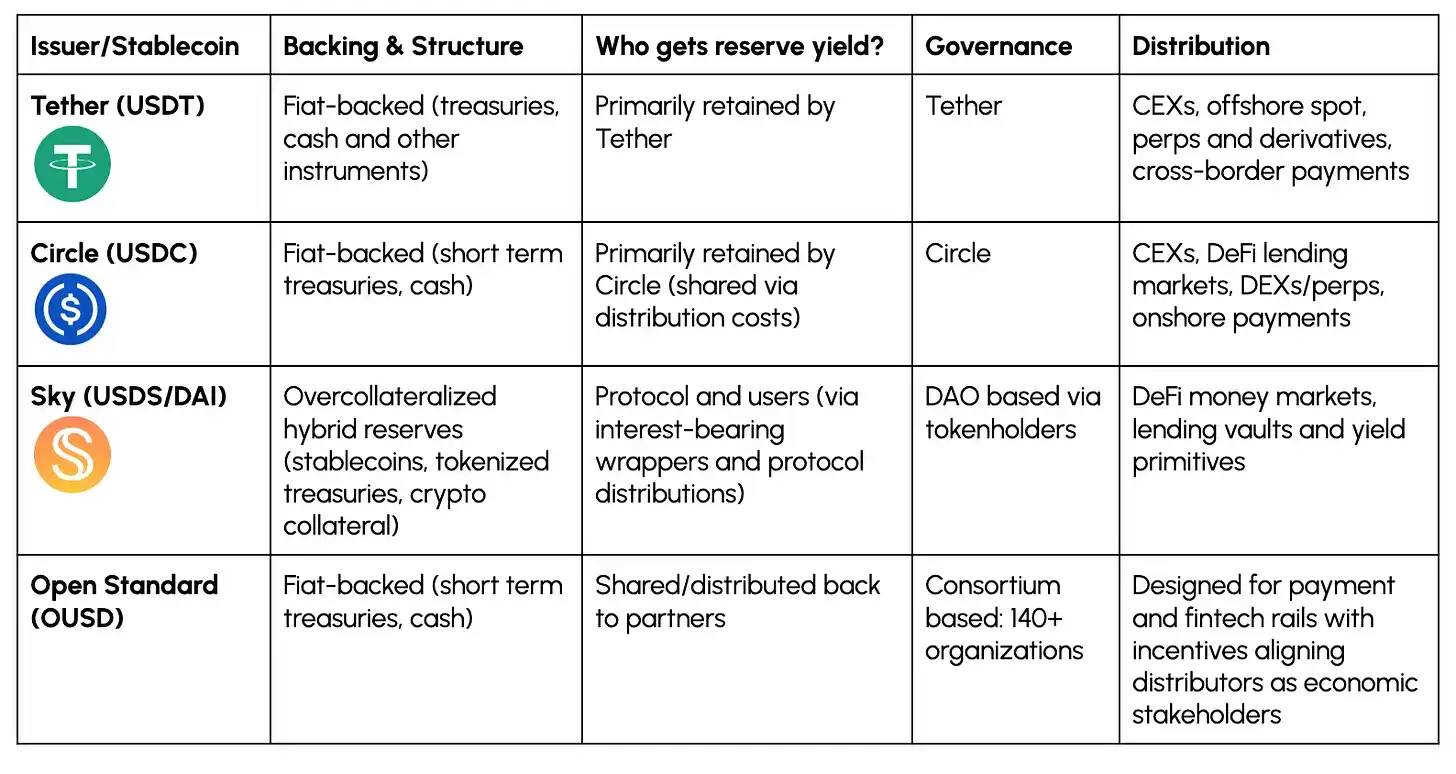
For issuers such as Tether and Circle, reserve income has historically driven most of the business. Sky and Ethena push more value to users. OpenUSD introduces a third structure: it routes reserve income to the distribution network itself, including fintech apps, exchanges, wallets, merchants and payment processors that control end-user access.
That distinction matters because distribution has become one of the central competitive variables in stablecoins. Circle’s current structure already includes revenue sharing with major partners, most notably Coinbase. OpenUSD bakes that logic into the model from the start.
According to the figures cited in the piece, Circle generated $2.7 billion in revenue in fiscal 2025, and 96% of that came from reserve income. A large share of those economics is already passed through to partners such as Coinbase as distribution cost. After those payments, Circle’s revenue net of distribution costs, or RDLC, stood at about $1.08 billion. The article uses that figure to show how much value Circle actually keeps once distribution is paid for.
The broader question is whether economic power in stablecoins is shifting away from issuers and toward the networks that own user distribution.
USDC still has a large installed network effect
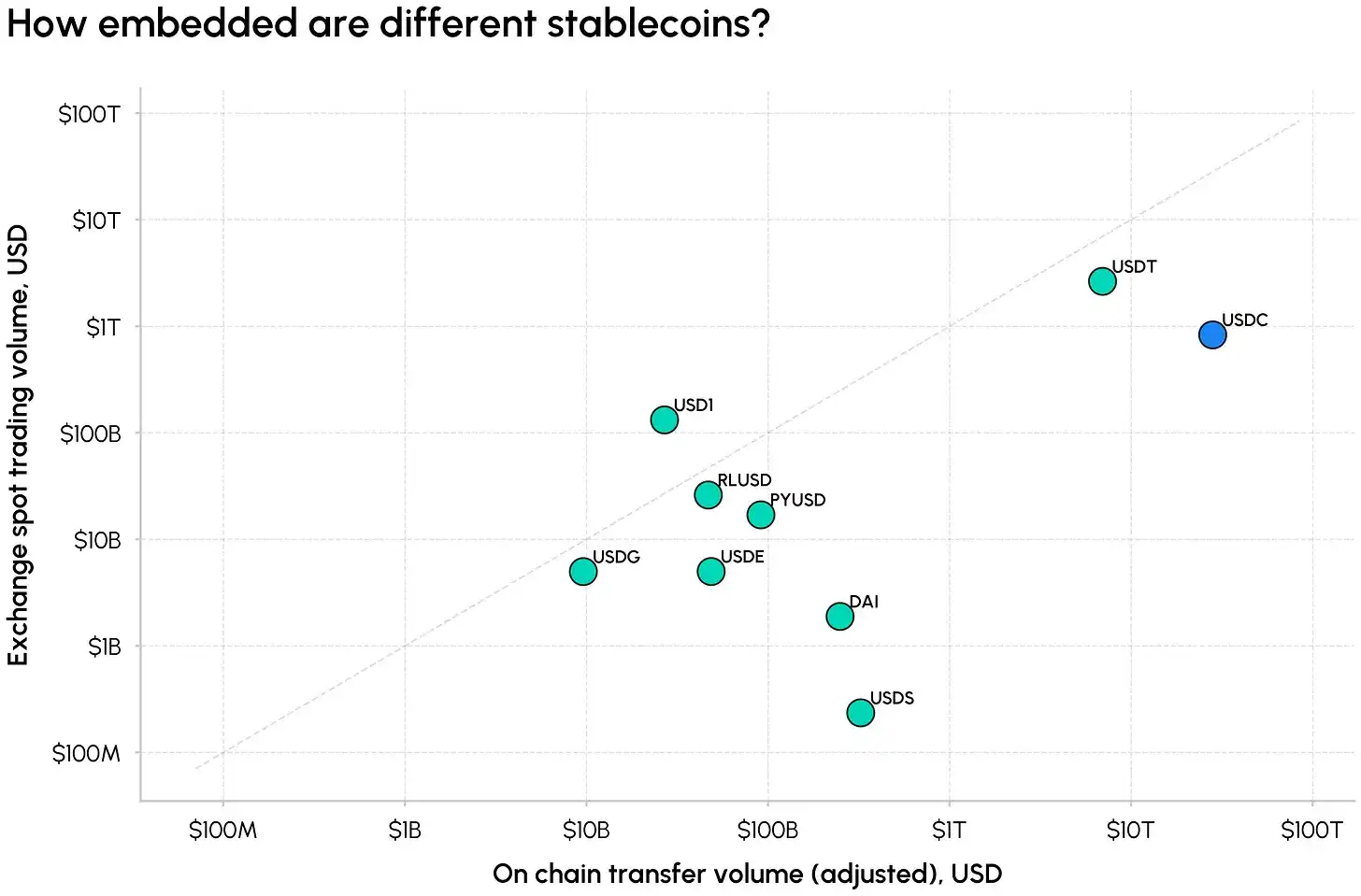
Even after a wave of new entrants, the stablecoin market remains heavily concentrated. USDT and USDC together account for about 86% of the market, the article says. USDC alone makes up roughly 23%, with a market capitalization of $73 billion. That position did not emerge overnight. It rests on deep liquidity, a more favorable regulatory profile and broad coverage across chains and trading venues.
A chart referenced in the piece compares stablecoins by adjusted onchain transfer volume and exchange trading volume as of June 2026. USDT and USDC stand apart for both settlement usage and trading activity. USDS, USDe and PYUSD occupy more niche positions, while Global Dollar, or USDG, another consortium-style stablecoin, has so far failed to gain similar traction.
USDC also dominates transfer settlement. In the first half of 2026, it settled about 79% of roughly $38 trillion in adjusted onchain transfer volume. Base accounted for 69% of that total. USDT settled about $7 trillion, or around 18%. The article argues that this points to a higher velocity for USDC even though its outstanding supply is smaller than USDT’s.
Where USDC sits in the market
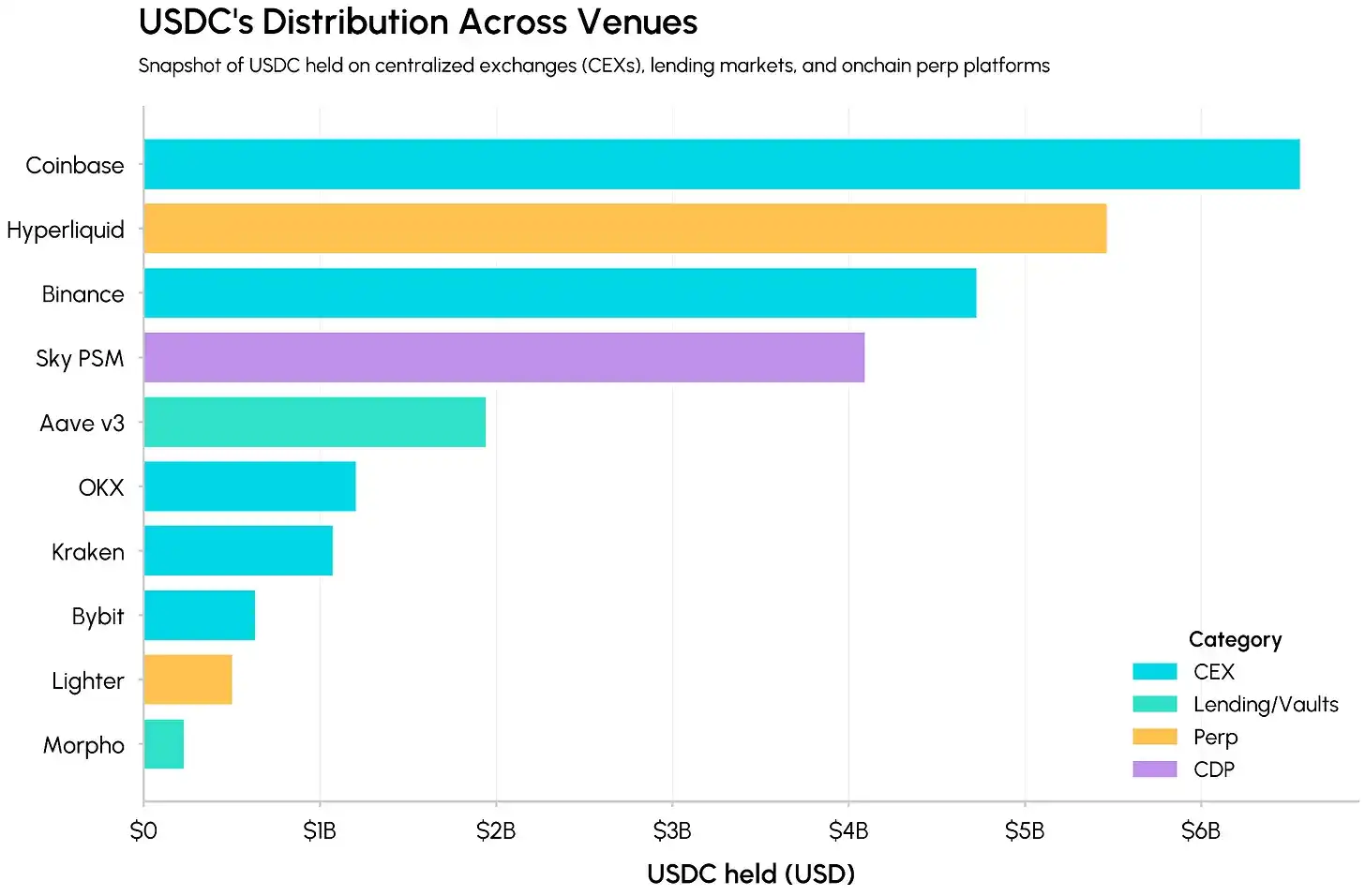
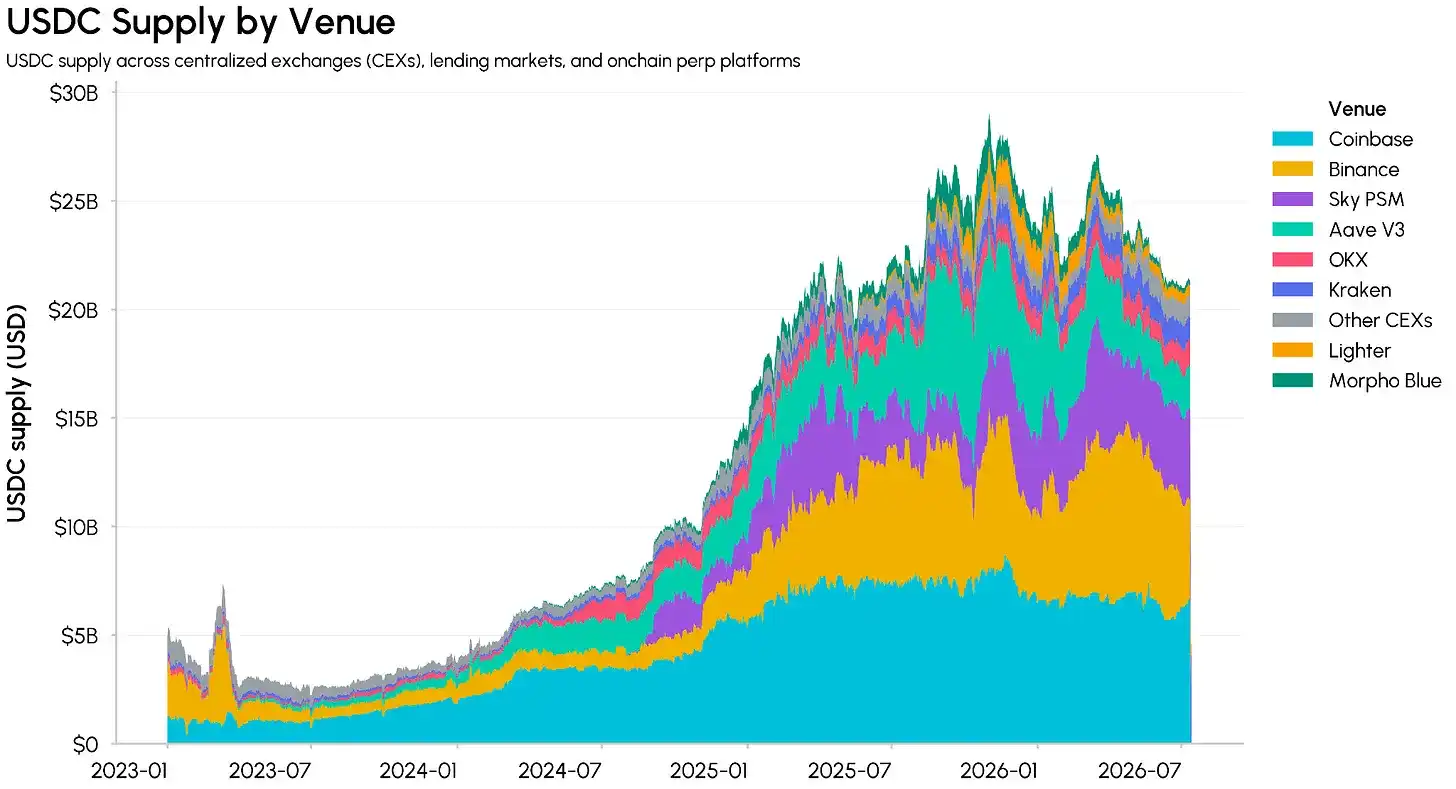
USDC’s position is tied not only to size but also to where it is actually used. On centralized exchanges, it functions as a major quote and settlement asset. In DeFi, it sits across money markets, vaults, DEX liquidity pools and collateral structures backing other stablecoins.
The article notes that exchanges including Coinbase and Binance hold billions of USDC. Onchain, Hyperliquid, Sky PSM and Aave v3 also account for large balances. In practice, that means USDC is placed at the center of high-frequency market activity and large-value settlement flows.
The relationship between Circle and Coinbase makes the shift in issuer economics more visible. Coinbase said in its first-quarter 2026 earnings report that about 25% of USDC supply was held in Coinbase products. Based on that reach, the article says Coinbase captures roughly half of USDC’s economics, not by replacing Circle but by controlling deeper integration and adoption.
Hyperliquid shows how distribution partners are taking a larger share
Hyperliquid is presented as one of the clearest recent examples. In May 2026, Coinbase became the official USDC vault deployer on Hyperliquid, while Circle served as the technical deployer. That arrangement reinforced USDC’s role as the platform’s native stablecoin.
Under AQAv2, Hyperliquid can capture up to 90% of the reserve yield generated by USDC balances on its platform. The article estimates that this can redirect $135 million to $160 million in annual revenue away from Circle and Coinbase and toward HYPE token buybacks and the protocol ecosystem.
That setup shows how deeply USDC is embedded in fast-growing centers of market activity, including onchain perpetual DEXs such as Hyperliquid and Lighter. In those venues, the default quote asset shapes liquidity, collateral preferences and downstream integrations. It also shows that platforms such as Coinbase and Hyperliquid are no longer just places where USDC is held. They are active economic participants in the float tied to USDC.
Regulated onshore venues remain a Circle advantage
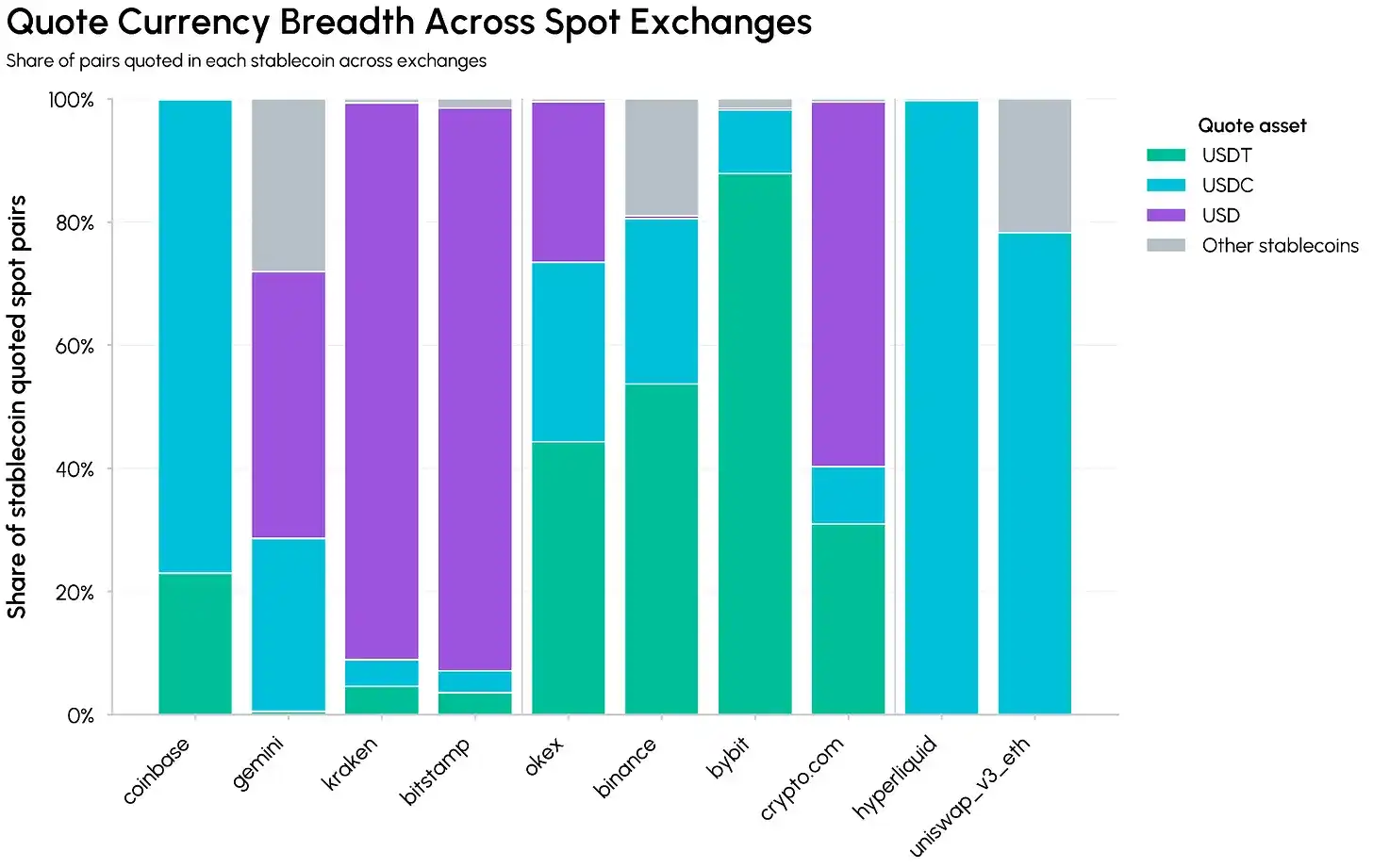
Stablecoin dominance also depends on liquidity depth and breadth. The article compares quote-asset coverage across spot exchanges for USDT, USDC and other stablecoins. On offshore venues such as Binance, Bybit and OKX, USDT still anchors the overwhelming majority of stablecoin-denominated markets.
On regulated or onshore exchanges including Coinbase, Gemini, Kraken, Bitstamp and Crypto.com, USD and USDC pairs play a much larger role. Coinbase has unified the USD and USDC order book. USDC is also the dominant quote asset on onchain venues such as Hyperliquid and Uniswap v3, placing it directly inside perpetuals and DeFi liquidity.
On the regulatory side, Circle has received approval from the Office of the Comptroller of the Currency to establish Circle National Trust, a national trust bank that can hold and manage USDC reserves under federal supervision. The article treats that as an important reinforcement of Circle’s regulatory edge and one reason exchanges, protocols and payment providers are willing to build around USDC as a dollar rail.
The fight is over reserve income and control of distribution
The article’s core conclusion is that OpenUSD should be understood as a consortium-governed, shared-revenue network rather than a direct attack on USDC’s existing supply. The pressure falls on the economics supporting that supply.
Competition in stablecoins is now evolving around three questions: who earns reserve income, how deeply each stablecoin is embedded in market infrastructure, and what regulatory framework stands behind it. OpenUSD is built on the idea that reserve revenue should move from the issuer to the payment networks, wallets, exchanges and other channels that actually drive adoption.
Whether that shift is strong enough to overcome USDC’s existing liquidity, broad reach and regulatory advantages remains an open question in the source analysis.