
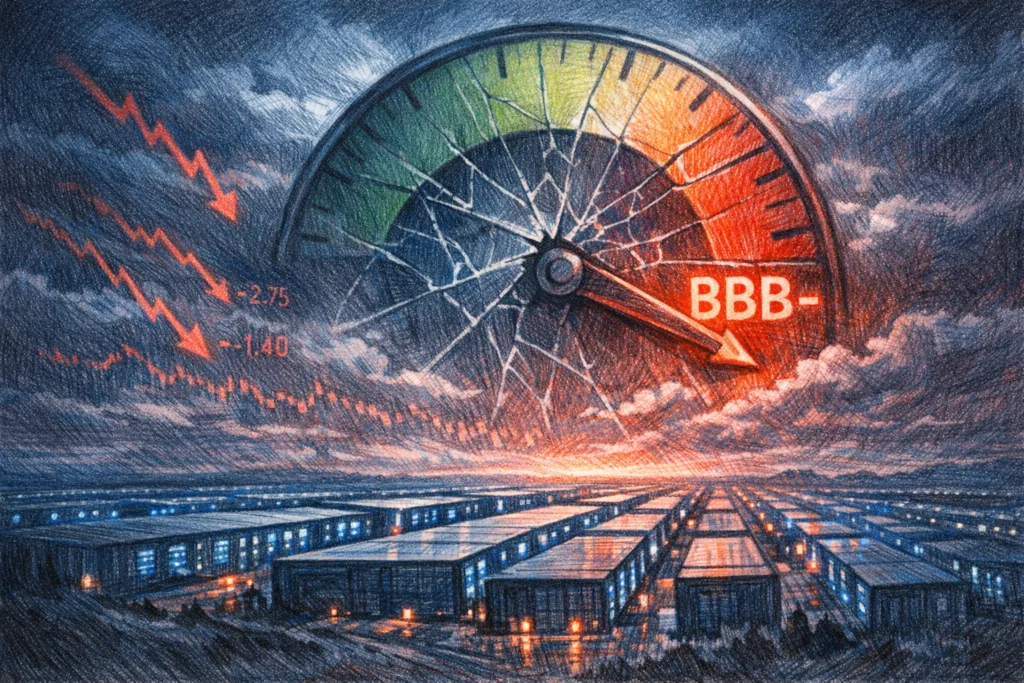
S&P Global cut Oracle’s credit rating to BBB- from BBB on July 10, moving the company to the last rung of investment-grade credit. One more downgrade would push its bonds into junk territory.
At the same time, Oracle shares have fallen 61% since September of last year, according to the source report. S&P’s move, though, was framed less as a reaction to the stock and more as a judgment on Oracle’s balance sheet, its rising capital needs, and its concentration of exposure to OpenAI.
Why S&P downgraded Oracle
The report said S&P pointed to two main reasons for the downgrade: Oracle’s high exposure to OpenAI and its large capital spending burden.
Oracle is said to hold $638 billion in remaining performance obligations, or RPO, representing signed business that has not yet been recognized as revenue. Roughly half of that amount comes from OpenAI alone.
S&P warned that if OpenAI were unable to meet its payment obligations, Oracle could be left holding long-term data center leases that are not easy to terminate and not easy to re-lease to other customers.
The article said this was not merely a hypothetical risk. Oracle had already acknowledged in its own filings that some of its data center investments may not pay back. BlockTempo reported earlier in July that Oracle had unusually disclosed concerns that certain data center projects might fail to recoup their costs, and its stock dropped 40% during that month.
Capex rises as cash flow pressure deepens
S&P also focused on Oracle’s spending plans. Oracle’s projected fiscal 2027 capital expenditures were revised up to between $90 billion and $95 billion, while its free operating cash flow gap is expected to widen to negative $42 billion.
Against that backdrop, Oracle’s adjusted leverage, measured as debt to EBITDA, is approaching 4.5x. The report said that level sits well above what would normally fit within a BBB rating profile.
Oracle’s total debt currently stands at about $160 billion, according to the article, a figure large enough on its own to keep rating agencies cautious.
Analyst Rich says the bond market was already sending a warning
In a recent note to clients, analyst Rich said Oracle may be the first hyperscale cloud provider to start weakening.
His argument was not limited to Oracle’s financial condition. He focused on the gap between signals from the stock market and the bond market. Last year, while Oracle’s shares kept climbing, credit default swap spreads did not tighten in step, he wrote.
In practical terms, that suggested bond investors had already started pricing in concern, even as equity investors continued pushing the stock higher.
Rich warned that bond-market signals often begin quietly, but can still serve as an early indication of downside risk. The report added that it is not unusual for credit markets to move ahead of equities in reflecting stress. By the time a stock starts to weaken as well, the warning from debt markets may already have been building for some time.
Oracle as a sign of strain in the AI cycle
Rich’s broader view, as cited in the report, is that Oracle may be turning into an early sign of a longer bear-market phase for equities. His reasoning was straightforward: if capital spending starts to cool, or if the AI infrastructure investments made by hyperscale cloud companies fail to generate the expected returns, default risk will rise. In that framework, Oracle is one of the most exposed companies.
The article argued that this goes beyond a single company. The financing structure behind the AI infrastructure race depends on a loop in which cloud companies borrow to build data centers and AI companies sign long-term contracts that support expected revenue.
If any part of that loop cracks, such as OpenAI’s ability to make payments, the chain reaction may show up first in credit reports rather than in stock charts.
The report ended with a simple contrast: stocks trade on narrative, while bonds trade on cash flow. From that perspective, S&P’s downgrade did not create a new problem so much as formalize concerns that the bond market had already been signaling. Oracle has not fallen into junk status, but the market’s doubts are already there.