
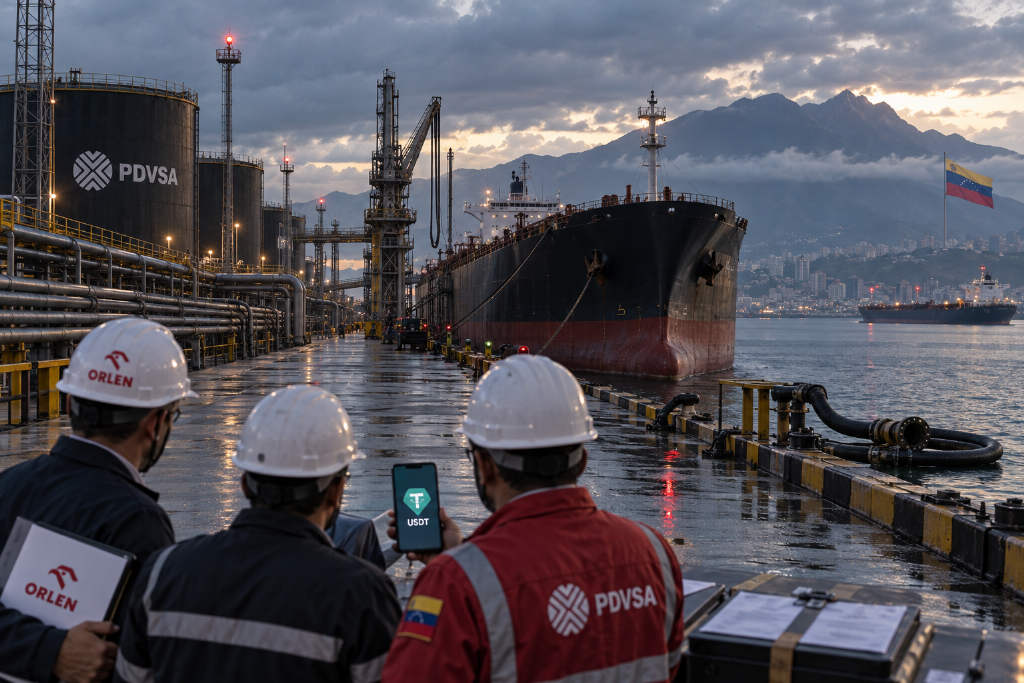
Poland’s state-controlled energy group Orlen is still trying to recover from a failed Venezuelan oil trade in which its Swiss unit, OTS, prepaid about $230 million and received only a fraction of what had been agreed. The Financial Times reported that OTS signed a contract worth about $345 million with Dubai trader Hannon International to buy 6 million barrels of Venezuelan Merey 16 crude. After receiving dollars from OTS, Hannon moved through intermediaries to obtain USDT for purchases in Venezuela.
The money changed hands across several layers. Most of the cargo did not arrive. What followed was a long stretch of loading delays, rising vessel costs and repayment disputes.
A sanctions window opened, and OTS moved quickly
The trade was launched after Washington temporarily eased sanctions on Venezuela’s oil sector. On Oct. 18, 2023, the U.S. Treasury authorized certain transactions involving Venezuela’s oil and gas industry for six months. The move was tied to an electoral roadmap agreement between representatives of the Venezuelan government and the opposition, while the U.S. kept the right to amend or withdraw the authorization.
Notes from Poland reported that OTS had been established in 2022 and was just over a year old when it started the purchase. In a company statement cited by the outlet on Nov. 24, 2023, OTS said it was conducting trading activity and that cargoes could be shipped to different destinations depending on chartering arrangements, rather than being sent to Orlen’s own refineries.
Reuters reported on Nov. 20, 2023 that Orlen had provisionally chartered the very large crude carrier Olympic Trophy for $13 million, with loading planned for early December and the crude intended for China. At the time, the sanctions relief created a short-lived opening for traders re-entering the Venezuelan market.
According to the Financial Times, the people behind the deal included then-OTS head Samer Awad and Hannon International founder Kam Ho “Alex” Tse. The crude contract between the two sides was worth about $345 million.
Reuters reported on May 14, 2024, citing trade documents it reviewed, that OTS transferred a total of $230 million to Hannon International Middle East DMCC in December 2023 and separately paid $100 million to Dubai-based Horizon Global. On the Hannon contract alone, the prepayment amounted to roughly two-thirds of the contract value.
Payment terms later became a central point of dispute. Notes from Poland, citing OTS on April 23, 2024, said the prepayments were unsecured and were sent to counterparties Orlen had not worked with before. Most of the money had gone out before the buyer had taken delivery of the cargo.
Dollars were converted into USDT, but the supply chain did not connect
Receiving dollars from OTS did not mean Hannon had already secured the oil. It still needed to pay through downstream channels and complete the local purchase. That is where USDT entered the transaction chain.
Reuters reported in April 2024 that Petróleos de Venezuela, S.A. (PDVSA) had been moving part of its oil sales into USDT settlement since 2023. By the end of the first quarter of 2024, many spot trades that did not involve barter required 50% of the cargo value to be prepaid in USDT. Reuters cited people familiar with the matter as saying the arrangement was meant to reduce the risk of revenue being frozen in overseas bank accounts.
The Financial Times said Hannon claimed it had paid $135 million to Horizon Global but received only 85 million USDT in return. Horizon disputed that account. Horizon was also a direct payee of OTS, which left it sitting in two positions at once: a recipient in OTS’s purchase flow and, according to Hannon, a party involved in the USDT conversion. That made the money trail harder to untangle.
The Financial Times also described traders in Venezuela handling USDT payments through the handover of USB devices. Even so, transfers among intermediaries were not the same as confirmed payment to the ultimate supplier.
Reuters reported on May 14, 2024, citing PDVSA sources, that the company had not received the relevant payment and therefore had not allocated cargoes to Orlen or its intermediaries. At one end of the chain, OTS had already sent out large prepayments. At the other, the supplier said no matching payment had arrived.
Six tankers were delayed, and demurrage kept building
The shipping side of the trade also stalled. Reuters reported on April 23, 2024 that six tanker loadings scheduled for December 2023 and January 2024 had still not been completed by March. Three of those vessels were very large crude carriers.
An Orlen manager said demurrage costs had reached about $600,000 a day. For OTS, the delay created two losses at the same time: prepayments were not turning into the cargo that had been contracted, while waiting vessels continued to burn cash.
The deal was not entirely empty. The Financial Times reported that OTS later received about 500,000 barrels of fuel oil, but the originally agreed heavy crude purchase was not completed.
At the same time, the sanctions window was closing. On April 17, 2024, the U.S. Treasury’s Office of Foreign Assets Control replaced the earlier authorization with General License 44A, moving the trade into a wind-down period running through May 31. A few months earlier, OTS had still been lining up ships and funding. By then, the focus had shifted to ending the trade and trying to retrieve the money already paid out.
Impairment charges, settlements, arbitration and criminal cases followed
On April 10, 2024, Orlen said OTS had demanded refunds for crude oil and refined products that were not delivered as agreed, but the prepayments were not returned on schedule. The subsidiary assessed the chances of recovery as low.
Orlen then said it expected to recognize about 1.6 billion zlotys in additional costs in its 2023 consolidated financial statements, mainly from impairment of prepayment assets. That disclosure covered a broader set of undelivered OTS procurement transactions and did not refer only to the $230 million prepayment tied to Hannon.
The blame dispute later moved into public view. Cointelegraph reported on Sept. 15, 2026 that Hannon lawyer David McCoy said the company took part in the trade at Orlen’s request and denied responsibility for the failure. He said Hannon had incurred its own costs while pursuing the missing funds and was open to discussions with Orlen.
A separate recovery track involved Horizon Global. Reuters reported on Jan. 8, 2025, citing a person familiar with the matter, that Orlen had reached a settlement under which Horizon would repay $100 million in installments by the end of that year.
That did not close the matter. Business Insider Polska reported on April 29, 2026 that OTS won a favorable arbitration ruling in London against Horizon Global. Orlen confirmed the result but did not disclose details. The report also said actual recovery would still depend on whether the counterparty had assets available for enforcement.
Internal decision-making later became part of a criminal case. Reuters reported on Aug. 7, 2026 that Polish prosecutors filed indictments against three former managers: former Orlen management board member Michał R., former OTS board member Marcin O., and former executive director Filip W., who had served at both companies. All three denied wrongdoing.
The charges relate to three crude purchase contracts signed in 2023. Investigators alleged that the individuals failed to protect company assets, causing about $378 million in losses. Proceedings involving former OTS head Samer A. were being handled separately.
Those figures should not be merged. Orlen’s roughly 1.6 billion zloty charge reflects a broader impairment disclosure. The prosecutors’ roughly $378 million figure refers to three crude contracts. The $230 million figure refers to the Hannon-linked prepayment. They come from different documents and cover different scopes.
A favorable ruling does not mean the cash is back
By the latest reports, the failed trade had already produced a real financial hit, but recovery and responsibility were still unresolved. A settlement, a favorable London arbitration result and parallel claims among the parties do not show that all prepayments have made their way back to Orlen.
OTS sent out the money in late 2023 to get crude onto ships. Years later, the same question remains at the center of the case: after moving through traders and intermediaries, where did the money go, and how much of it can still be recovered?