
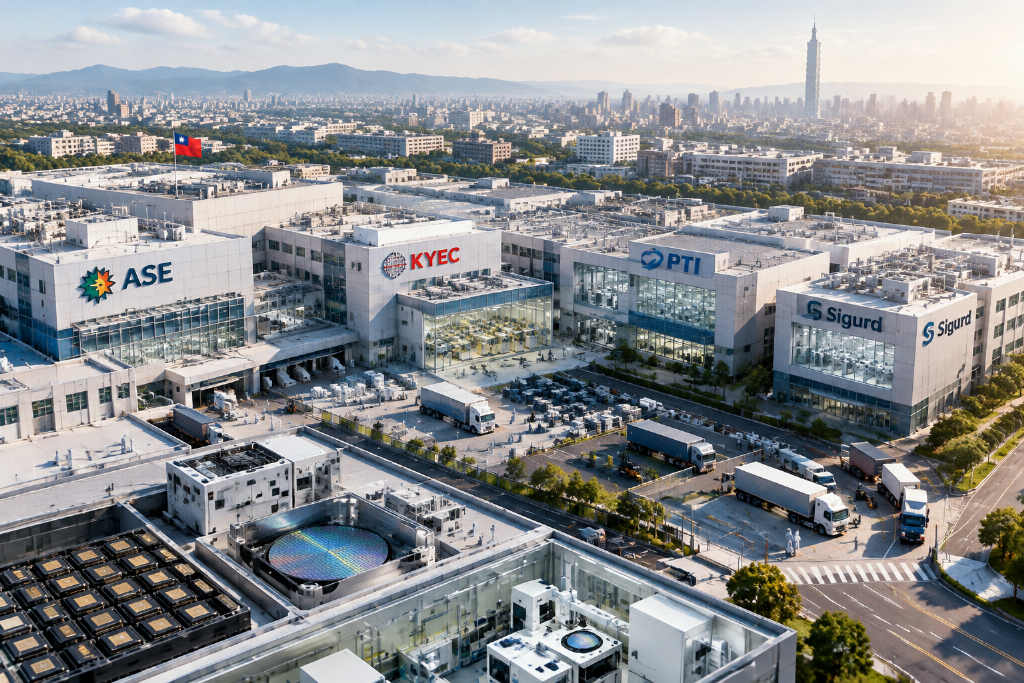
The outsourced semiconductor assembly and test industry is entering a strong pricing cycle as AI chip demand tightens capacity. Economic Daily News, citing industry sources, said longer AI chip testing times and a growing push by cloud giants to develop in-house chips have left OSAT capacity in short supply, with recent quote increases running from 10% to 30%. Rush orders from smaller customers may even be quoted at double previous levels.
The report said Taiwanese providers including ASE Technology Holding (3711), King Yuan Electronics (2449), Powertech Technology (6239) and Ardentec (3264) are expected to benefit. At the same time, additional capacity from major OSAT companies is only expected to come online gradually in 2027, which means the current gap is unlikely to be filled in the near term.
Pricing moves break with past practice
OSAT pricing has usually been more stable than pricing in wafer foundry or memory markets. Industry sources said quotes are typically negotiated once a year, with only limited adjustments during the contract period, making the current scale of increases relatively unusual. Supply chain sources added that OSAT companies have recently been raising prices on an ongoing basis, with increases of 10% to 30%, while urgent orders from smaller customers may face doubled pricing.
One factor behind the demand jump is that front-line chipmakers are accelerating shipments of wafers that had been sitting in wafer banks, which is lifting demand for downstream packaging and testing services and pushing quotes higher.
Advanced AI chip designs are making packaging and testing harder
Industry analysis cited in the report said major AI chip companies such as NVIDIA and AMD continue to roll out new platforms. With demand for AI computing power growing at an exponential rate, customer orders remain strong, and AI chip capacity has already been booked out for the next one to two years. Demand has strengthened across chip design, wafer foundry and semiconductor equipment, and that pressure has now spread to OSAT services.
Specification upgrades are a key part of the story. As NVIDIA, AMD and others launch next-generation AI chips built on advanced 2 nm and 3 nm process technologies, CoWoS advanced packaging is carrying larger HBM capacity and moving toward HBM4 with higher stack counts. The coming adoption of CPO, or co-packaged optics, adds another layer of complexity because it is a technology these platforms had not previously used. That has increased both packaging difficulty and testing time.
The report also said pricing offered by major AI chip companies to OSAT providers has been attractive enough that AI chips are taking up a large share of industry capacity.
Cloud companies and new entrants are competing for the same capacity
Another source of demand is coming from large cloud service providers. Google, Microsoft, Meta and Amazon are continuing to invest in self-developed AI chips and, according to the report, have already locked in capacity for next year with foundries and OSAT providers. At the same time, newer players such as OpenAI and Anthropic have started to require customized AI chips, making overall OSAT capacity even tighter.
As AI chip demand stays strong, existing packaging and testing capacity for non-AI chips is being squeezed out. The report said that is also one reason OSAT companies have raised prices sharply in recent weeks.
Expansion plans point to 2027
To respond to customer demand, major OSAT companies have been expanding capacity in Taiwan, Southeast Asia and North America, with the benefits expected to emerge gradually in 2027. Even so, near-term supply from those projects remains limited and is unlikely to close the service gap created by the current AI opportunity.
With the supply-demand imbalance still unresolved in the short term, future pricing and order trends at ASE Technology Holding, King Yuan Electronics, Powertech Technology and Ardentec will remain key indicators for tracking this OSAT upcycle.