

Enterprise stablecoins are no longer being discussed only as a future story.
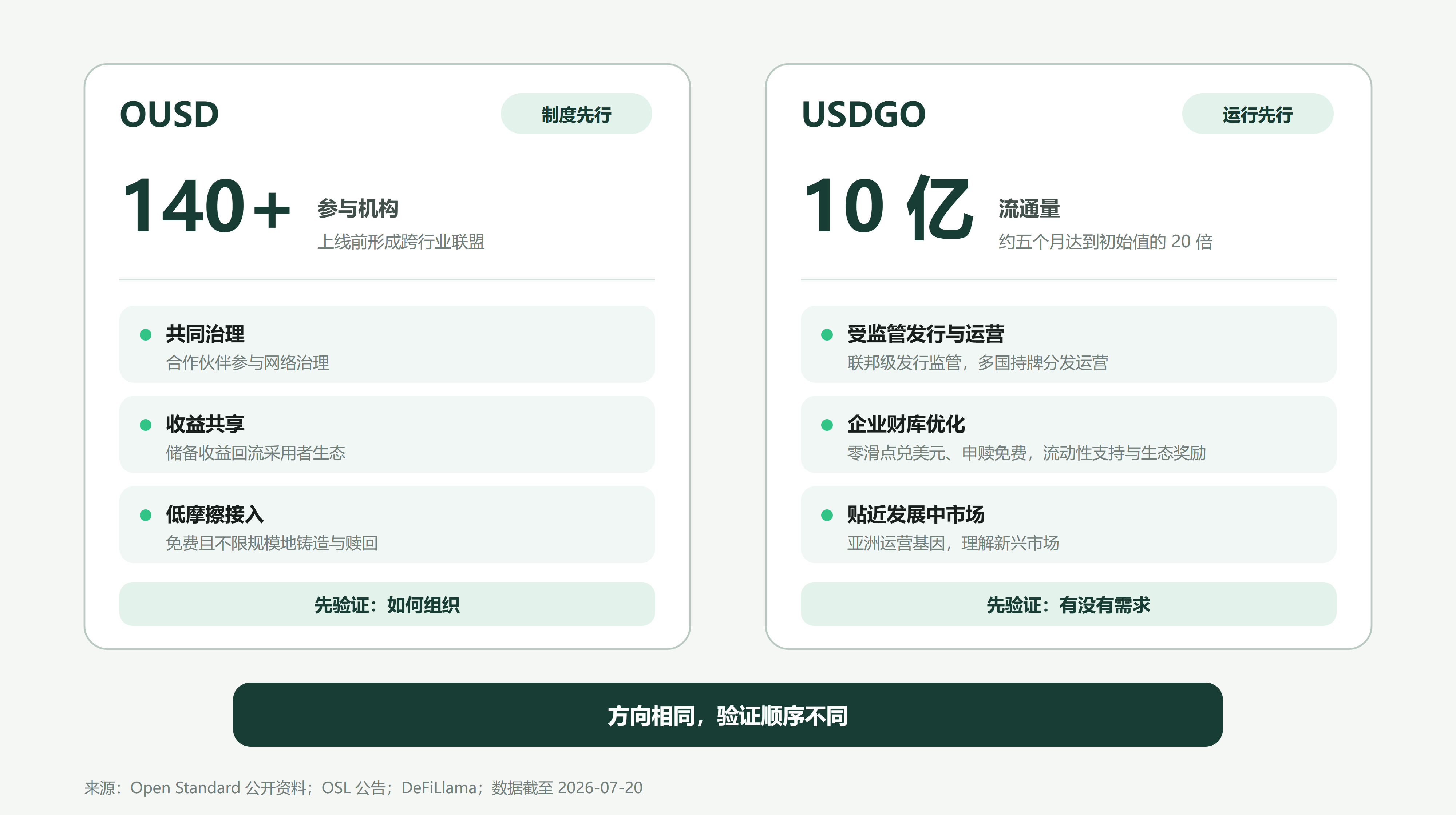
In a market analysis, Foresight wrote that two recent developments are worth reading together. On June 30, Open Standard introduced Open USD, or OUSD, bringing together more than 140 companies across finance, payments, technology, and crypto, including Visa, Mastercard, Stripe, BlackRock, BNY, Google, and Coinbase. The project is scheduled to go live later in 2026. On July 20, according to DefiLlama’s methodology, USDGO’s circulating supply passed $1 billion, putting it among the world’s top six compliant stablecoins by circulation and making it the largest compliant U.S. dollar stablecoin operated by an Asian stablecoin operator.
Foresight’s argument is that OUSD is trying to turn enterprise stablecoin demand into a global industry consensus, while USDGO’s rise to $1 billion offers a real-world early sample for that thesis. In that sense, the sector has entered a stage where distribution matters most.
Why new enterprise stablecoins are still emerging despite USDT and USDC
USDT and USDC already sit on top of massive liquidity networks, so the obvious question is why the market would need another dollar stablecoin at all.
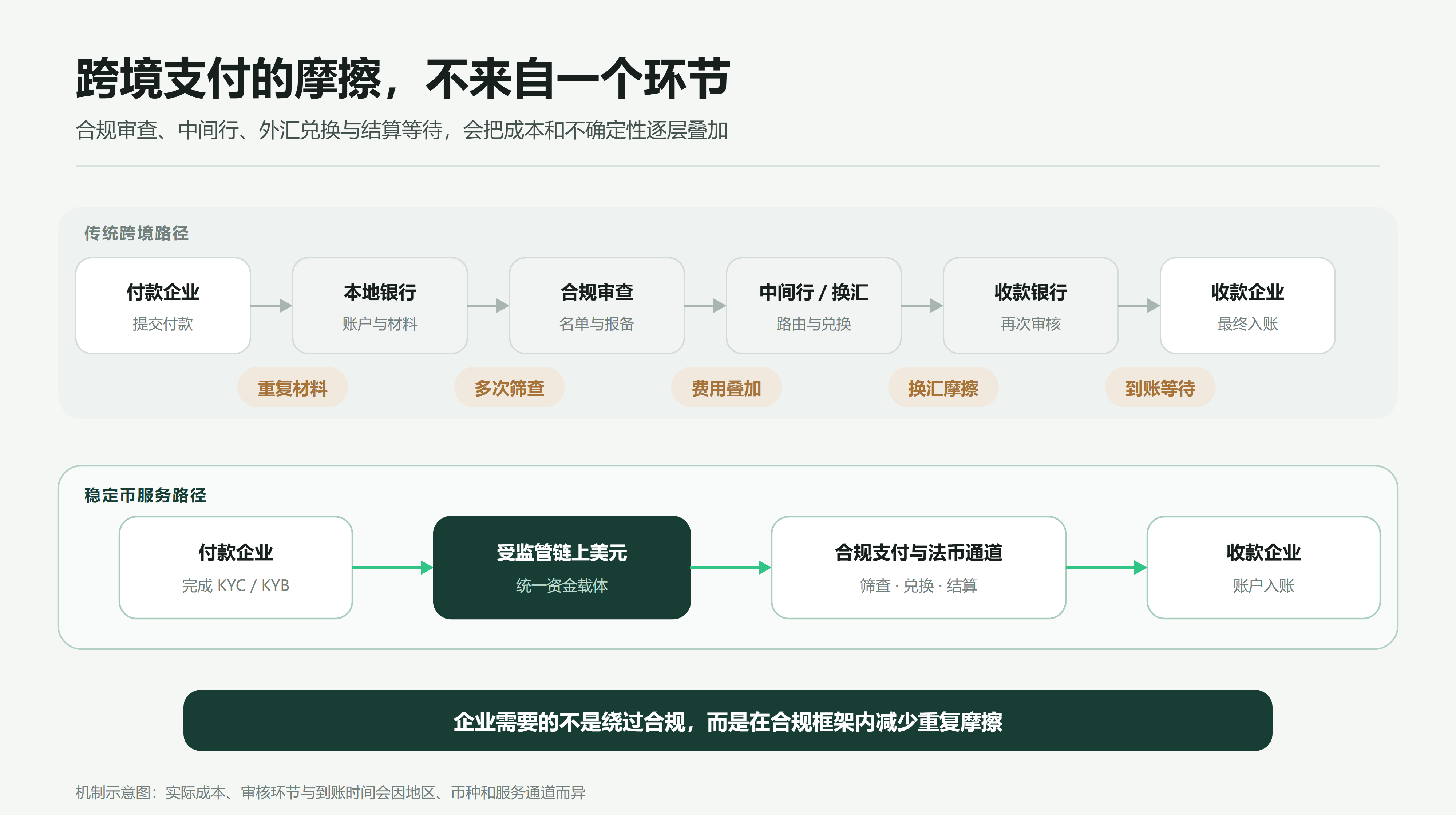
That issue has followed every enterprise stablecoin project. Many earlier discussions framed the opportunity around two structural pain points in traditional payments. The first is compliance cost. Cross-border money movement requires checks at every step, not just at onboarding: anti-money laundering reviews, sanctions screening, reporting obligations, and coordination across different jurisdictions. Each additional layer adds friction and uncertainty. The second is settlement efficiency. A B2B cross-border payment worth hundreds of thousands of dollars can pass through messaging rails, correspondent banks, foreign exchange conversion, and final account crediting, with fees, FX spreads, and funding costs stacking up along the way. Settlement often takes several business days.
Foresight says that explanation is incomplete. The opportunity for enterprise stablecoins does not come only from existing stablecoins being insufficiently compliant or from traditional rails being too slow. A deeper reason is that enterprises use money in a very different way from crypto-native users.
In crypto markets, stablecoins are first and foremost liquidity assets. Exchanges provide the entry point, wallets and blockchains handle transfers, and DeFi protocols supply lending, market-making, and yield venues. If a stablecoin has deep enough trading pairs and onchain liquidity, users will generally choose it.
A multinational company works from a different checklist. It will not move supplier payments, merchant settlement, or treasury operations onchain just because transfers are faster. It also needs to evaluate issuer risk, minting and redemption, fiat conversion, technical integration, accounting treatment, liquidity management, and regulatory requirements across markets.
Foresight lays out the questions enterprises actually care about: Who is the legal issuer? Who manages the reserves? Can large redemptions be processed smoothly? How does conversion between fiat and stablecoins work? Can treasury costs be optimized? How does the product connect to existing finance systems? How are KYC, AML, sanctions screening, and accounting handled?
The article also says the economic model that worked in crypto trading may not transfer neatly into enterprise payments. Under the old structure, issuers such as Tether and Circle handle issuance and reserve management and keep most of the income generated by those reserves, while exchanges, wallets, and onchain protocols build user access, liquidity, and integration.
That arrangement works in crypto because stablecoins are indispensable liquidity tools. Distribution channels can still make money from trading, custody, lending, and related services even if they do not share reserve income directly.
In enterprise markets, though, the cost of distributing a stablecoin is much higher. Payment companies, banks, and fintech platforms have to complete technical integration and compliance checks, persuade clients to change settlement tools, adjust money workflows, and continue supporting fiat on- and off-ramps, liquidity management, reconciliation, and customer service. If the economics from stablecoin growth remain concentrated at the issuer level, the institutions actually sourcing clients and building the distribution network may lack incentive for long-term investment.
This is where OUSD and USDGO part ways in structure.
According to Open Standard’s design, reserve income, apart from a small management fee needed for day-to-day operations, will be distributed to partners including banks, payment platforms, e-commerce companies, and technology service providers. In other words, OUSD is being positioned as a stablecoin network that adopters help build, help govern, and share in economically.
USDGO follows a more execution-driven route. It starts with regulated issuance, regional distribution, and specific enterprise use cases. Anchorage Digital Bank provides the issuance and reserve base, while OSL handles brand operations, market distribution, and enterprise onboarding. The model then connects payment, custody, fiat access, and liquidity providers. Foresight says the aim is to reduce the barriers for enterprise adoption through a professional division of labor among the issuer, regional operator, and service partners. The article adds that clients in the USDGO ecosystem can also receive participation incentives.
The two models are not identical, but they point to the same conclusion. What enterprises need is not just a token that can move onchain. They need a money network that links markets, accounts, fiat systems, and business platforms.
For banks, that network could support digital asset settlement and corporate treasury management. For payment companies, it could be used for merchant settlement and cross-border payments. For internet platforms, it could become a base layer for payouts to merchants, creators, and gig workers. For crypto firms, it can still serve trading and onchain liquidity functions.
Viewed that way, Foresight says enterprise stablecoins have entered a distribution-first phase. OUSD’s launch also shows that large payment institutions are trying to prove that companies across finance, payments, technology, and crypto are willing to organize around a new stablecoin structure. Whether that willingness becomes an efficient operating network is still unclear. A large distribution map and a large volume of actual payment activity are not the same thing.
What USDGO’s first six months may be telling the market
If OUSD is the coalition experiment, USDGO is the live sample the market can inspect today.
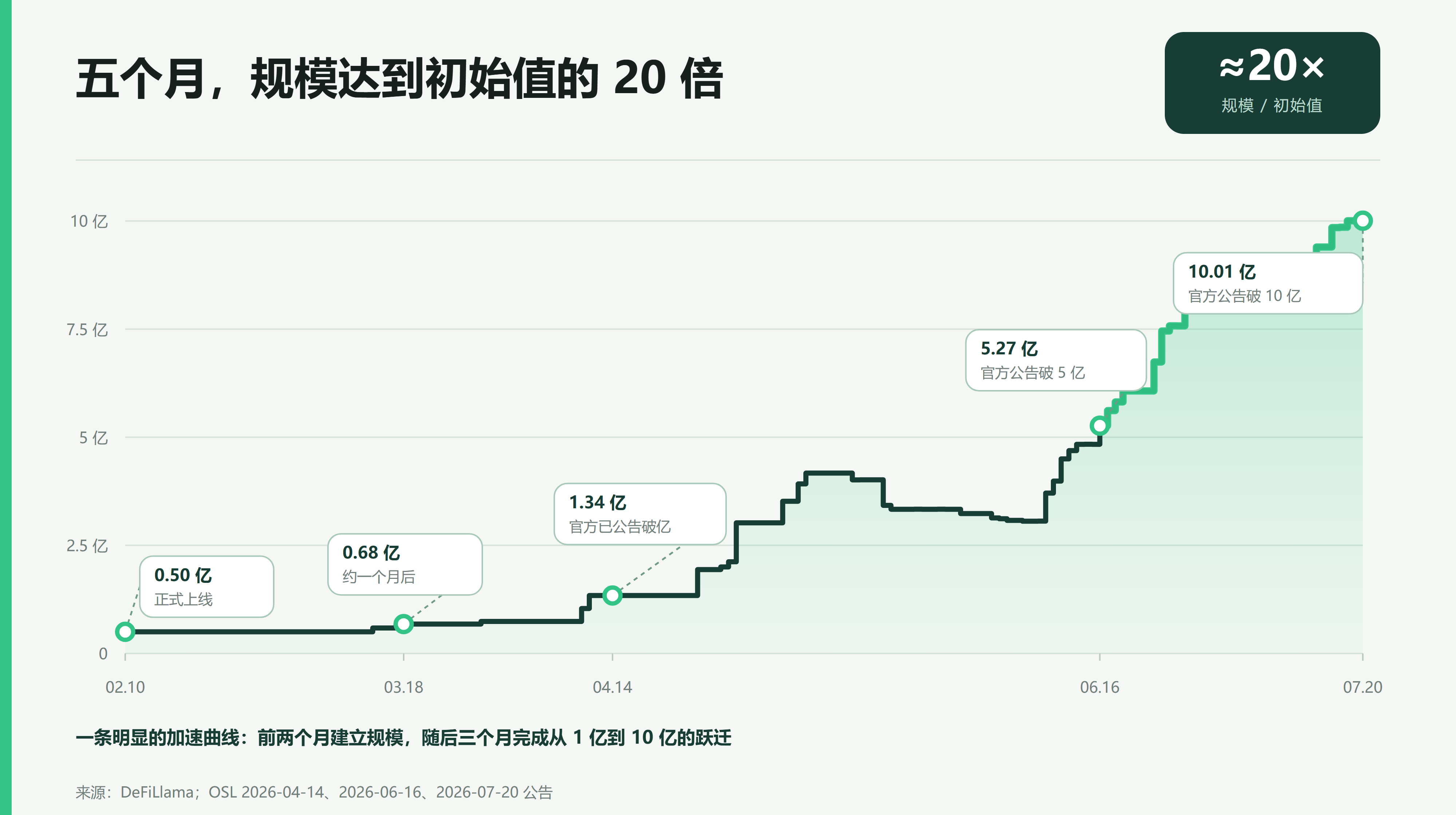
USDGO went live on Feb. 10, 2026, with an initial issuance of $50 million on Solana. Its circulating supply rose above $68 million within one month, passed $100 million in April, exceeded $500 million in June, and reached $1 billion in July.
That move from $50 million to $1 billion in less than half a year suggests, at minimum, that enterprise demand for compliant digital dollars remains underdeveloped even with USDT and USDC already dominating much of the stablecoin market. Foresight says it also shows that this demand can translate into meaningful capital scale and support actual holding and usage.
The article stresses that the more important signal is not just the pace of growth. For enterprises, USDGO’s appeal is not mainly about which chain it runs on, nor only about faster transfers. As discussed earlier, the deciding factor is whether issuance, reserves, minting and redemption, regional distribution, fiat access, and compliance services can be connected into one complete chain.
On the issuance side, Anchorage Digital Bank N.A., the issuer behind USDGO, is described in the article as the first federally regulated crypto bank in the United States. Foresight also notes that notable names that have issued stablecoins with Anchorage include Western Union and Tether.
That means USDGO is not issued by a typical offshore foundation, nor by a Web3 project or a crypto community group. Foresight says the issuer is a licensed institution regulated by the Office of the Comptroller of the Currency, or OCC, and holds a federal banking charter.
On the operations and distribution side, OSL Group serves as operator and distributor for USDGO. Foresight describes OSL as Hong Kong’s first licensed and publicly listed virtual asset platform, one that has long stood as a representative player in Hong Kong’s virtual asset market. In recent years, it has also expanded into stablecoin-focused payments and trading and has obtained dozens of compliance licenses and registrations globally.
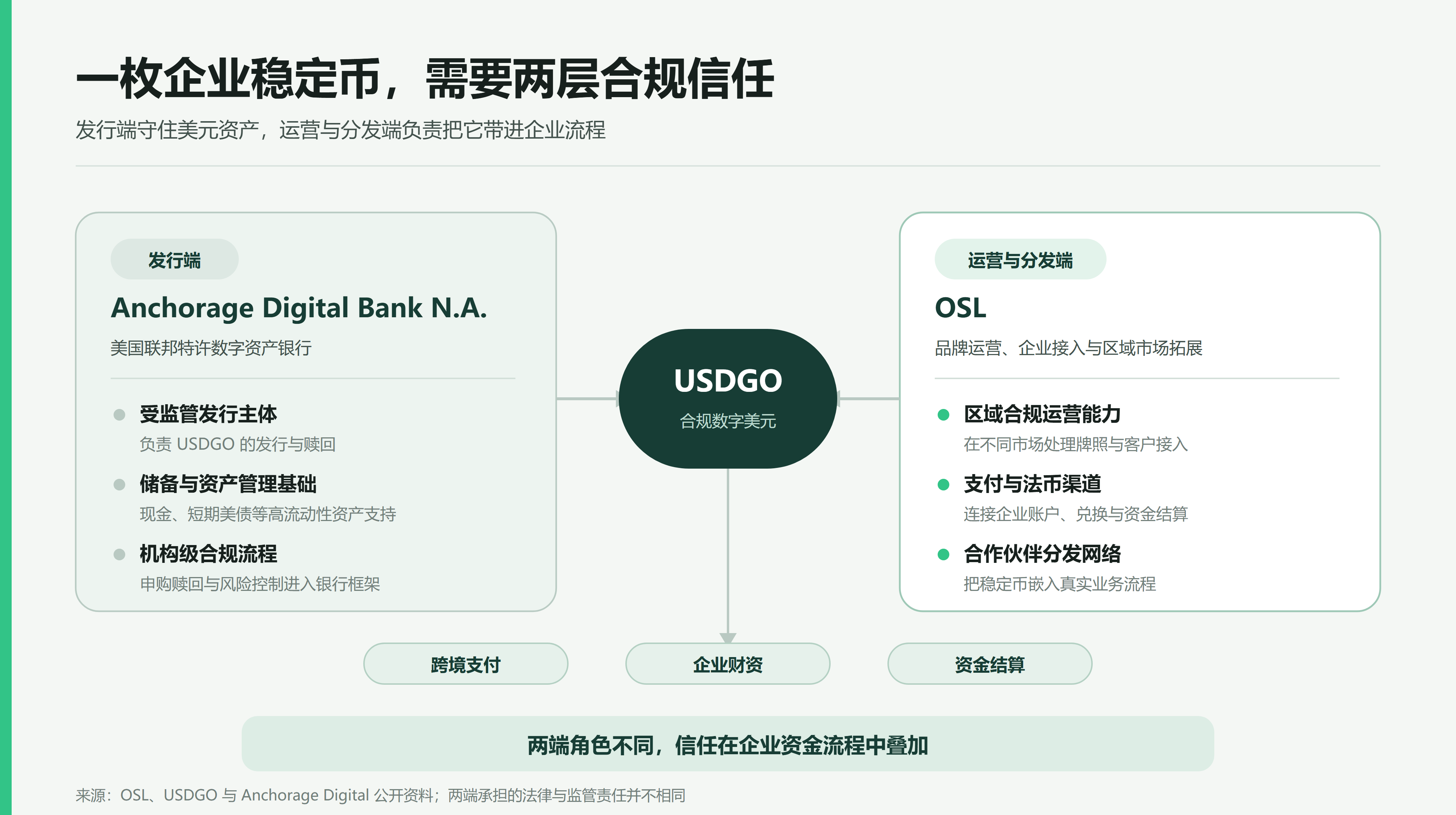
The article argues that, at least on the visible compliance chain, USDGO offers a structure that looks more familiar to traditional finance: the compliance status of the dollar reserves is backed by a federal-level bank, while market rollout and distribution in Asia are handled by a licensed public company.
That still is not enough on its own. Traditional companies do not have to find separate custodians, FX platforms, clearing rails, and transaction verification tools just to use a bank account. If a stablecoin requires enterprises to assemble the full onchain stack by themselves, it is unlikely to become a mass commercial tool.
For that reason, Foresight says USDGO was not built around token issuance alone. It has tried to combine payments, trading, custody, fiat rails, and liquidity management from the start, while also offering ecosystem support designed to lower costs and improve efficiency for enterprise clients.
According to information disclosed by OSL and cited in the article, USDGO has partnered with payment and trading service providers including Banxa, Yellow Card, GoldStack, PolyFlow, Geoswift, and Vantage. Those partnerships cover cross-border e-commerce, international trade, onchain fund transfers, corporate treasury management, and digital asset trading. On the infrastructure and institutional custody side, the network also connects to Solana, Fireblocks, Cactus Custody, and Amber Group.
The key, Foresight says, is not to turn every company into a wallet operator. It is to hide the stablecoin behind the payment and treasury workflow. What the enterprise sees can be an API, a settlement account, or a corporate payments interface, while the underlying money moves, converts, and settles through a stablecoin layer.
The article says that direction is similar to what OUSD participants have emphasized repeatedly: stablecoins should not end up as products that every end user has to understand directly. They should behave more like internet protocols, sitting underneath the actual business flow.
USDGO’s choice to focus on Asian cross-border business and emerging markets is also portrayed as deliberate. Compared with the relatively unified markets in Europe and the United States, cross-border money movement across Asia, Africa, and Latin America carries more friction: local currency volatility, uneven banking access, mismatched settlement hours, complex FX steps, and the cost and delay created by correspondent banks.
OSL has identified Southeast Asia, Africa, and Latin America as key application markets and said USDGO is being used in cross-border transfers, trade finance, corporate treasury management, e-commerce, and interactive entertainment. Foresight’s point is that demand for dollar assets in those regions is already clear, while the cost of accessing dollar liquidity, making cross-border payments, and managing funds in transit is often higher than in mature financial markets.
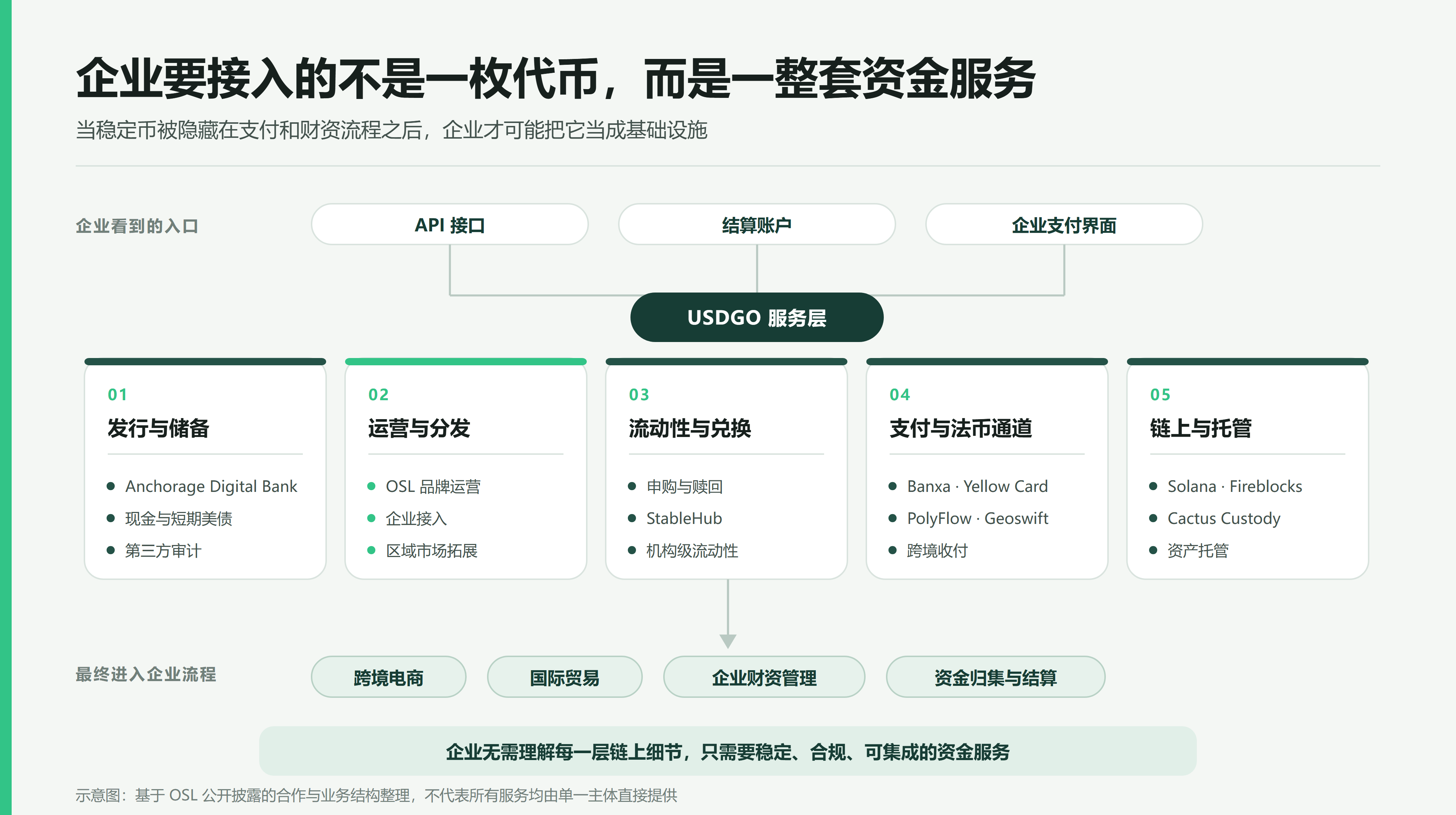
In that setting, the value of a stablecoin is not only speed. It is also the ability to unify money across regions into a single onchain dollar asset that moves around the clock. The article points to USDGO’s zero-spread dollar FX conversion, free minting and redemption, 24/7 support, and additional partner incentives as part of an effort to reduce financial friction and opportunity cost for participating businesses.
What enterprise stablecoins will be measured on from $1 billion to $10 billion
Foresight frames OUSD as a global stablecoin alliance being built by large institutions, while USDGO looks more like an enterprise digital dollar service already running in regional markets. What each one has validated so far is different.
OUSD has succeeded in bringing major financial institutions, payment companies, and technology platforms back to the table to discuss stablecoin governance and economics. What it has not yet proved is whether more than 140 participants can form a unified, efficient, and durable distribution network. USDGO, by contrast, has already shown that a newly launched enterprise stablecoin can build $1 billion in circulation in a relatively short period while expanding across different markets and use cases. What it still needs to show is whether that capital can move into payment, settlement, and treasury loops in a stable and lasting way.
That is why the article says the leap from $1 billion to $10 billion is not simply a matter of issuing nine times more supply. The real task is to convert funds layer by layer: first into the system, then into continuous movement, and finally into habitual enterprise usage.
Foresight lists several metrics to watch next.
The first is fund quality, not just top-line circulation. How many enterprises make up that $1 billion? Is the money concentrated among a small number of institutions or platforms? Are companies holding long-term operating balances, or are the funds mainly short-term allocations and incentive-driven capital? Only when the funding base becomes more diversified and forms stable enterprise balances does circulation become durable.
The second is actual usage efficiency. Once supply is minted, it has to keep moving. A $1 billion stablecoin whose funds mostly sit idle is very different from a $1 billion stablecoin that is repeatedly used for supplier payments, merchant settlement, cross-border collections, and treasury concentration.
The third is liquidity and redemption capacity. Enterprise stablecoins are not mainly dealing with transfers of a few hundred dollars. They often need to handle flows worth hundreds of thousands or even millions of dollars. Whether large subscriptions and redemptions can be processed smoothly, and whether price gaps between stablecoins and fiat remain stable, will shape whether enterprises are willing to rely on the product as a normal operating tool.
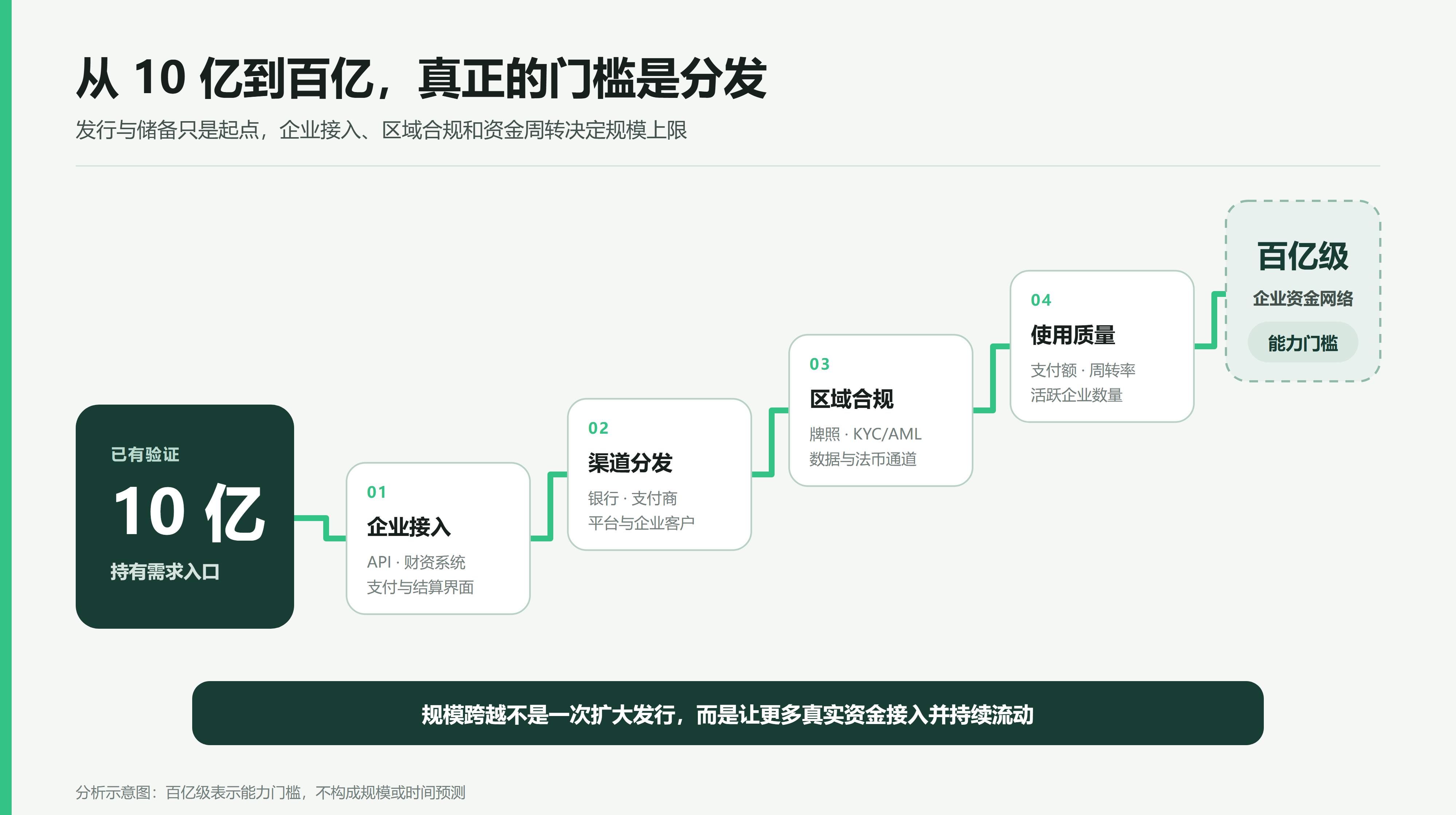
If a company has to line up multiple redemption and conversion plans before making a payment, then the stablecoin has not truly simplified treasury management. It has only moved the complexity from bank rails to the chain. For enterprise stablecoins to become routine tools, Foresight says they need deep liquidity, stable fiat channels, and redemption systems capable of handling large flows in and out.
The fourth is the sustainability of the business model and the ability to expand globally. Whether it is OUSD’s reserve-income sharing or USDGO’s incentive and service structure built around ecosystem partners, both approaches still have to deal with changes in rate cycles and with differences across regions in licensing, data rules, KYC, AML, sanctions screening, and fiat channels.
For that reason, the article says enterprise stablecoin competition will not be a simple replay of the market-share battle between USDT and USDC. It is closer to a contest of combined capabilities. Issuance and reserves are only the starting point. Payment networks, banking channels, client relationships, liquidity, technical integration, and regional compliance all have to be assembled into a single system.
The sector may have crossed an early threshold, but $1 billion is still a starting point
Foresight closes by saying that major industry changes often pass through similar phases. The market may still be debating who will do what, while the underlying shift has already crossed an early threshold.
In the article’s view, the arrival of OUSD is an important sign that enterprise stablecoins are maturing and entering the mainstream field of vision for global financial institutions. At the same time, USDGO’s rise to $1 billion in circulation within six months shows that an enterprise stablecoin can be issued, can be held, and can build the base liquidity needed to support large-value payments.
Still, $1 billion is only a new starting line.
The path from $1 billion to $10 billion runs through a full chain: from being issued, to being held, to being used continuously inside trade, payments, and corporate finance cycles. Foresight suggests that only when digital dollars become as natural to enterprises as a banking interface, to the point that users no longer need to know which stablecoin is operating underneath, will they stop looking like crypto assets and start functioning as real infrastructure for global commerce.