PancakeSwap’s governance proposal The Flip is facing heavy resistance from voters.
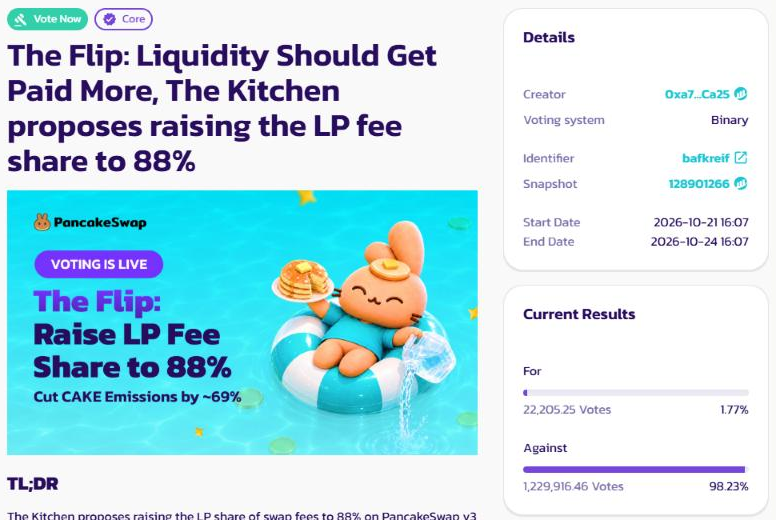
As of Oct. 23, the voting page showed 33 addresses had participated. Roughly 1.23 million votes were cast against the proposal, while only about 22,000 supported it, putting opposition at 98.2%. One address alone accounted for about 766,000 no votes, or roughly 60% of the total. Voting is set to close at 16:07 on Oct. 24.
At the center of the debate is a basic question for the BNB Chain decentralized exchange: should more trading fees go to liquidity providers, or should those fees continue to feed CAKE through buybacks and burns?
What The Flip would change
Under PancakeSwap’s current setup, each trading fee paid by users is split into three parts. Most goes to liquidity providers, while the rest is used either to buy back and burn CAKE or to fund the treasury.
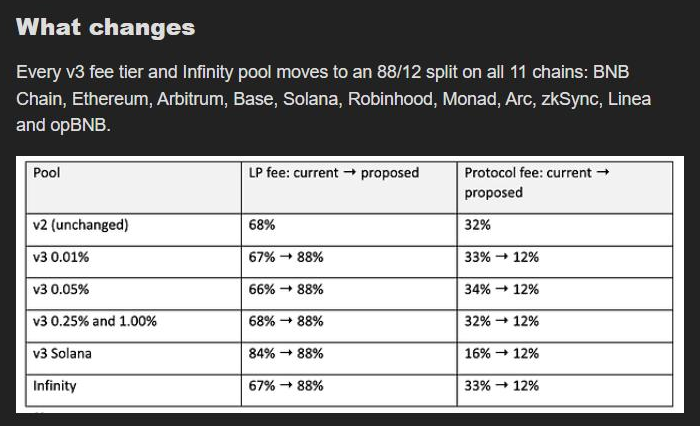
On Oct. 14, PancakeSwap’s core team, The Kitchen, introduced The Flip on the governance forum. The proposal would raise the LP share for v3 and Infinity pools on 11 chains from the current 66% to 68% range for most pools to 88%. The remaining 12% would go entirely to the treasury and would no longer be used directly for burns. v2 pools would stay unchanged.
The proposal also cuts new CAKE issuance tied to rewards. Daily emissions would fall from 22,500 CAKE to 7,000, a reduction of about 69%, with that allocation redirected to Pantry, the ecosystem growth fund.
Whether the proposal passes is up to CAKE holders. Voting power is based on the CAKE balance held in a BNB Chain wallet at the snapshot, with one CAKE equal to one vote. Tokens that are staked, deposited in liquidity pools, or held on exchanges do not count.
Past core proposals have drawn very different levels of participation. A January 2026 proposal to lower CAKE’s supply cap received about 1.67 million votes. A February proposal to keep stablecoin pool fees drew about 320,000 votes. A June proposal on fee routing for peripheral products received about 4.03 million votes. The Flip has accumulated about 1.25 million votes so far, leaving room for movement before the deadline.
The Kitchen’s case: use fees to deepen liquidity
The Kitchen’s argument is straightforward. Liquidity shapes execution quality.
Using 2025 trading volume as the basis, the team said the new fee split could add about $62 million a year in earnings for v3 and Infinity LPs and support as much as 30% more liquidity. Deeper pools would reduce price impact on individual trades and could attract more order flow from aggregators. The team said the idea is to use platform fees, not extra CAKE issuance, to attract liquidity.
Why opponents are pushing back
Critics say the proposal would cut off CAKE’s largest burn source.
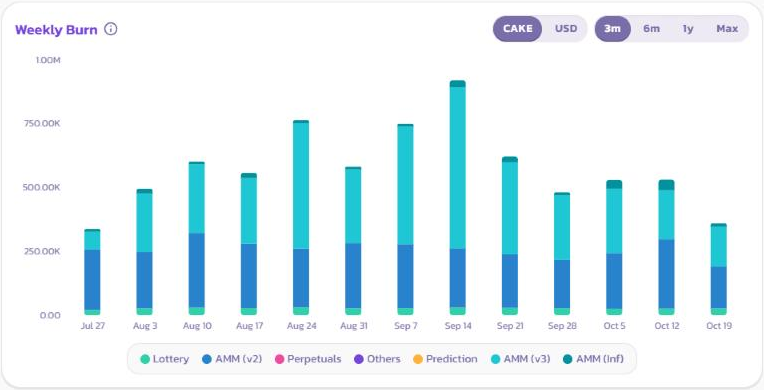
According to PancakeSwap’s official burn dashboard, weekly product-level data from the week of July 27 through the week of Oct. 19 shows about 7.51 million CAKE were burned over 13 weeks. Of that total, v3 pools accounted for about 3.9 million CAKE, or 51.9%, while v2 pools contributed about 3.01 million, or 40.1%.
v3 has generated more than half of total burns largely because trading activity there is far higher than on v2. DefiLlama data shows v3 currently has about $720 million in total value locked, less than half of v2, but from Sept. 23 to Oct. 22 it processed $15.4 billion in volume, more than 13 times v2.
Using the 13-week average, CAKE is now running at net deflation of about 426,000 tokens per week. If The Flip were fully implemented, the roughly 319,000 CAKE burned each week by v3 and Infinity would drop to zero, while lower emissions would reduce issuance by only about 103,000 CAKE per week. Net deflation would fall to about 210,000 CAKE a week, less than half the current pace. Using the team’s 10-week average instead, the figure would be about 190,000 per week.
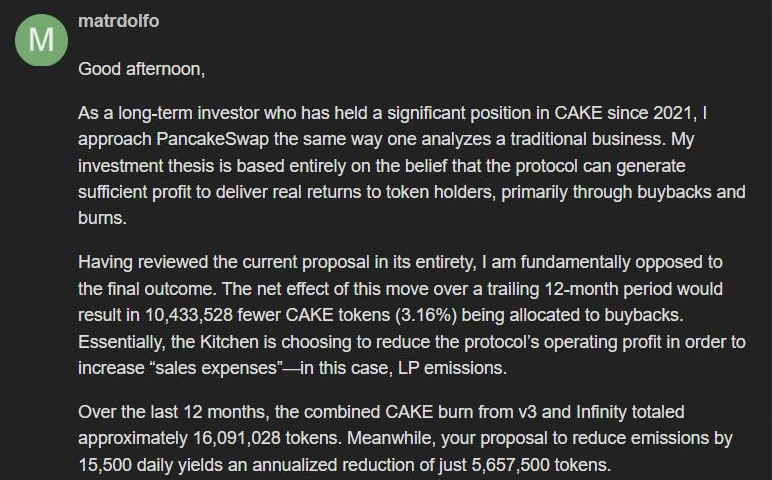
On the governance forum, a long-term holder using the name matrdolfo, who said he has been heavily invested in CAKE since 2021, posted an annual comparison. Over the past 12 months, v3 and Infinity together burned about 16.09 million CAKE, while the new plan would reduce annual issuance by only about 5.66 million CAKE.
Deflation as a tool, or as the goal
Why burns matter so much to holders is tied to CAKE’s history.
CAKE was heavily inflated in its early years through farming rewards. Starting in 2023, the team repeatedly revised tokenomics toward a deflationary model. Tokenomics 3.0, introduced in April 2025, removed the veCAKE lockup mechanism, cut emissions, and set a target of reducing total supply by about 20% before 2030.
According to PancakeSwap’s September burn report, CAKE has recorded net deflation for 37 straight months and total supply has fallen by about 61.6 million from the peak of roughly 392 million in September 2023.
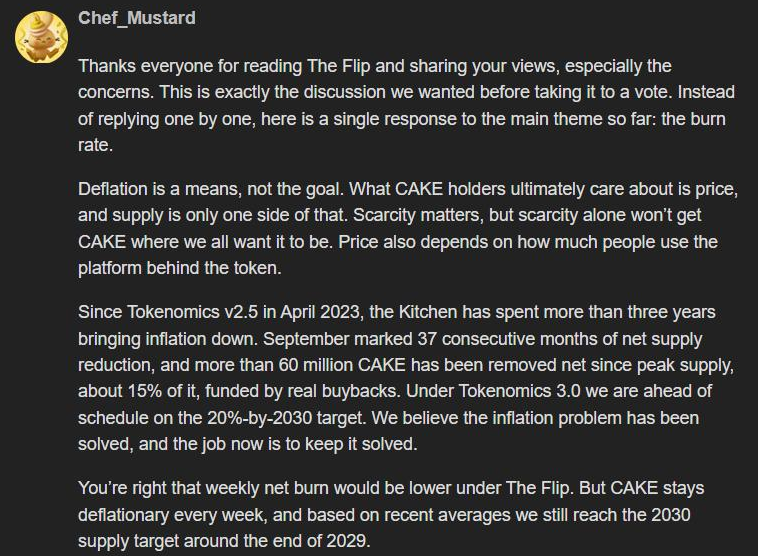
In its forum response, The Kitchen said deflation is a means rather than an end, and that token price ultimately depends on platform usage. The team also said CAKE’s supply reduction under Tokenomics 3.0 is already ahead of schedule and that lower treasury revenue is a short-term sacrifice for long-term growth.
A revised version did not calm the debate
On Oct. 19, the team put forward a revised plan.
Under that version, the switch would happen in stages across chains. Chains contributing the least to CAKE burns would move first, while the biggest contributors would move last. The final step would not happen until CAKE reaches the 20% total supply reduction target, which the team expects about 12 months after the first batch is completed. Emissions would first be lowered to 11,000 CAKE on week 10. The team also said non-stablecoin fees received by the treasury would continue to be used to buy back CAKE.
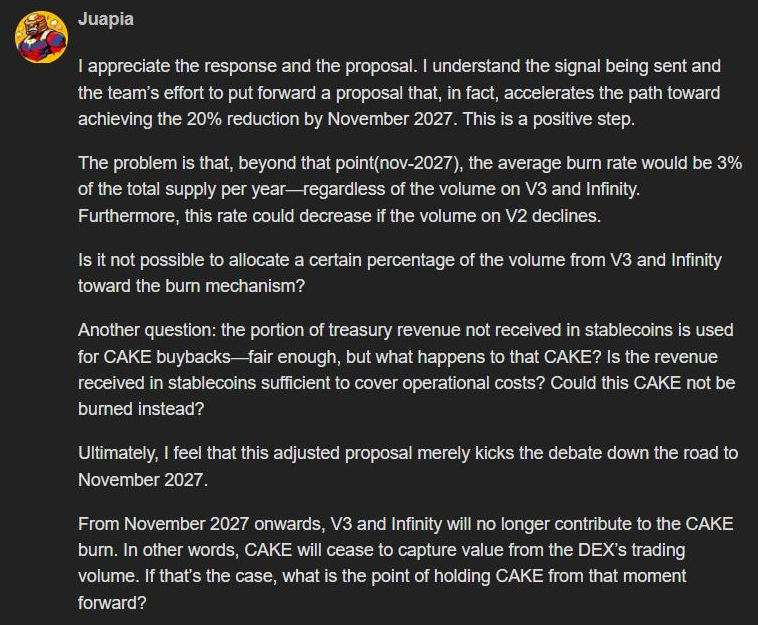
The compromise did not stop the criticism. A user named Juapia argued that proportional burns matter because higher platform usage means more CAKE gets burned. Once the full switch is complete, even if v3 and Infinity volume keeps growing, that growth would no longer translate directly into CAKE burns. In Juapia’s view, the revised plan only pushes the dispute back to November 2027.
The market backdrop behind the proposal
The proposal comes as PancakeSwap is trying to respond to weaker trading momentum.
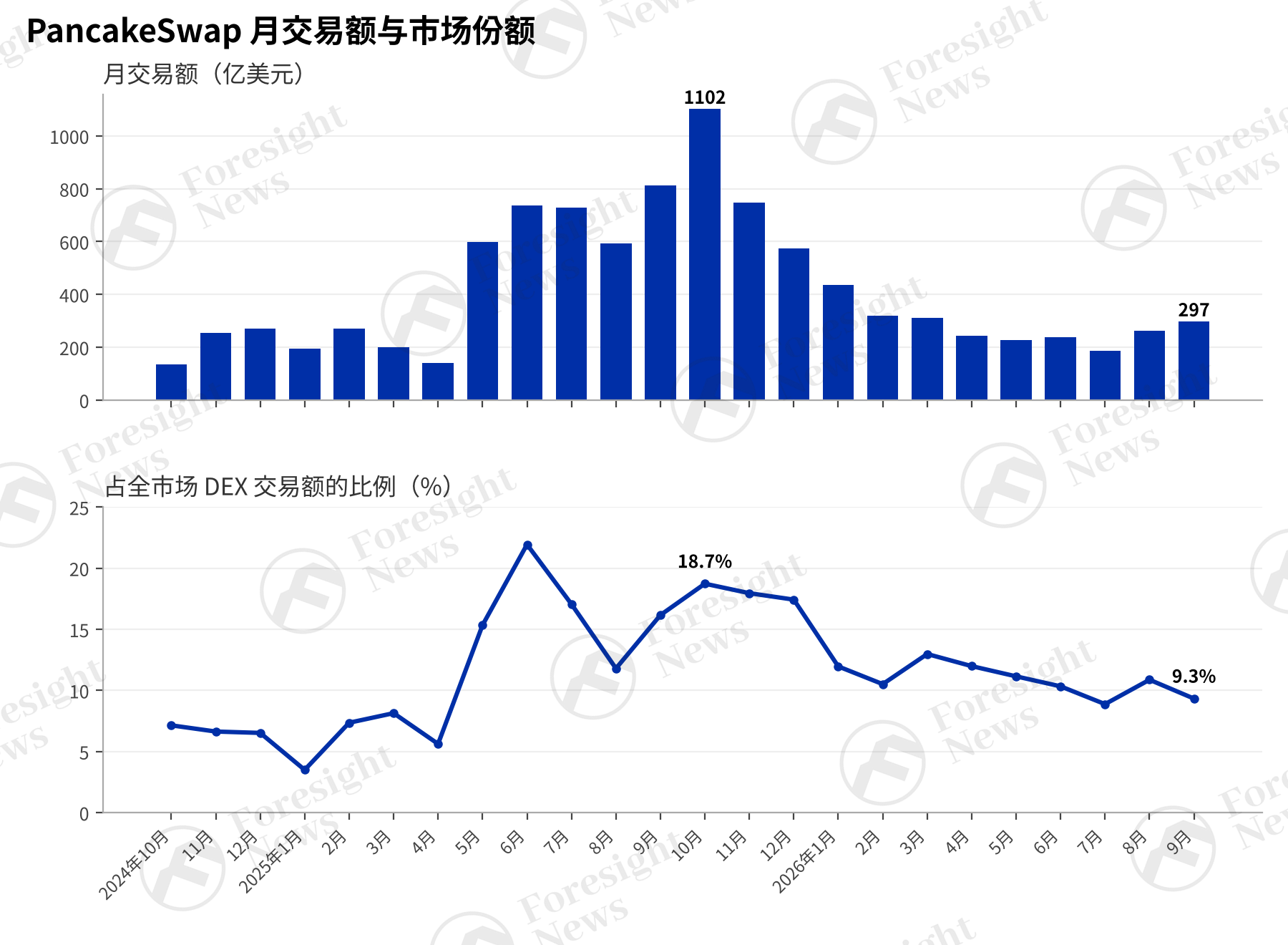
DefiLlama data shows PancakeSwap’s monthly volume peaked at about $110.2 billion in October 2025 and then generally declined, hitting about $18.5 billion in July 2026. Activity started to recover in August. September volume came in at about $29.7 billion, up 13.4% month over month, while monthly fees reached about $24.3 million, up 38.5%.
Over the same period, total DEX monthly volume across the market fell from about $588.1 billion to about $318.4 billion, a drop of roughly 45.9%. PancakeSwap’s decline was steeper at 73.0%, compared with 25.4% for Uniswap, 42.8% for Aerodrome, and 58.1% for Raydium. Its share of total DEX volume also dropped from 18.7% to 9.3%.
Another issue raised by critics is protocol take rate. Crypto analyst thelearningpill, citing 30-day Token Terminal data as of Oct. 18, said PancakeSwap’s protocol revenue accounted for 32.7% of fees, the highest among major AMMs. Raydium stood at 16.1% and Uniswap at 12.5%.
If The Flip is implemented, that share for PancakeSwap v3 and Infinity would fall to 12%. But both of the peers cited in the debate still route a fixed portion of fees back to their tokens. Uniswap turned on protocol fees through the UNIfication proposal in December 2025, directing one-sixth to one-fourth of v3 LP fees to UNI burns. Raydium allocates a fixed 12% of fees to buy back RAY.
Where the disagreement really sits
Community opponents are not rejecting the value of liquidity itself. The real split is over how business growth should flow through to the token.
A user named PancakesLover said the proposal needs to keep v3 and Infinity fees linked to CAKE and suggested allocating 4% to CAKE holders while LPs would still receive 84%. He said he would vote yes if the team adopted that structure; otherwise, the foundation he is part of sees no reason to keep holding CAKE. Other forum users proposed preserving a 6% to 10% burn ratio, but those versions were not included in the final vote.
Voting ends at 16:07 on Oct. 24. If the proposal fails, the current fee distribution model and the daily 22,500 CAKE emission rate will remain in place, and the team would need to submit a new proposal.