

Pantera says perpetuals are moving from crypto’s edge toward the center of finance
Pantera Capital says perpetual futures are no longer just a crypto-native product. In its view, they are turning into one of the defining trading instruments of modern markets, and recent action by the U.S. Commodity Futures Trading Commission, or CFTC, shows the U.S. regulatory system has started to accept that shift.
The firm frames perpetuals as a cleaner version of futures: contracts without expiry that rely on funding payments between longs and shorts to keep prices close to spot. Pantera argues that structure makes them easier to manage than dated futures, easier to understand than options in many cases, and naturally suited to 24/7 trading. That matters because the users who grew up in online, global markets expect continuous access rather than limited exchange hours.
Pantera traces the product’s intellectual roots back to a 1993 paper by Nobel laureate Robert Shiller, but says traditional exchange structure kept the idea from catching on. Crypto did the opposite. It gave perpetuals an internet-native market in which the model could scale, first through BitMEX in 2016 and later across the wider digital asset sector.
The report cites 2025 centralized exchange perpetual volume of $62 trillion, compared with about $19 trillion in spot volume. Total derivatives volume reached $86 trillion, with perpetuals making up most of that figure, which Pantera says points to a stronger market preference for perpetuals than for options.
Hyperliquid is described as the main on-chain breakout
For years, most perpetual trading stayed on centralized exchanges. Pantera says the more important recent development is the move on-chain. Early decentralized versions, including GMX, Synthetix, and DYDX, found some traction but struggled to match centralized venues on latency, liquidity, and user experience.
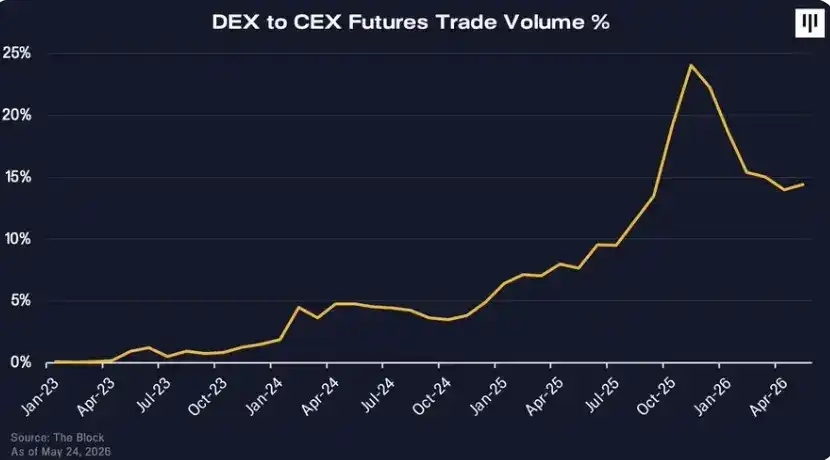
Pantera says Hyperliquid changed that. The firm writes that decentralized perpetual volume has climbed to 14% of centralized perpetual volume, up from less than 1% when Hyperliquid first launched in early 2023. It adds that Hyperliquid now accounts for about 40% of on-chain perpetual trading.
The protocol was conceived by Jeff Yan, a Harvard Math 55 alumnus and former high-frequency trader who previously ran the market-making firm Chameleon Trading. Pantera says the collapse of FTX pushed Yan and his team to build a decentralized alternative, while also convincing them that existing blockchains were too slow for professional-grade on-chain trading.
The team built its own Layer 1 for trading and released it globally in late February 2023. Pantera says one design choice was a speed-bump-like feature intended to stop the most aggressive high-frequency trading firms from exploiting market makers, even at the cost of some short-term volume.
To deal with the cold-start problem, the team also opened its proprietary trading algorithms through HLP, an on-chain vault that anyone can join. Pantera says that decision helped seed liquidity and also strengthened support from the community. The report notes that the team moved to Singapore in spring 2024 because of uncertainty around U.S. rules for DeFi and perpetuals.
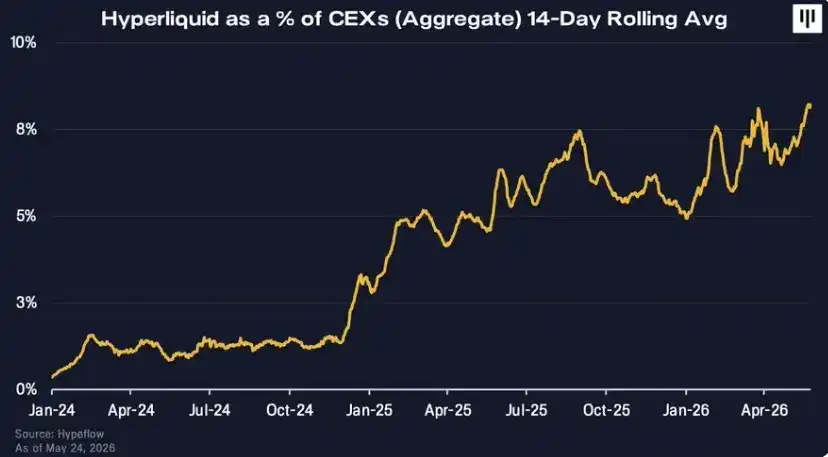
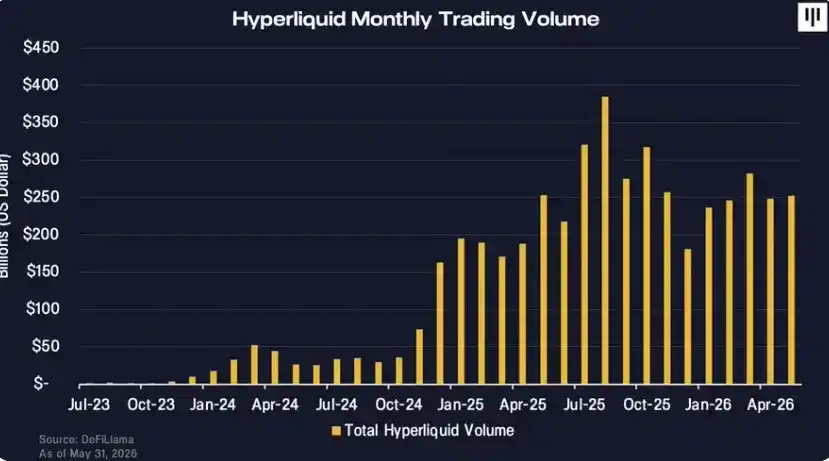
Pantera says Hyperliquid has become the largest and most profitable decentralized perpetual exchange, with monthly volume above $250 billion and annualized revenue of $800 million. It also says Hyperliquid’s share of trading relative to centralized venues has kept rising.
The platform’s pitch has expanded beyond crypto
Pantera says Hyperliquid’s growth accelerated this year as it moved beyond crypto-native assets into equities, commodities, indexes, and private companies. Jeff Yan describes that goal as housing “all finance” on one platform.
The report points to two blockchain-native traits behind that push. One is continuous market access. Hyperliquid runs around the clock, including weekends and holidays, while venues such as the New York Stock Exchange and CME operate on weekday schedules. The other is permissionless listing, which allows outside groups to launch markets tied to whatever assets traders want most rather than limiting listings to the core team’s initial roadmap.
Pantera says that listing model was unlocked by Hyperliquid Improvement Proposal 3, or HIP-3, which allows third parties to deploy new perpetual markets and earn part of the trading fees. It identifies trade.xyz as the most active outside deployer.
The firm uses several cases to show what that flexibility looks like in practice. When gold and silver prices surged in late 2025, Pantera says Hyperliquid was the only venue where those assets could be traded over the weekend, including when China announced a change to silver collateral requirements. It says silver briefly reached 2% of global derivatives volume at the peak.
Pantera gives a similar example for oil. When the Iran conflict began on a Saturday morning in late February, it says Hyperliquid was the only platform where oil could be traded that weekend. The original article says daily crude volume surged, though the figure is missing in the source text. Pantera adds that when oil futures opened on Sunday night, they opened at the price already traded on Hyperliquid’s perpetual market. At the peak, oil trading on Hyperliquid reached 2% of global oil derivatives volume.
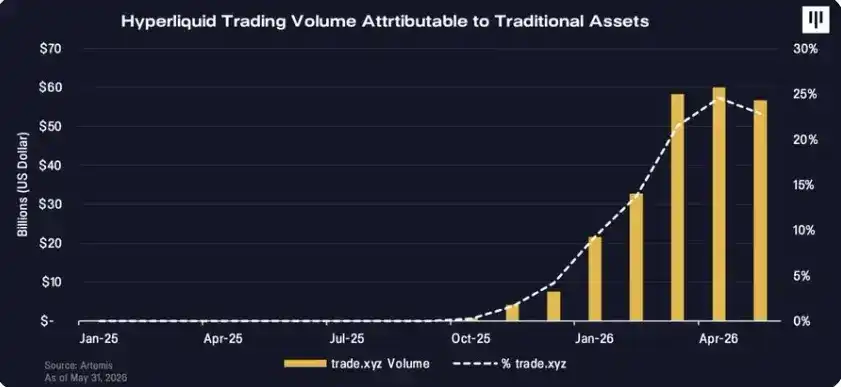
One month later, a fully licensed S&P 500 perpetual contract recorded more than $100 million in first-day volume. Pantera says traditional assets have at times made up as much as 40% of Hyperliquid’s trading, compared with basically zero at the end of 2025.
Mainstream finance has started paying attention
Pantera says Hyperliquid has drawn broader attention this year. According to the firm, more traditional-asset hedge funds are referencing Hyperliquid prices and even considering trading there to react faster to world events.
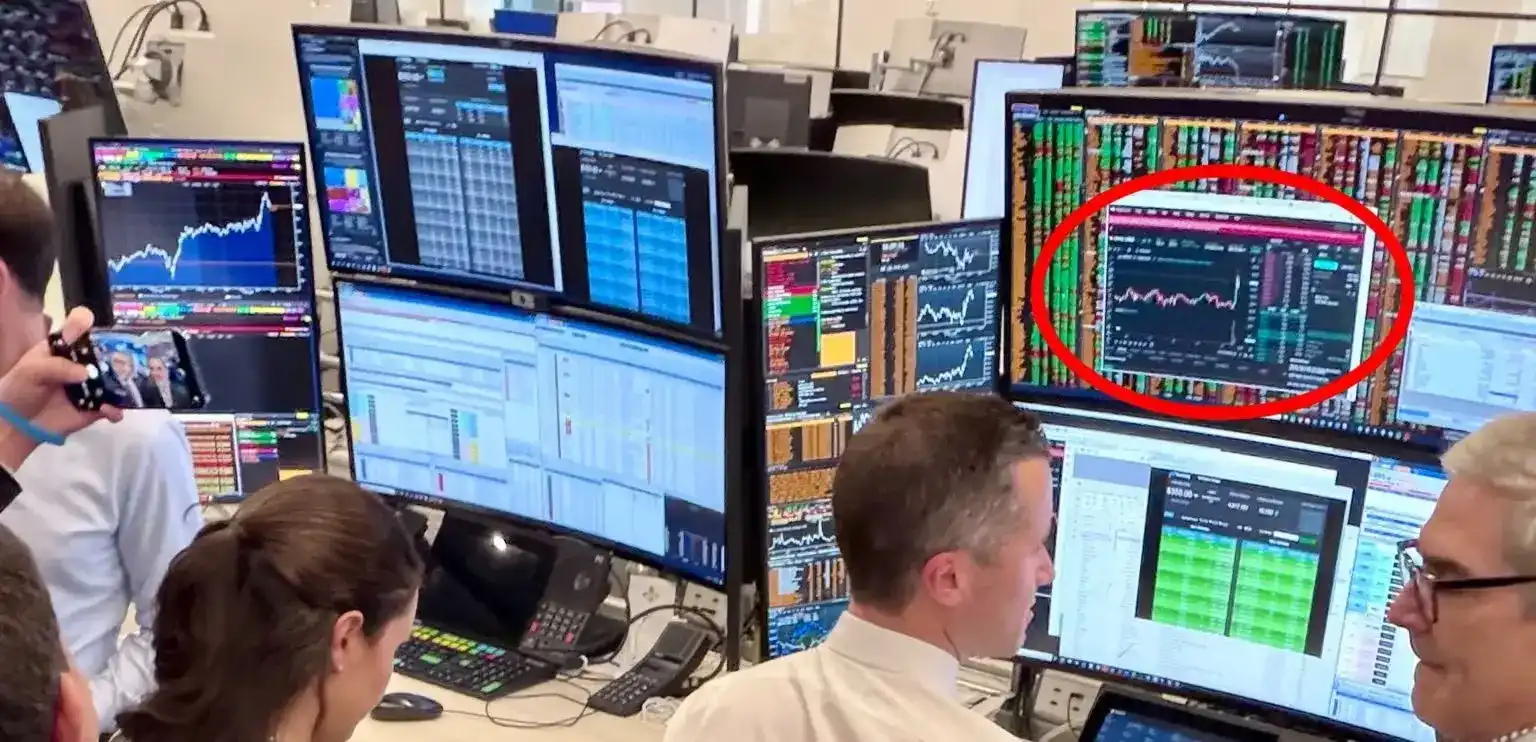
It argues that Hyperliquid is becoming a price-discovery venue for hours when other markets are closed, and not only on weekends. Pantera says that increasingly applies to pre-IPO private companies as well. On the day of Cerebras’s IPO, which the report calls the biggest IPO of the year to date, banks underwriting the deal were watching Hyperliquid’s price. The report also mentions a circulated photo showing a banker with the Hyperliquid trading screen open before the listing.
Traditional exchange operators are also watching, Pantera says. On May 27, at Bernstein’s Strategic Decisions Conference, Intercontinental Exchange founder and CEO Jeffrey Sprecher called Hyperliquid “bigger than Nasdaq” and said ICE had met its founders several times. Pantera adds that reports two weeks earlier said ICE and CME had pressed regulators to restrict Hyperliquid, which it interprets as a sign they see the platform as a real competitive threat.
Public markets have taken notice too. Pantera points to Hyperliquid Strategies Inc. (NASDAQ: PURR), a digital asset treasury company focused on Hyperliquid in which Pantera is a cornerstone investor. The company holds HYPE on its balance sheet, is chaired by former Barclays CEO Bob Diamond, and is led by CEO David Schamis. Pantera says the two have promoted the HYPE case in mainstream U.S. financial media including CNBC’s Squawk Box and Bloomberg.
As of June 1, 2026, PURR was up more than 200% year to date and was one of the few digital asset treasury companies consistently trading at a premium to net asset value, according to Pantera.
SpaceX, HYPE buybacks, and the size of the market
Pantera says the next catalyst to watch is the reported IPO target for SpaceX later that month. Hyperliquid already lists a SpaceX perpetual, giving traders a way to express a pricing view before Nasdaq trading opens to public equity investors.
As of June 1, 2026, Pantera says SpaceX was trading on Hyperliquid at about $200 per share, above the level bankers were rumored to want for the IPO. The firm also says Elon Musk’s profile as a crypto-friendly SpaceX chief executive could push bankers and investors to pay attention to SpaceX trading on the platform.
On token economics, Pantera says Hyperliquid is a token-based protocol with HYPE as its native asset. It highlights a programmatic buyback mechanism funded with 99% of platform revenue. The investment case, as Pantera lays it out, rests on a large and growing addressable market, strong execution, a scale flywheel tied to order-book liquidity, a product experience built on a custom Layer 1, and a direct link between protocol growth and token-holder value.
The report estimates Hyperliquid’s total addressable market at roughly $10 trillion in daily notional volume. As reference points, it lists about $200 billion a day in stock trading tied to 0DTE options and leveraged ETFs, $2 trillion a day in commodity derivatives, and about $8 trillion a day in foreign-exchange derivatives. Pantera says capturing even a very low single-digit share of that combined volume on a sustained basis would imply revenue around 5x current levels, with similar upside for valuation.
Pantera says regulation remains the biggest risk, even as the CFTC opens a path
For all of the upside in the report, Pantera says regulation is still Hyperliquid’s biggest risk. Perpetuals are not yet freely tradable in the U.S., though the firm says a trend toward legalization and listing has now emerged. Hyperliquid has no KYC requirement, and while it geofences U.S. users, Pantera says it is not impossible to imagine ways around that.
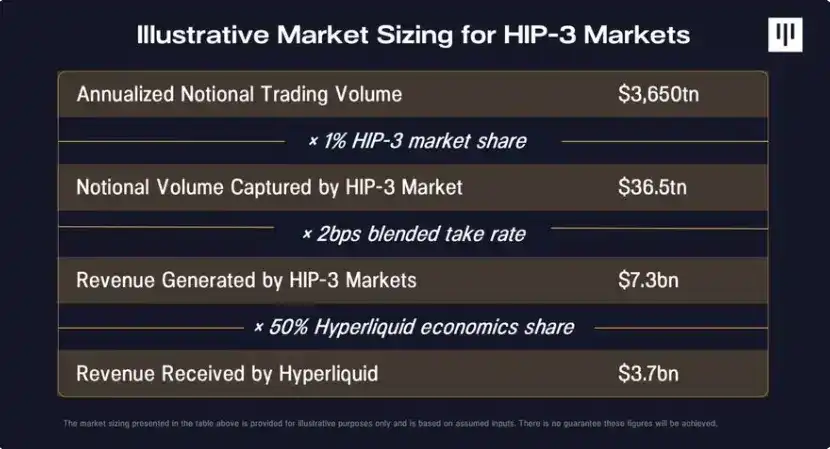
If perpetuals become legal in the U.S., Hyperliquid could face much tougher competition from regulated venues and could lose some American volume to those platforms, Pantera says. One possible response, it adds, would be for Hyperliquid to launch its own regulated U.S. version, as other platforms have done.
The firm says the biggest single constraint on U.S. perpetual growth has long been regulatory uncertainty, which was one reason Hyperliquid’s team moved offshore to Singapore. That started to change last week, it says. Pantera points to the CFTC’s approval of a bitcoin-based perpetual futures contract filed by Kalshi, a registered U.S. exchange, and says CFTC staff also cleared a path for Coinbase to offer certain crypto perpetuals through a foreign affiliate by treating them as foreign futures.
Pantera’s broader reading is that the CFTC has opened a route for regulated crypto perpetuals under the existing futures framework rather than insisting on a separate ruleset. The harder question, it says, is what would be required to bring decentralized perpetuals to U.S. users. For a permissionless on-chain protocol, that path is still unclear, especially if it aims to preserve permissionless access and no-KYC design while addressing sanctions and market-integrity concerns.
Pantera ends with a simple point: perpetuals started on the edge of crypto because that was where market structure changed fastest. Now they are moving toward the center of global finance, and Hyperliquid is sitting in the middle of that transition.