


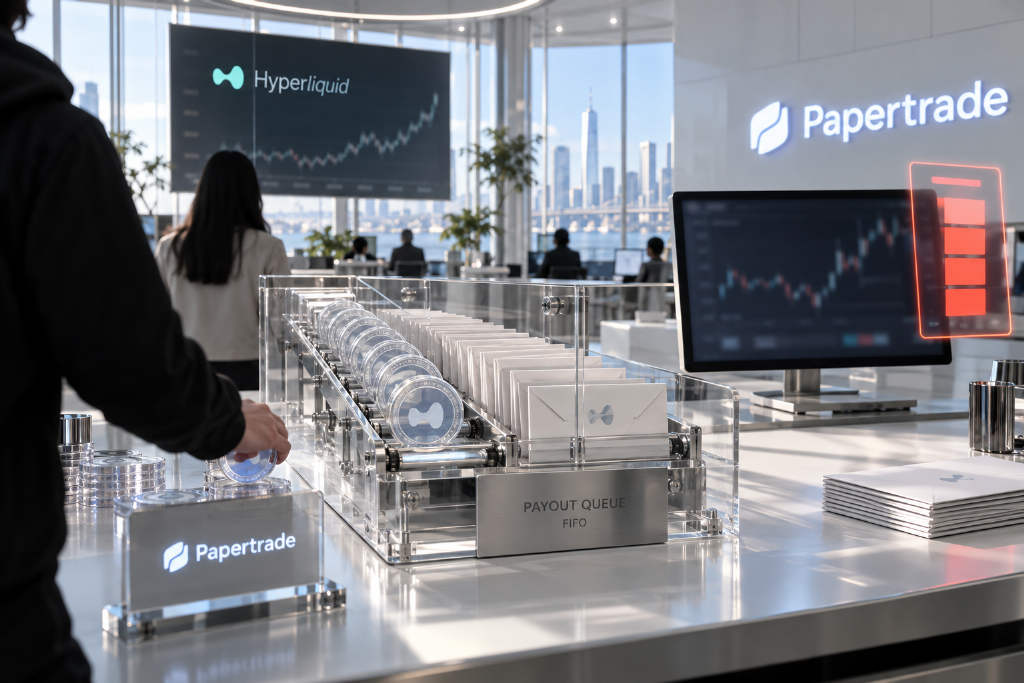
Papertrade is trying to launch a perpetuals venue with a structure that breaks from the usual exchange model: no external LPs, a public queue for unpaid profits, and a token that is minted from trader losses. According to the article published by ChainCatcher, the project plans to open deposits on Oct. 8 and begin trading on Oct. 10.
The article says Papertrade describes itself as a fully on-chain perpetual exchange offering up to 1000x leverage, no funding rate, no slippage, and a liquidity pool that can grow from zero. Economically, though, the report argues it looks closer to a casino than to a standard exchange.
The protocol takes the other side of every trade
On venues such as Hyperliquid or Lighter, longs and shorts are matched through an order book and market makers provide liquidity. Papertrade does not match traders against one another. The protocol itself takes the other side of each position.
Its reference price comes from Hyperliquid. Papertrade uses the midpoint between Hyperliquid’s best bid and best ask for entries and exits, but it does not hedge there. It records positions, follows the reference price, and settles profit and loss from its own cash pool.
The initial markets are limited to BTC and ETH. The article says Blurr explained in a founder interview that even the most liquid assets are hard to manage at 1000x leverage. Faster-moving and easier-to-push tokens could let traders extract more from the protocol than liquidations recover. SOL was mentioned as a possible later market at close to 300x, but not as a confirmed launch asset.
Positions are isolated margin only. Traders cannot use cross margin, cannot add margin after opening a trade, and cannot partially close a position. Current documentation sets a per-user cap at $10 million, while an earlier interview example used $20 million. The article says the live contract settings will be the final reference.
It uses a simple leverage example to show how tight the risk is. A trader who posts $100 at 1000x controls a notional position of $100,000. A 0.10% move produces a $100 profit or loss, equal to the starting margin. Papertrade expects liquidation to happen earlier, roughly after a 0.05% move against the trader.
There is no funding payment. Blurr argued this can work for BTC and ETH because spot and perpetual prices usually stay close. Stocks, gold, and markets with overnight or weekend closures are harder to handle under the same setup.
“Zero slippage” applies to pricing, not necessarily to what winners receive
Because Papertrade has no local order book, large trades do not walk through multiple price levels. Each trade is priced at the midpoint of Hyperliquid’s best bid and ask. That is what the project means by “zero slippage.”
The article says that does not mean the final payout always equals the raw profit shown on the trade. Winning positions pass through a payout curve. Small moves are discounted more heavily, while larger moves get closer to the full raw profit. One example in the report shows a trade with $1,000 in raw profit ending up with a $600 payout after the curve, though that number is only illustrative and the actual result depends on live parameters.
Blurr said in the interview that the team borrowed heavily from Rollbit’s math. The article’s conclusion is straightforward: “zero slippage” describes entry and exit pricing, not the amount a trader ultimately receives. Before a user confirms a trade, the app should show the reference price, raw profit, post-curve profit, and any queue delay.
Fees are also not described as a simple charge on position size. In the interview, Blurr described a fee equivalent to 1% of profit and loss. The exact formula, and whether it is applied before or after the payout curve, still needs to be specified in the contract.
Margin comes back first, unpaid profit goes into a FIFO queue
The center of the design is a public payout queue.
The article starts with an empty cash pool. If one trader deposits $100 and closes with a $100 gain, the protocol can return the original margin, but it may not have the extra $100 profit available. That unpaid profit becomes a public claim in the queue.
If the next trader loses $40, that $40 goes first to the earlier winner, who still has a remaining $60 claim. Another $60 loss clears the rest. If a second winner appears before the first claim is fully paid, that trader waits behind the first one. The queue is first in, first out.
Official risk documentation allows the cash pool to go negative. The article also cites a larger example from Blurr: if the pool has $5 million available and a winning trade requires $6 million, the trader gets $5 million immediately and waits for the final $1 million.
This is where liquidity risk sits. If the wait becomes too long, traders may leave. If traders leave, the stream of losses needed to repay queued claims weakens as well. The team describes the queue as an early backstop and says the ideal case is that it is rarely used.
PAPER is minted from losses and liquidations, with the richest emissions at the start
PAPER starts from zero supply. The project says there is no premine, no team or VC allocation, no airdrop, and no vesting schedule. Tokens are minted only when users realize trading losses or are liquidated.
Current documentation says that as long as the protocol’s tracked cash balance remains below $2 million, every $1 of loss mints 100 PAPER. A $100 loss would therefore mint 10,000 PAPER.
Once the balance rises above $2 million, the mint curve tightens. The article says the high-water mark H tracks cumulative LP profit above that threshold, and the marginal mint rate becomes 100 × (120M / (120M + H))² PAPER per qualifying dollar of loss.
It then gives a series of examples. At H = $50 million, the rate is about 50 PAPER per dollar. At $120 million, it falls to 25, and half of the 12 billion tail has been emitted. At $260 million, it is about 10. At $420 million, it is 5. At $1.08 billion, it is 1, by which point 10.8 billion PAPER has been emitted from the tail.
The 12 billion figure is not a hard cap. It is the mathematical limit of the decaying tail if the high-water mark keeps rising. If tracked LP falls back below $2 million, the flat 100 PAPER-per-dollar rate returns, reopening a path to unlimited minting.
The article notes an inconsistency in the interviews. Blurr moved between 100 and 1000 PAPER per dollar in different remarks, while the current documentation says 100. Until contracts are public, the report treats 100 as the more usable working number.
PAPER can be staked immediately, but it will not be freely transferable at launch
Under the current design, PAPER can be staked right away. Stakers are supposed to receive most of the house fees and any cash above the protocol’s target balance.
Blurr put the initial target near $5 million. The article gives an example: if the pool reaches $6 million and the target stays unchanged, the extra $1 million could go to stakers, while the protocol keeps enough revenue to cover trading costs.
At launch, however, PAPER will not be freely transferable. Users can mint it and stake it, but transfers are scheduled for a later phase. Without a market price, 10,000 PAPER earned from a $100 loss could be worth $5, $50, or more than the loss itself. The article says nobody knows yet.
That uncertainty could drive early trading. Anyone expecting PAPER to appreciate may intentionally lose money to farm it. The report says Blurr explicitly suggested doing this through agents and said Papertrade was designed to support that behavior.
Intentional losses add cash to the pool and can help clear the queue, but they can also make demand look healthier than it really is. If bots chasing PAPER account for most of the early volume, activity could drop sharply once emissions decline or the token opens weakly.
The article also cites a pre-launch simulation snapshot using live BTC and ETH prices. In that snapshot, 100x produced the cheapest PAPER at about $2.55 per 1,000 tokens. Adaptive leverage came in at $2.81, 20x at $4.38, 1000x at $5.06, and 3x was the most expensive at $17.38. These are early results rather than live product data, but the point is clear: the highest leverage is not automatically the cheapest route to farming PAPER.
Early-holder advantage and access control are major watchpoints
The article lays out a plain long-term strategy embedded in the design: accumulate a large PAPER position while emissions are still rich, stake it, and then bring in more trading activity. Later users contribute cash and fee revenue, but receive fewer tokens for the same losses. Once transfers open, early positions can be sold into a market that already has a revenue story.
It says there is no public evidence that the founders plan to farm through affiliated wallets or reserve hidden allocations. The measurable concern is access. PAPER distribution begins before direct contract access opens, while the project-operated relayer controls order flow. Public code and wallet distribution will show whether the first large allocations went to ordinary users, coordinated farmers, or team-linked wallets.
The report also mentions a more aggressive scenario in which PAPER could one day be accepted as collateral for new positions. That would turn early token balances into leverage. Current documentation does not say PAPER will be accepted as collateral, so the article treats this as a scenario to watch rather than part of the launch design.
It breaks the risk by participant:
- Losing traders supply cash to the system and receive PAPER that may never cover their losses.
- Winning traders recover margin, but may have to wait for profit.
- PAPER stakers earn fees and cash above the target balance, while taking dilution and weak-volume risk.
- Papertrade absorbs the combined PnL of all users while paying trading costs and running trade submission.
On that basis, the article argues that PAPER looks more like a claim on the house than like a standard points token.
Simulation results show the design can work under assumptions, not that deposits are safe
An independent repository called PaperTrade-Simulations ran about 3.6 million historical high-leverage Hyperliquid trades through 608 scenarios. According to the article, all 608 remained solvent. In 81.2% of them, the system never entered debt. The worst queue reached roughly $61,974 and was cleared the same day. In the model, the cash pool hit its $5 million cap within five days.
The token numbers were large as well. Final PAPER supply reached 8.63 billion, and simulated staking fees totaled $248.1 million. The report says these outcomes show that enough loss flow can sustain the design. They do not show that a new venue will attract that flow, or keep it once real users see a queue.
Even the weakest scenario assumed 25% of the selected Hyperliquid activity. The source traders used leverage below 1000x, and mixing those trades together removed much of the herd behavior that can appear when many users lean the same way. The model also excluded price manipulation, relayer delay, liquidation failure, farming bots, and user churn after slow payouts.
The article adds that the dataset was distributed externally without a published integrity hash. The repository had only one commit and no independent reproduction. As a result, it says the model is useful for testing assumptions, but not strong enough to endorse deposits.
The key metrics are payout speed and reuse, not headline volume
In the healthy version of the flywheel, high leverage pulls traders in, losses build the cash pool, and staking sends part of the revenue back to PAPER holders. If that return looks attractive, farming continues to supply the cash needed for payouts.
The useful variable, the article says, is net trader loss relative to newly created winner claims. Positive inflow grows the pool. Negative inflow lengthens waits and weakens the incentive to trade or farm. Because 1000x leverage can turn a small amount of margin into huge notional volume, headline volume can hide what is really happening.
It lists the metrics that matter more:
- peak queue liabilities and average wait time;
- the share of winner profits paid instantly;
- how much cash remains after unpaid claims;
- how much PAPER is minted per $1 of net retained cash;
- whether traders come back after a first liquidation;
- fee revenue after trading costs.
Those numbers separate a growing cash balance from a system where leveraged volume spins around a thin layer of money.
The price source is part of the risk model
Papertrade reads Hyperliquid’s public price instead of running its own signer set. The article says that order book can be pushed. An attacker could move the best bid and ask on Hyperliquid, trade against the distorted Papertrade price, and then let the market snap back. If the money inside Papertrade exceeds the cost of moving Hyperliquid’s BTC or ETH book, the attack works.
That logic supports the planned $5 million cap. The team wants the pool to stay below the rough cost of pushing the BTC or ETH order book. The article says that assumption has not been independently verified.
Stale prices create another opening. If HyperEVM pauses while Hyperliquid keeps moving, Papertrade could briefly quote an old price. A trader holding both long and short positions could close the losing side against the stale quote and keep the winning side. Blurr discussed freezing or settling markets in that case.
At 1000x leverage, seconds matter. The price source, trade queue, and liquidation system need to stay in sync. If they do not, delay alone can decide who wins and who pays.
The launch starts with a project-run relayer, not direct contract access
Papertrade runs on-chain, but users will not interact directly with the contracts on day one. The launch plan has four phases:
- Deposits open on Oct. 8 while trading remains closed.
- Trading starts on Oct. 10 through the website and a project-operated relayer.
- Direct contract access opens later for users, apps, and agents.
- Builder rewards and PAPER transfers arrive in a later phase.
The relayer submits user trades on-chain to prevent bots from starting gas wars. Requests do not receive equal priority. Liquidations come before closes, closes come before new opens, and larger trades may jump ahead of smaller ones, according to the interview cited in the article. Early users therefore have to trust those servers to stay online during congestion and to enforce that ordering fairly.
Papertrade also plans to cover blockchain fees for ordinary users. Small withdrawals may wait until fees fall, while larger positions get faster service. Emergency controls allow the team to stop new positions, close markets, change limits, and manage the relayer. Until direct access opens and those powers are fully documented, the product still depends heavily on the team.
The idea predates the current launch push, and the team remains small
The article traces the concept back more than two years before the September marketing push. Blurr said he and Jez wrote the first paper on the queue system in the summer of 2024 after testing blackjack and coin-flip models. The Martingaler white paper described a game that could start without a pre-funded house and record unpaid winnings as liabilities.
By January 2025, Jez was discussing the combination of extreme leverage, smoothed entry prices, asymmetric payouts, and casino economics associated with Rollbit. He also framed casino tokens as ownership claims on future cash flow. In September, he publicly referred to Blurr as a business partner and explained why leveraged markets can run out of collateral before losers generate enough to pay winners. Papertrade’s queue is the mechanism that pushes that gap forward in time.
The queue survived into the launch design, but the token model changed. The white paper used a different emissions model and discussed buybacks and burns. The current version uses staking and a declining mint curve. The article says public contracts should clarify which parameters actually go live.
Papertrade is presented as a project by Jez and Blurr. Jez is Colin Hong. The article cites a World Poker Tour profile listing MIT, Morgan Stanley, and a Venture Partner role at Standard Crypto. Blurr is a pseudonymous founder whose public background comes mainly from two long interviews and the white paper. He said he met Jez in New York in 2021 and that Papertrade was built by only two or three people. That means contracts, relayer operations, risk parameters, and emergency response sit in very few hands.
Funding has not been disclosed. The article adds that the “fair launch” claim applies to PAPER distribution, and Jez’s role at Standard Crypto does not prove that the fund invested in the project.
Competition, distribution, and what can actually be defended
The report places Papertrade somewhere between a perpetual exchange and an online casino. Hyperliquid and Lighter offer deeper markets and instant settlement. Papertrade offers much higher leverage, no funding rate, and no local order-book slippage, but the house takes the other side and profits can be delayed.
Economically, the article says the closest comparison is gTrade because traders face a shared pool priced off external markets. The difference is the cold start. gTrade needs funded liquidity up front, while Papertrade turns uncovered winnings into debt. Rollbit shows there is an audience for simple extreme-leverage trading. Trade.xyz and other HIP-3 markets solve a different problem by adding assets to Hyperliquid rather than removing the need for pre-funded liquidity.
The mechanism itself looks easy to copy. Any durable edge would have to come from reliable payouts, cash already sitting in the pool, execution quality, and distribution. Builder code may help by sending 1% of referred trading revenue to external apps, though direct contract access and third-party integrations are not live yet.
The project already has an audience. The article says a Sept. 29 launch video on X passed 1 million views, while a detailed launch post drew about 133,000 views and more than 1,000 likes. That may create a noisy first week. The more useful demand signal comes later, when users who have already been liquidated, received PAPER, or waited in the profit queue decide whether to trade again.
As of Oct. 2, there was still no public contract address, verified code, or audit report
The article closes by separating what exists from what is still missing. Papertrade has detailed documentation, a white paper, and a concrete launch plan. But as of Oct. 2, there was still no official contract address, verified source code, or public code repository. Users therefore could not verify live fees, token emissions, payout rules, emergency controls, or upgrade permissions.
Papertrade hired Guardian Audits, and Guardian publicly confirmed the engagement. At the report’s cutoff, however, there was still no Papertrade report, audited code version, findings, or fixes in Guardian’s repository.
Some protections are already described in writing. Temporary trading keys cannot withdraw funds, and liquidations or queue payouts are supposed to be callable by anyone. The article says those claims still need to match deployed code.
At 1000x leverage, it argues, public evidence is needed before deposits open: official contracts, matching source code, a completed audit, and a small end-to-end “deposit-trade-withdraw” test that anyone can follow.
What would actually validate the model
On launch day, the full path has to work without manual intervention: deposit, open, close or liquidate, payout, and withdrawal. Before confirmation, the app should show raw profit, adjusted profit, and queue status.
A sharp BTC or ETH move will be the first real stress test, especially if traders lean heavily to one side. That will hit liquidations, position limits, pricing, and the queue at the same time. If debt appears, the article says observers should watch not only the peak size but also how quickly it is cleared.
One month later, reuse matters more than launch volume. The report points to returning traders, the share of bot activity, how much PAPER is minted for each net $1 added to the pool, and staking income after trading costs.
Once PAPER becomes tradable, its market price will put a value on tokens earned through losses. If buying PAPER directly turns out to be cheaper than farming it, activity could be pulled away from the trading product itself. Later still, direct integrations and real builder-code revenue will show whether other apps find the mechanism useful.
The article’s final point is that Papertrade does not remove the need for liquidity. It asks trader losses over time to create that liquidity, then rewards the people providing those losses with PAPER. The first serious burst of volatility will decide whether delayed payouts are just a cold-start mechanism or a way of turning a liquidity shortfall into protocol debt. Peak volume will not answer that. Payout speed and repeat usage will.