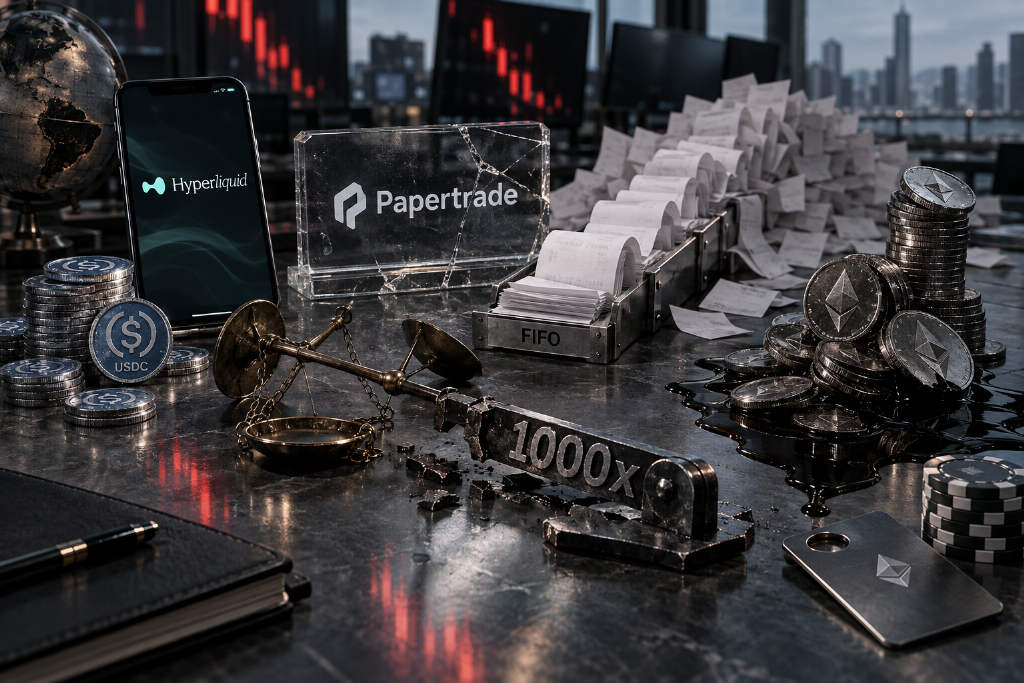
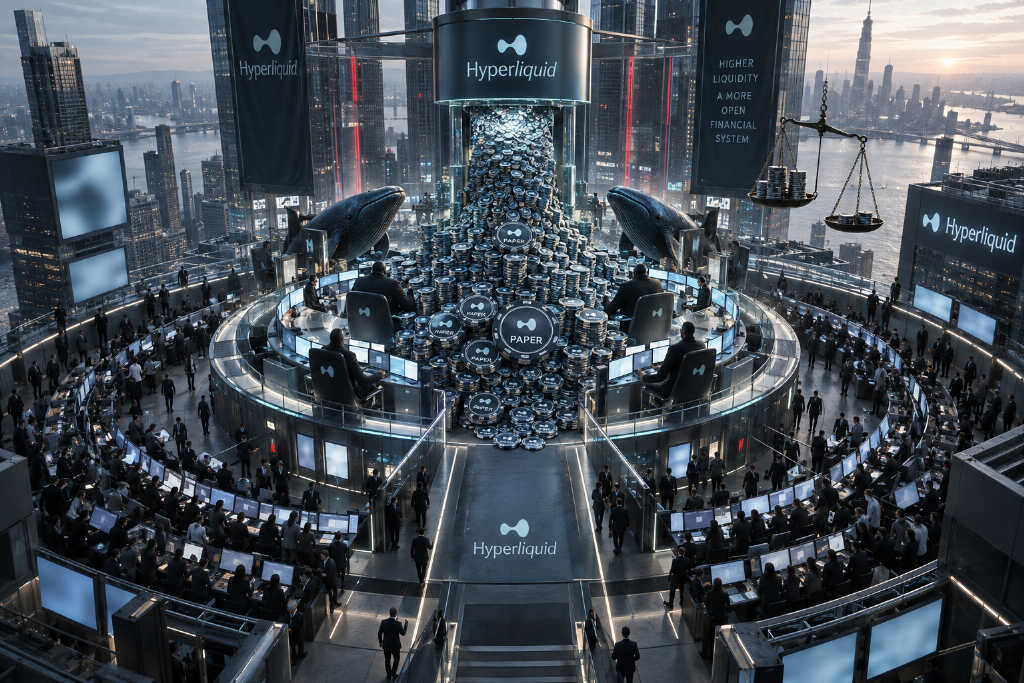
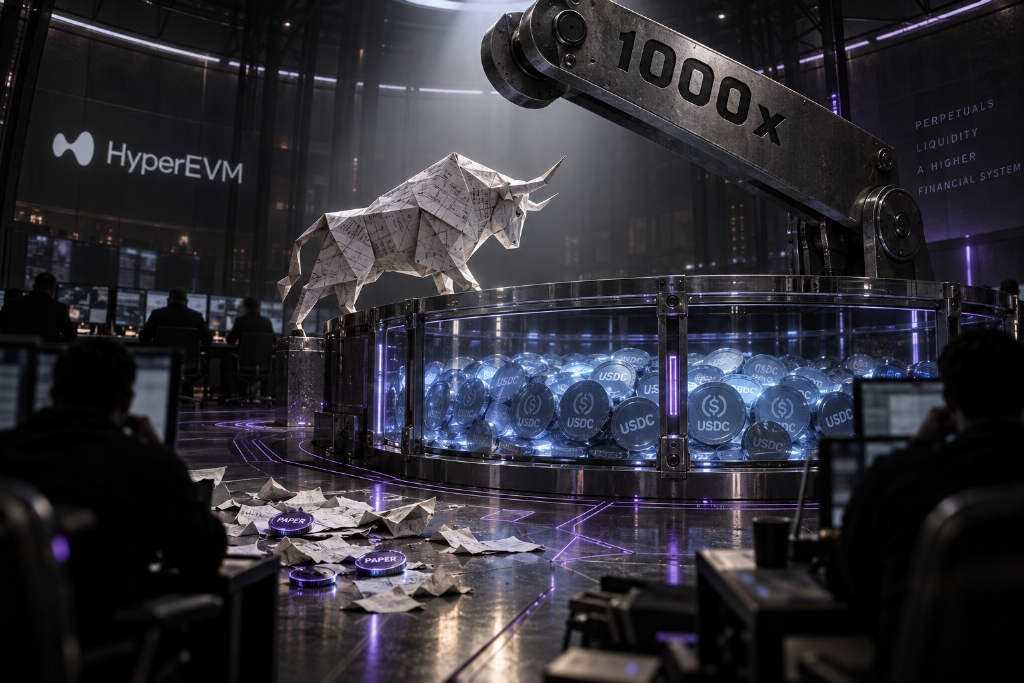
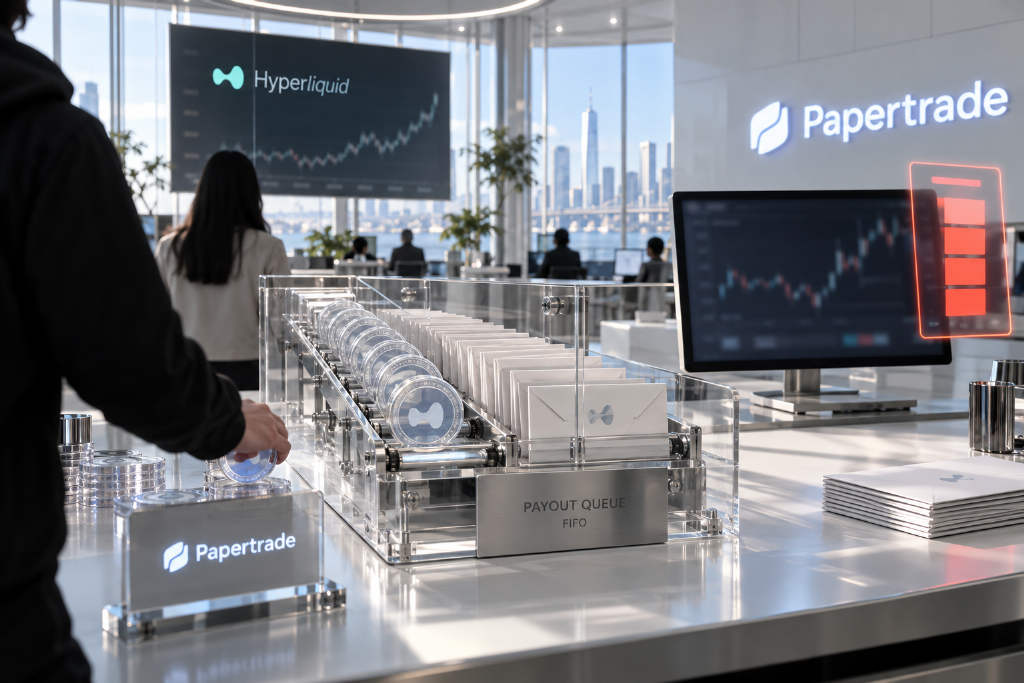
Papertrade2026-10-12 08:30:06Papertrade’s 1,000x leverage model faces scrutiny after payout queues and a sharp OI dropPapertrade, a synthetic perpetuals platform built on Hyperliquid’s HyperEVM, is facing criticism over a design that routes all user PnL through a shared USDC pool and rewards losing traders with PAPER tokens. Foresight News reported that on the platform’s first day, a professional trader used roughly $52,000 in costs on the Hyperliquid side to extract about $1.28 million from Papertrade after first buying around 6,060 ETH to push price up 0.12%, then opening 30 short positions with a combined notional value of $297 million and selling 6,590 ETH. The article argues that the model depends on a steady stream of trader losses to fund winner payouts, while profits beyond the pool’s available balance are placed into a FIFO queue rather than paid instantly. It also points to early data showing estimated first-day net realized trader losses of $18 million to $30 million, staking rewards of about $10.3 million to $12.6 million, a later official claim of roughly $25 million distributed to stakers, and a liquidity pool that at one point reached about $5 million. According to the platform’s latest website data cited in the piece, open interest has fallen from above $3.3 billion to around $400 million, a drop of about 88%.290
Papertrade2026-10-11 07:35:10Papertrade’s model faces scrutiny as early PAPER holders appear to gain the upper handPapertrade, a perpetuals platform in the Hyperliquid ecosystem, has drawn attention with up to 1000x leverage and a mechanism that rewards trading losses with PAPER tokens. That design helped attract users quickly, but it has also raised questions about whether late entrants can still earn meaningful returns. Four Pillars head of research 100y argued that PAPER has no fixed supply cap, allowing early participants to accumulate large positions at lower cost and potentially recover their initial losses several times over through staking rewards. Later users, by contrast, face ongoing dilution and depend on the platform sustaining real trading demand over time. Separate analysis from Blockworks Research’s shaunda devens pointed in the same direction. Using Monte Carlo simulations, the research suggested returns could be heavily skewed toward early participants and specific hedged farming strategies, while users relying only on loss mining and staking distributions may need far longer to break even. The platform’s trading design has also come under criticism, including asymmetric profit reductions, win fees, and claims that its price reference system may be vulnerable to cross-platform manipulation. Together, those issues have sharpened the debate over whether Papertrade is a durable trading venue or a structure that mainly rewards early whales.240
Papertrade2026-10-10 08:25:33Papertrade nears launch with 1,000x leverage, loss mining and a shared USDC counterparty poolPapertrade, a perpetual futures exchange built on HyperEVM, is preparing to go live after opening pre-deposits. The project, co-founded by semi-anonymous traders Jez and Blurr, replaces the usual order book and external market makers with a shared USDC pool called Martingaler LP, which takes the other side of every trade. Traders can open BTC and ETH positions with up to 1,000x leverage, no slippage and no funding fees. If they lose, those losses flow into the pool and can mint PAPER tokens; if they win, profits are paid out from the same pool, with unpaid gains queued if liquidity is short. The launch is expected to roll out in phases because HyperEVM may face congestion. Pre-deposits opened on Thursday, while trading is expected to begin around an hour after Saturday’s HyperEVM upgrade, though the exact time has not been disclosed and a delay to Sunday remains possible. Around the launch, outside projects including DXAP, PaperStrategy and PaperDAO have already formed to trade, accumulate or stake PAPER. The article also flags several risks: delayed payouts if too many traders win, possible price manipulation through Hyperliquid prices used as the effective oracle, PAPER dilution through paired long-short strategies, and the liquidation risk that comes with 1,000x leverage, where a roughly 0.1% adverse move can wipe out margin.250
Hyperliquid2026-10-11 07:08:53Papertrade draws $136 million in TVL after launch, while traders debate LP arbitrage riskPapertrade, a synthetic perpetuals protocol built in the Hyperliquid ecosystem, went live on Oct. 10 and quickly drew attention with up to 1,000x leverage, zero order-book slippage, no traditional funding rate, and a token design that mints PAPER for eligible trading losses. The platform shows $136 million in total value locked, more than $28.1 billion in cumulative volume, and 11,473 accounts. The model has also triggered concerns over whether its economics can hold up under stress. According to comments cited from X users Ray and Yankee, Papertrade does not open real perpetual positions on Hyperliquid. Instead, the protocol’s liquidity pool acts as the direct counterparty to traders. That structure, they argue, could expose LP capital to outsized losses during sharp market gaps, especially if traders use two-sided hedged positions with 1,000x leverage. Papertrade’s design also ties PAPER issuance to realized trader losses, while profitable positions may be paid through a FIFO queue if available liquidity is insufficient. Critics say that if extreme volatility produces large trader gains at the same time, the pool could face liquidity strain, delayed payouts, and pressure on the token’s value if confidence in future protocol revenue weakens.270
Papertrade2026-10-11 02:04:45Papertrade Tries to Bootstrap a Perpetuals Venue With Trader Losses, Putting the Payout Queue at the CenterPapertrade is pitching an unusual on-chain perpetuals model: up to 1000x leverage, no external LPs, no funding rate, and pricing derived from Hyperliquid without hedging there. Instead of relying on pre-funded liquidity, the protocol would return a winning trader’s margin immediately while any unpaid profit becomes a public claim in a first-in, first-out queue. Later trader losses refill the cash pool and, in return, mint PAPER, a token tied to future platform economics. The design shifts the main constraint away from order-book depth and toward payout timing. Papertrade can, in theory, start from zero liquidity, but it still needs enough ongoing losses to settle queued profits on time. The project says deposits are scheduled to open on Oct. 8 and trading on Oct. 10. At the same time, the article notes that as of Oct. 2 there was still no official contract address, verified source code, or published audit report, even though Guardian Audits had been engaged. The report also highlights a long list of open questions: how the payout curve and fees will be implemented on-chain, whether early PAPER distribution favors a narrow set of users before direct contract access opens, how resilient the model is under real one-sided volatility, and whether users will keep trading after experiencing liquidations, delayed profit payouts, or both.290
HyperEVM2026-10-10 09:46:29Papertrade to Launch Trading on HyperEVM on Oct. 10 With $85.3 Million in Pre-Launch DepositsPapertrade, a perpetual futures exchange built on HyperEVM, is scheduled to open trading at 10:00 a.m. Eastern Time on Oct. 10, according to a ChainCatcher report. Data from DefiLlama shows the platform had accumulated about $85.3 million in deposits before launch. The exchange says it will offer leverage of up to 1000x, with traders taking positions directly against the protocol’s own liquidity pool rather than matching with counterparties. In its announcement, Papertrade said web trading will go live after HyperEVM completes an upgrade, and deposits will be paused at 9:45 a.m. ET to prioritize the trading launch. Users must deposit in advance to take part at launch. The platform prices entries and exits using the midpoint of Hyperliquid’s best bid and ask, while positions are structured as synthetic trades against its pool, with no corresponding perpetual contract listed on Hyperliquid. Papertrade also said it removes funding rates and instead reduces gains on profitable exits through an asymmetric impact discount. If the pool cannot cover profitable trades, unpaid profits become queued debt to be filled by losses from later traders. Its PAPER token starts with zero supply, is minted from realized losses, carries no team or venture allocation, and at first will only support staking and unstaking, not wallet-to-wallet transfers.260
Papertrade2026-10-10 06:30:59Papertrade set to launch with 1000x leverage and loss-based PAPER miningPapertrade, a perpetual futures exchange built on HyperEVM, is scheduled to begin live trading on Oct. 10 after opening pre-deposits a day earlier. Created by semi-anonymous traders Jez and Blurr, the protocol replaces a traditional order book and outside market makers with a shared USDC pool called Martingaler LP, which acts as the counterparty to every trade and is funded by trader losses. The design has drawn attention because it combines up to 1000x leverage, zero slippage, no funding rate and a token incentive that rewards losing traders. When users lose money or get liquidated, their losses flow into the pool and they receive PAPER tokens. Those tokens can then be staked for a share of exchange fee revenue in USDC, and once the pool exceeds $5 million, additional pool yield can also be distributed to stakers. Papertrade plans a phased rollout because HyperEVM could face congestion. Trading is expected to begin around an hour after Saturday’s HyperEVM upgrade, though no exact time has been announced and a delay to Sunday remains possible. At the same time, projects including DXAP, PaperStrategy and PaperDAO are already forming around the launch. The setup also comes with clear risks: delayed payouts if the pool runs short, possible price manipulation through Hyperliquid pricing, low-cost PAPER farming through paired positions, and liquidation risk from extreme leverage.270