
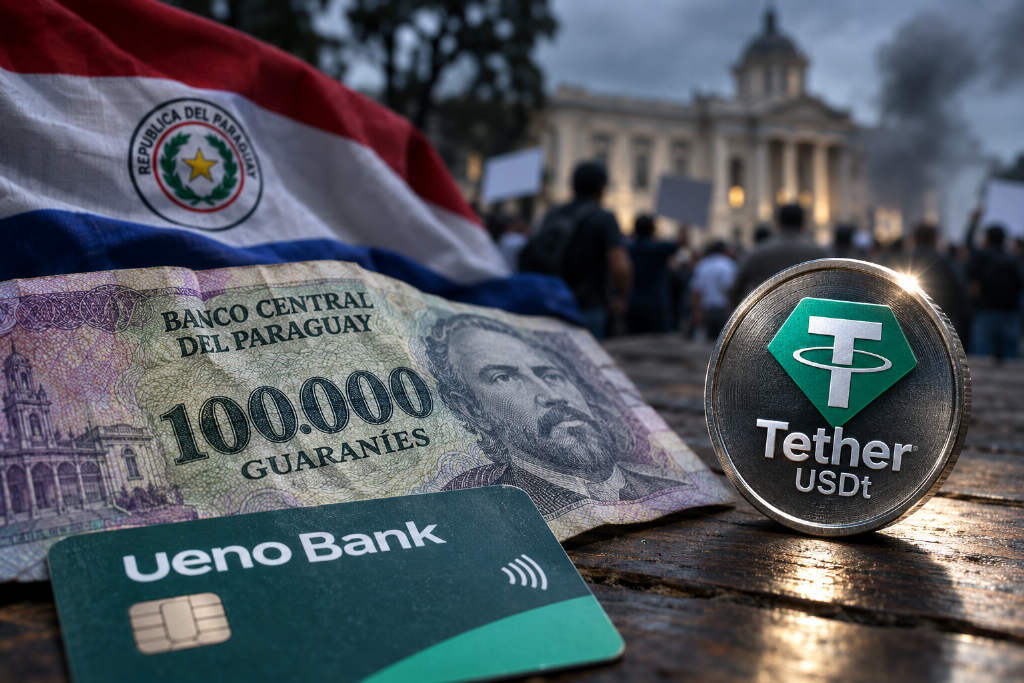
The collapse of Paraguay’s digital lender Ueno Bank left nearly three million customers unable to access their accounts, equal to roughly 60% of the country’s adult population. The local guaraní, or PYG, fell 12.3% in one week, prompting some people to turn to dollar-pegged stablecoins to preserve the value of their funds and keep ordinary payments moving.
Paraguay’s Central Bank placed Ueno into resolution on Nov. 3 after the bank’s solvency ratio dropped below half the legally required minimum. An investigation found questionable lending practices, along with deficiencies in credit documentation and accounting.
The failure also set off a political crisis. Thousands of people took to the streets to protest, while President Santiago Peña attempted to resign before being impeached and arrested on charges of breach of trust and using his office for personal gain.
Peer-to-peer market reflects the shock
Paraguay’s peer-to-peer crypto market quickly reflected the turmoil. Some sellers sought premiums of as much as 13% for USDt. Tether CEO Paolo Ardoino said, “USDt is a lifeline for hundreds millions of people in the world.”
For many customers, the collapse created uncertainty around savings, wages and the money needed for everyday expenses. With the domestic currency losing value, stablecoins became one way to hold funds in dollar terms or continue making payments while access to bank services was disrupted.
David Eisenmann, founder and chief executive of Paraguayan crypto exchange X4T, told Cointelegraph that the timing of the intervention made the need for liquidity more acute. The action came in the first days of the month, when salaries, rent and supplier invoices were due.
“The intervention came in the first days of the month,” Eisenmann said, “exactly when salaries, rent and supplier invoices are due.” Many business owners, he added, “couldn’t make payroll.” For some customers, USDt was “suddenly the most liquid money” available to them.
X4T sees demand moving in both directions
Eisenmann said X4T processed more than $10 million in local on-ramp volume during the 30 days to early November. Some of that trading activity, he noted, took place before Ueno failed.
“The dollar began recovering against the guaraní in October,” he said, “and the Ueno news sped up a move that was already underway.”
The activity “runs in both directions,” according to Eisenmann. Some customers sold crypto for guaraníes or dollars to cover payments they could no longer make through Ueno. At the same time, demand for USDt and USDC as dollar-based stores of value rose sharply.
Paraguay’s Central Bank said that 93.1% of customers with deposits at Ueno had been repaid as of Nov. 9. The repayment figure did not fully restore confidence, and X4T continued to receive more online inquiries about dollar-denominated stablecoins. Eisenmann said the level of interest “has not changed significantly” from the week of the collapse.
No evidence yet of a mass move into stablecoins
Rhys Hicks, an associate analyst at data and analytics company GlobalData, said Ueno’s failure showed “how much can go wrong when governance does not keep pace with growth.”
Hicks said he had not seen evidence of a mass migration from Paraguayan banks into stablecoins. Other banks “picked up the slack,” he said, while people “seem to have been angrier” with the government than with the banks.
“Some consumers will look for different ways to keep their money safe, but I do not see an overwhelming shift to stablecoins yet,” Hicks said.
The search for dollars predates crypto
Turning to dollars when confidence in domestic banks weakens is not a new behavior. During Argentina’s 2001 financial crisis, the government imposed the “corralito,” restricting cash withdrawals from bank accounts after a run on deposits.
As the crisis around Argentina’s currency peg and sovereign debt deepened, the government later converted dollar-denominated deposits into pesos. The move reduced people’s savings by about 30% overnight and damaged confidence in an already strained banking system.
Stablecoins offer a new digital rail for that same impulse, but they are not decentralized and are not insulated from banks.
During the March 2023 collapse of Silicon Valley Bank, stablecoin issuer Circle disclosed that $3.3 billion of USDC reserves, or about 8% of the total, were held at the lender. USDC briefly lost its peg and fell to 86 cents on secondary markets after Circle said it could not withdraw the funds.
A paper from the Bank for International Settlements on stablecoins and the international monetary system warned that broad use of dollar-backed tokens could create challenges for monetary sovereignty in emerging markets.
Liquidity comes with protection gaps
Hicks said stablecoins can offer an alternative during periods of political instability and “low trust in the local system” because they are pegged to a currency viewed as more stable, such as the US dollar.
He also said regulators need to address transparency and consumer protection. Stablecoin holders do not receive the same deposit guarantees as bank customers, and there is no central bank that can step in to make them whole.
Eisenmann expects the episode to encourage more “diversification,” with people “spreading their money across banks, cash and digital assets” instead of depending on one institution.
“How quickly trust in the banks returns will depend on how quickly and transparently the authorities handle the resolution,” he said.



