
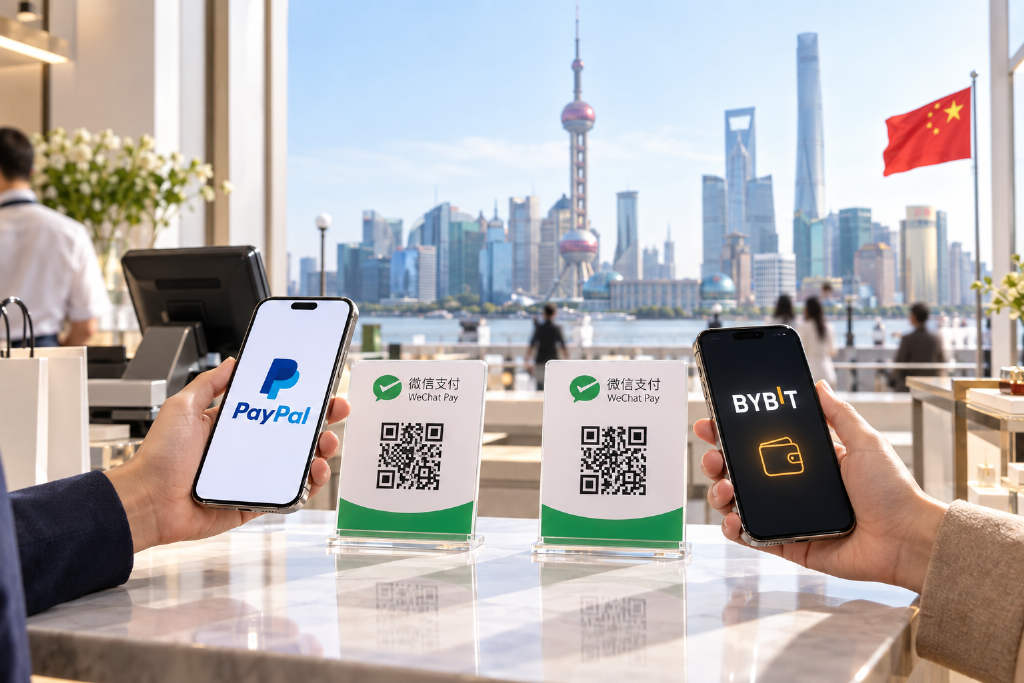
PayPal and Bybit have arrived at two different answers for WeChat QR payments in mainland China: one uses conventional cross-border settlement rails, while the other is testing direct crypto-funded payments for eligible users.
On Aug. 19, PayPal said through its official account that users can pay by scanning WeChat merchant collection codes in mainland China with the PayPal app. In the replies, one user asked whether the tie-up could support direct payments in PYUSD, given that PayPal already supports the stablecoin. There was no official reply to that question.
PayPal’s setup runs on traditional settlement channels
The article says TenPay Global, Tencent’s cross-border payments platform, completed an integration in May with PayPal World, PayPal’s cross-border wallet platform. Under that arrangement, U.S. PayPal users can scan WeChat Pay QR codes from merchants in mainland China directly in the app, without downloading WeChat and without opening a Chinese bank account.
Merchants receive payments in renminbi, while the PayPal account is charged in the user’s local currency. The settlement path relies on correspondent banking and foreign-exchange conversion channels.
Decrypt, a U.S. crypto media outlet, cited PayPal as saying that the World platform does not depend on blockchain or tokenized assets. Instead, it imitates some functions associated with stablecoins at the user-experience level, including faster settlement and currency conversion. In other words, PayPal did not use its own stablecoin in this payment flow.
Bybit puts a crypto payment beta online
Around Sept. 12, Dubai-headquartered crypto exchange Bybit published a page on its website labeled “Bybit Pay x WeChat Pay (Beta).” The page says eligible users can scan WeChat Pay merchant QR codes in mainland China and pay directly with crypto assets in their accounts.
That is a different model from PayPal’s. Here, the payment is made with crypto assets themselves rather than through a conventional cross-border payment structure designed to mimic some stablecoin-like features.
Mainland China remains a restricted jurisdiction on Bybit
The article also notes an important limitation. Mainland China has long appeared on Bybit’s list of excluded jurisdictions, and the platform does not open account registration or identity verification to mainland residents. The location shown on the page refers to the merchant side, not to where users are allowed to register for and use the service.
That means the beta is effectively limited to overseas users whose accounts were opened in supported service regions, who already hold crypto assets, and who then happen to spend in mainland China. The source gives examples such as foreign tourists or Chinese users who live abroad and hold crypto.
One less step than the prepaid card route
The piece argues that Bybit’s move is less abrupt than it may look, because it formalizes a path that already existed.
Before this, some users who maintained overseas exchange accounts and regularly traveled to and from mainland China were already spending through WeChat Pay or Alipay by using exchange-issued U.S. dollar prepaid cards. The process involved converting USDT into U.S. dollars, loading the funds onto the card, and then binding the card to WeChat or Alipay. That route runs through the clearing networks of Mastercard or Visa, and the combined foreign-exchange and crypto conversion fees amount to about 1.9%.
In that structure, card networks serve as a conversion layer between crypto assets and the WeChat merchant acquiring network. Bybit Pay’s QR Pay removes at least one visible step for the user. Instead of converting crypto into dollars held on a card before paying, the user scans and pays directly.
Bybit has not disclosed how the payment is settled into WeChat Pay’s acquiring system on the back end. The official materials do not specify whether the flow relies on banking channels or some other clearing arrangement.
The next hurdle is compliance, not technology
According to the article, what Bybit can currently serve is still only a narrow slice of demand: users whose accounts are registered in supported regions and who are physically in mainland China making purchases. If that route proves stable, the next questions are whether the service footprint can expand, whether merchant coverage can deepen, and whether the review process can be standardized.
The source says those are not technical issues. They turn on licensing and regulatory communication.
If an exchange can settle crypto-funded payments into one of the world’s largest mobile payment merchant networks, even through a small beta opening, that would still show the route itself is workable. The remaining contest, as framed in the article, is who can clear approval and regional restrictions first and turn a limited beta path into something repeatable at scale.
