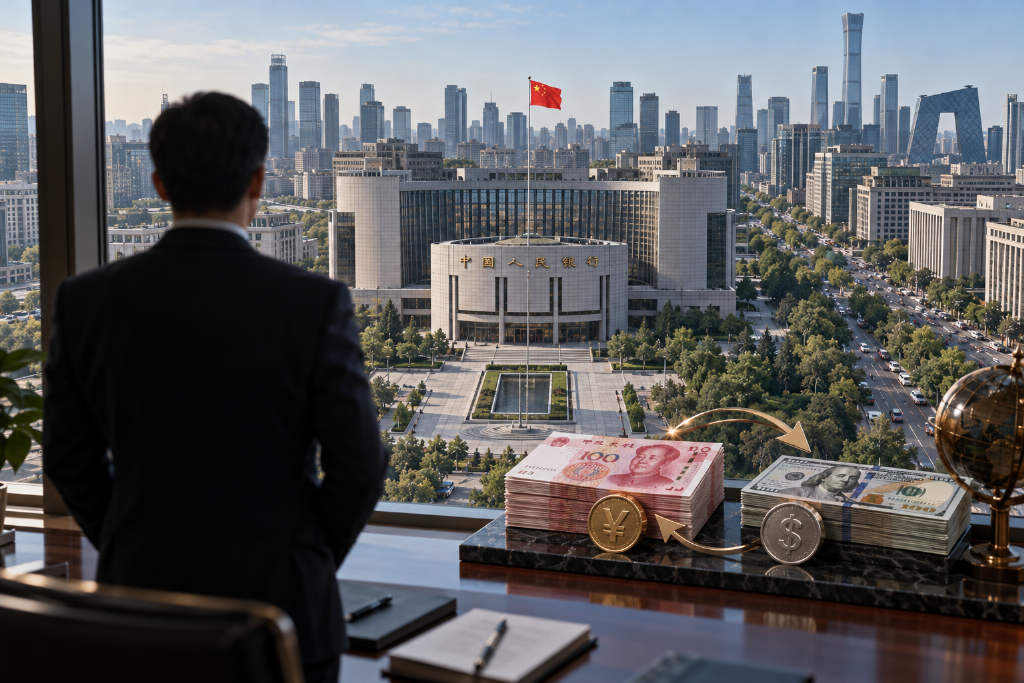
The People’s Bank of China has published a policy statement on the renminbi exchange rate, laying out its official position on how the currency is managed. According to the document, China operates a managed floating exchange rate regime based on market supply and demand, with reference to a basket of currencies. The central bank said it exited routine foreign-exchange intervention after 2017.
The statement also said China has no intention of seeking a trade advantage through currency depreciation and does not engage in competitive devaluation. It added that macro-prudential tools are used only in the face of major external shocks, citing the pandemic and the April 2025 tariff war as examples, to prevent short-term overshooting.
On long-term currency performance, the PBOC said the renminbi has appreciated 23% against the U.S. dollar since the 2005 exchange-rate reform, while its nominal effective exchange rate has risen by more than 50%. Since the start of 2025, the yuan has gained about 9% against the dollar. The central bank also rejected claims that IMF external balance assessments can be treated as official proof that the renminbi is undervalued, calling that an incorrect interpretation and saying global imbalances require joint action by deficit and surplus countries.
China’s central bank has published a policy statement on the renminbi exchange rate, saying the country maintains a managed floating exchange rate regime based on market supply and demand and adjusted with reference to a basket of currencies.
PBOC sets out its official position
According to the statement released on the People’s Bank of China website, China ended routine foreign-exchange intervention after 2017. The central bank said it has no intention of gaining a trade competitive edge through depreciation and does not pursue competitive currency devaluation.
The document said macro-prudential tools are used only during major external shocks, including the pandemic and the April 2025 tariff war, to guard against short-term overshooting.
Exchange-rate data cited in the statement
The PBOC said that since China’s 2005 exchange-rate reform, the renminbi has appreciated 23% against the U.S. dollar, while its nominal effective exchange rate has risen by more than 50%. Since the start of 2025, the yuan has appreciated by about 9% against the dollar.
The central bank also said it is a misinterpretation to use International Monetary Fund external balance assessment conclusions as official evidence that the renminbi is undervalued. On global imbalances, the statement said both deficit countries and surplus countries need to act together.
This article was originally published by Bit.Fan. For more cryptocurrency news and market insights, visit www.bit.fan. Disclaimer:
The market information, project data, and third-party content displayed on this platform are for industry information sharing only and do not constitute any form of investment advice or return commitment.
Cryptocurrency trading carries high risks. Users should fully assess their risk tolerance and make independent decisions. All profits, losses, and legal responsibilities are borne by the users themselves.