
Pearl is trying to merge two workloads that have long shared the same hardware but not the same economics: AI inference and proof-of-work mining.

The idea goes back years. When Ethereum still used PoW, miners relied on consumer GPUs running Ethash. An RTX 3060 delivered about 48 MH/s on Ethash, and people naturally asked whether the same card could mine and run models at the same time.
That never turned into a practical setup because the bottlenecks were different. Ethash leaned on memory bandwidth and fixed-difficulty hashing. AI workloads need tensor-core floating point throughput and tens of gigabytes of memory, with data-center cards such as the H100 carrying most of the load. A gaming laptop GPU could mine and could also limp through a small model, but not do both well at once.
Vitalik Buterin gave a blunt assessment in 2019. He said, “If a useful and easily verifiable proof-of-work could be found, cryptocurrency mining would become a huge boon to society, but I suspect this is impossible.”
Pearl says it has solved that problem. The quote from Buterin is displayed prominently on Pearl’s website.
Pearl replaces repeated hashing with matrix multiplication
Pearl is a standalone proof-of-work blockchain with a native token called PRL. Instead of having miners repeatedly compute hashes, it asks them to perform matrix multiplication, the same multiply-accumulate operation used in neural network layers. In the project’s design, one GPU workload can both produce blocks and generate verifiable AI computation.
The company’s framing is that “energy, data, and money” can meet in a single operation. Bitcoin ties energy to money. AI ties energy to data. Monetization ties data to money. Pearl wants all three to happen inside one matrix multiplication.
That pitch stands out partly because new PoW chains have been rare. Most of the industry’s attention in recent years has gone to layer 2s, modular systems, and restaking. PRL, with a circulating market capitalization of $430 million, is trying to reopen a question that PoW largely left behind: can mining be useful without giving up the permissionless model that secures a public chain?
The real problem is not usefulness alone, but permissionless usefulness
Bitcoin’s proof-of-work has a defining trait: the computation miners perform has no direct relationship to the outside world. The same unit of electricity could instead be used to run models, generate tokens, create images, or do other work, which is why many people see conventional mining as wasteful.
But the hard part is not making computation useful in the abstract. The hard part is keeping it permissionless. Permissionless means anyone can mine without registration and without someone screening eligibility. Bitcoin’s security model depends on that. Whatever miners compute, the cost structure is the same. Once the work is replaced with something that has real-world value, miners gain an incentive to cut corners or choose cheaper inputs.
So the question is not whether mining can be useful. It is whether it can be useful while staying permissionless, and whether the system can stop miners from cheating.
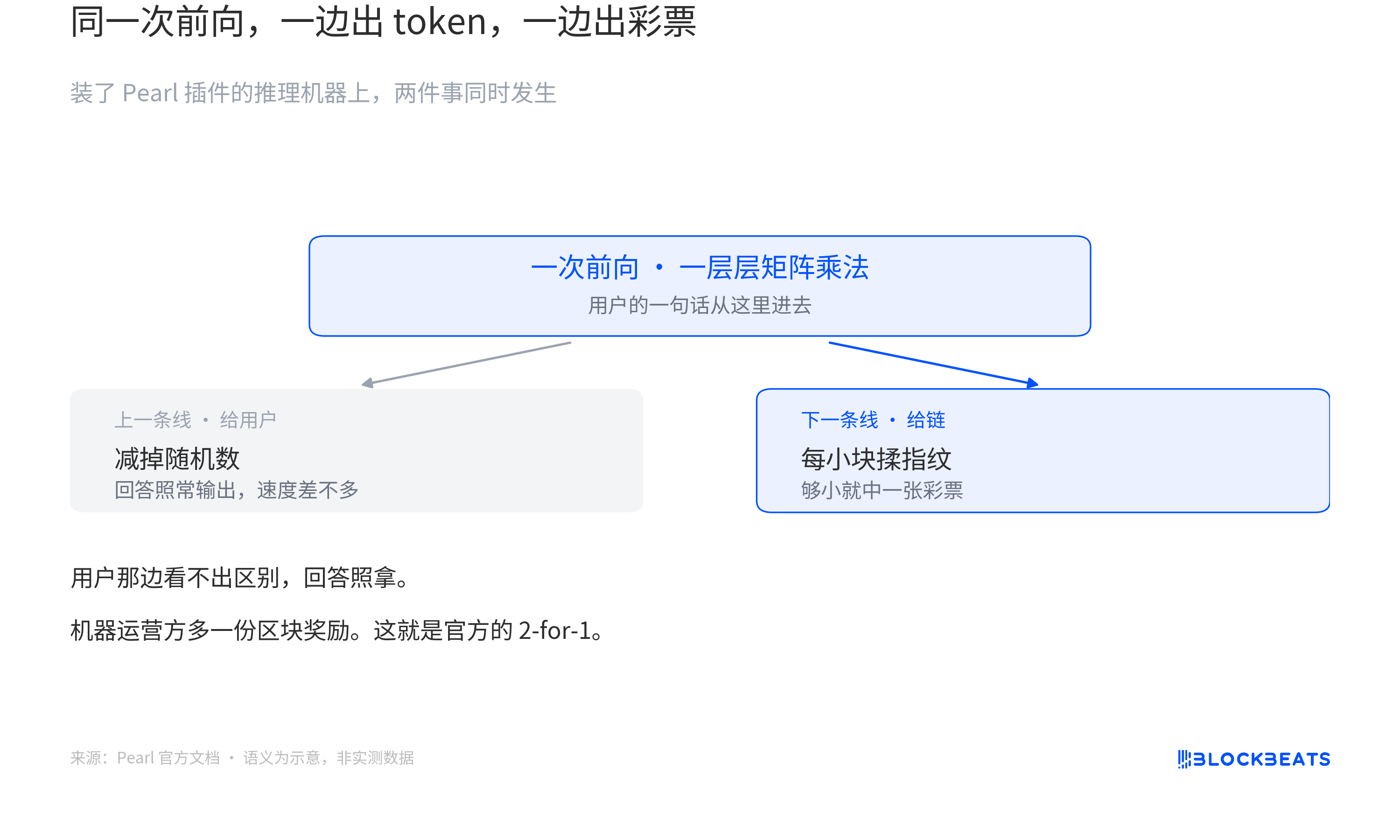
Pearl’s answer is to swap Bitcoin’s random hashing for matrix multiplication and let GPUs treat proof-of-work as a byproduct of AI load. Its white paper uses the phrase “2-for-1.” In plain terms, a batch of GPUs used to have two destinations: mine and burn power for coins, or run models and burn power for AI output. Pearl wants those two paths to collapse into one.
That idea has been modeled in detail. Cryptography researcher Rafael Pass, in the paper The Economics of Proof-of-Useful-Work, divides machine activity into three categories: pure mining, pure inference, and duplex work that produces both. Duplex work is not free. The paper gives an example in which one unit of compute doing two jobs does not produce two full outputs, but roughly one and a half. If the overhead is low enough, the token is accepted by the market at sufficient scale, and inference demand exists, then block rewards effectively subsidize inference pricing and can pull in compute that otherwise would not be supplied.
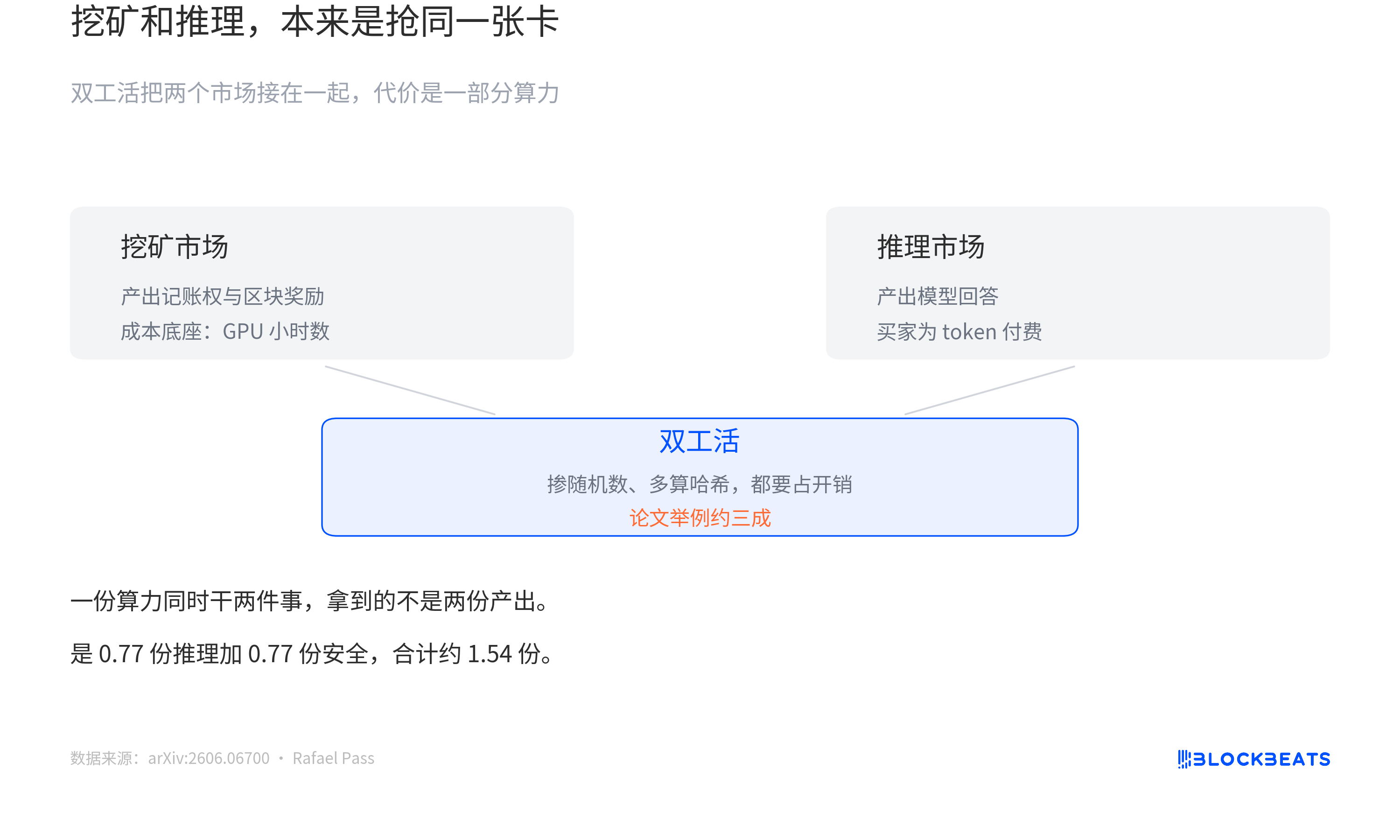
The math is one thing. The variables are another. Overhead, token price, and inference demand are the three inputs that determine whether the model works economically, and none of them are under Pearl’s direct control. A footnote in the paper says it was completed while the author was consulting for Pearl Research Labs.
Why matrix multiplication can be used as proof-of-work
To understand Pearl’s mechanism, it helps to unpack matrix multiplication itself. This is not a new operation invented for crypto. It is an old and standard one, and nearly every neural-network layer uses it.
A matrix is a table of numbers arranged in rows and columns. Two matrices can be multiplied if the number of columns in the first equals the number of rows in the second. Each cell in the output matrix is computed by taking one row from the first matrix and one column from the second, multiplying the entries pairwise, and summing them.
The article gives a minimal example. If the first row of matrix A is 1 and 2, and the first column of matrix B is 5 and 7, then the top-left cell of the result is 1×5 + 2×7 = 19. The rest of the output is filled in the same way.
In AI models, one layer can be written as input times weights. A user prompt is turned into vectors, multiplied by the weight matrix for that layer, passed through a nonlinear function, and then sent to the next layer. As models get larger, the matrices get larger, and the number of multiply-accumulate operations can reach into the trillions. GPUs are built for this kind of regular arithmetic, which is why mining cards and AI cards come from the same hardware family.
In Pearl’s ideal scenario, someone asks a chatbot a question online and the server GPU starts running the model layer by layer. If that machine has Pearl’s plugin installed and is running one of its certified open-source models, then the same matrix multiplications used to generate the answer are also used to try for block production. After each small chunk is computed, the system derives a fingerprint. If the fingerprint is small enough, the miner effectively wins a lottery ticket and receives a block reward. The user sees no difference in the response and may even pay less. One batch of multiply-accumulate operations turns into AI output and blockchain rewards at the same time.
How the protocol tries to stop shortcutting
For that design to hold, Pearl first has to stop miners from faking the expensive part of the computation.
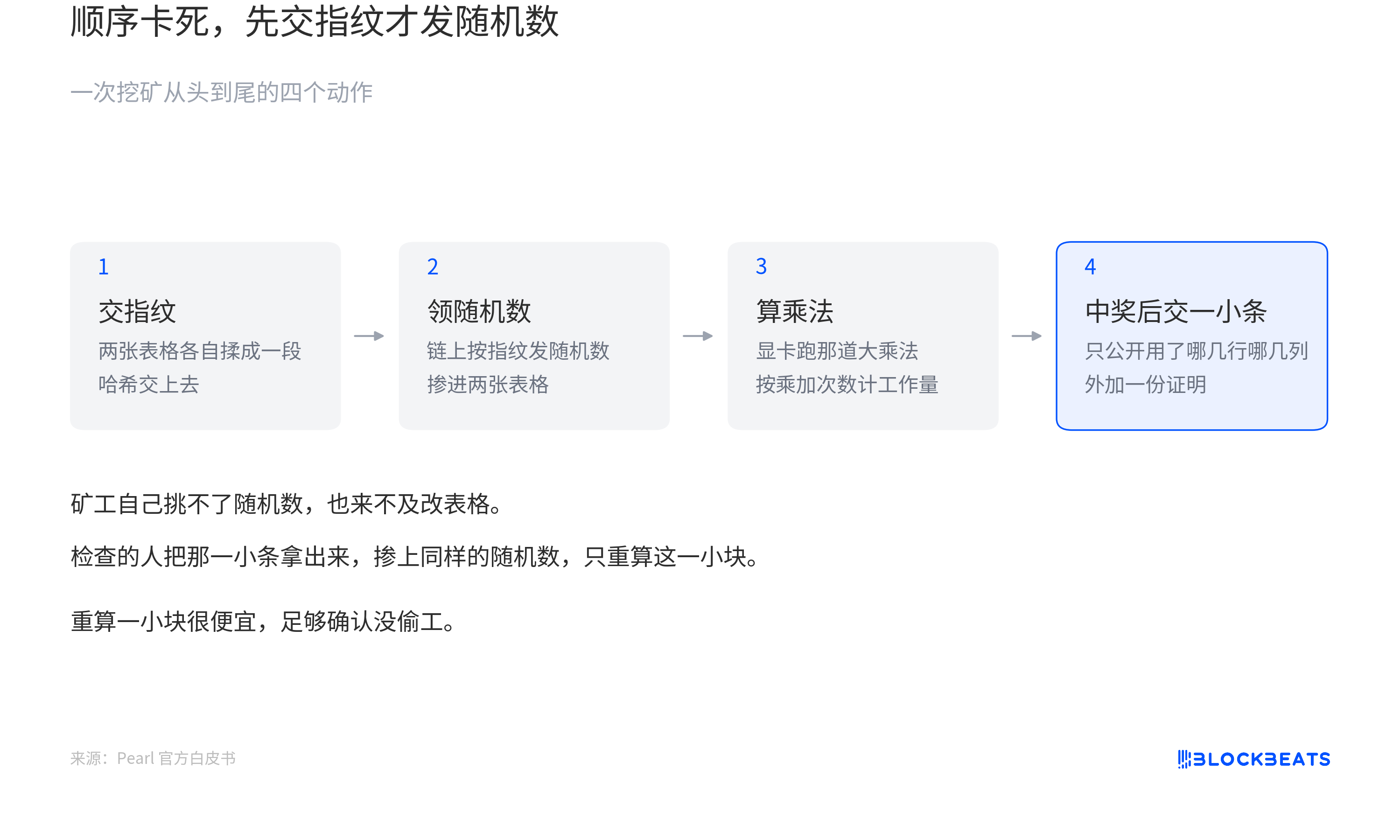
In Pearl’s flow, the miner starts with two matrices and compresses them into a fingerprint. That means hashing all the numbers in the matrices into a short digest. Only after the chain sees that fingerprint does it reveal what random values must be mixed into the matrices. The order matters. Once the fingerprint is fixed, the miner cannot go back and alter the matrices.
The project calls this adding noise. In simpler terms, it injects random numbers into the two matrices, with the amount and placement determined by the fingerprint rather than by the miner.
Without that step, there is a shortcut. The product of clean matrices A and B differs from the product of the noised versions by three correction terms. Those terms are not tiny, but they are cheap to compute. A miner who already has clean A and B could compute the clean answer first and then add the cheap corrections, avoiding the expensive large matrix multiplication entirely.
That is why the protocol does not require miners to submit the full computed result. Instead, they submit the relevant input rows together with a proof. The verifier takes that small portion, applies the same random noise, recomputes only that slice, and checks whether the fingerprint matches. Recomputing a small slice is cheap, but enough to show the miner did not skip the work.
If the matrices contain company weights or user data, the design can add a zero-knowledge proof layer to show that the computation happened without revealing which exact matrices were used.
Certified models and a commercial API already exist
Pearl has moved beyond theory in at least part of the stack.
On Hugging Face, the pearl-ai organization lists four certified models: Llama 3.3 70B, Llama 3.1 8B, Qwen3 30B, and Gemma 4 31B. Pearl calls them “certified variants.” They are not retrained from scratch. The same weights are repacked into Pearl’s quantization format so they can run inside the plugin while performing inference and mining at the same time.
The reported accuracy loss is small. For Gemma 4 31B, MMLU drops from 90.93 to 90.56.
As of Oct. 9, 2026, the four models had 30-day download counts ranging from 195 to 6,424, with likes of 0, 3, 5, and 6.
There is also a commercial route. In May 2026, Pearl and Together AI launched an API for running a Gemma model. According to Together’s announcement, the endpoint was priced 25% below a standard API, with the difference offset by the token’s future value.
The models are public. The code is open source. The next question is whether the live network is actually doing useful inference.
Research in June 2026 said useful AI output was zero
That question was tested by researcher Abhinaba Basu in a June 2026 paper titled The Usefulness Gap in Proof-of-Useful-Work.
The paper estimated Pearl’s network at about 24 EH/s at the time, roughly equivalent to 320,000 RTX 3090-class GPUs and about 112 megawatts of power draw. Its conclusion on useful AI output was stark: zero.
Basu sampled 8,012 miner work units. The hardware in those samples was capable of inference, but in mainstream mining software he found 4,803 strings related to matrix multiplication and zero strings related to machine-learning frameworks.
He also wrote his own miner, filled matrices with random numbers, ran it on Nvidia hardware, AMD hardware, CPUs, and Apple chips, and obtained 44 shares accepted by a mining pool. In other words, the design allows “real data sent to a model for a result” and “mining with the same card” to be unified in theory, but in live operation they remained separate.
What is the network actually running, then? According to the Kryptex mining pool page, network hashrate has climbed to 46.37 EH/s, difficulty stands at 2.26 TH, block time is about 203 seconds, each block pays 2,271.03 PRL, daily issuance is about 966,000 PRL, and the token price is about $1.30. Over six months, hashrate nearly doubled. Most of that increase still appears to come from miners filling matrices with random numbers. The dominant activity in the market remains simple: buy GPUs, plug them in, fill random values, and wait for settlement.
The protocol can verify the multiplication, not the meaning of the inputs
The article uses a cafeteria analogy to explain Pearl’s current bottleneck. Imagine a notice that says anyone who chops 100 jin of vegetables gets paid. Chopping is real work. It takes time and effort. But if the check only asks whether 100 jin were chopped, not what was chopped, someone can bring in a truckload of rotten leaves, cut enough weight, and still collect the money. The labor happened. The kitchen just cannot use the result.
That is where Pearl is stuck. The protocol checks whether the matrix fingerprint matches, whether the result really equals the product of the two matrices, whether the work meets the difficulty target, and, in the formal design, whether the input passes a statistical gate meant to catch obvious manipulation. Those checks exist.
What it does not check is where the two matrices came from. A miner can generate two random matrices locally. The multiplication is still hard, the fingerprint still qualifies, and the miner can still win rewards. The output simply has no buyer. The protocol recognizes the multiplication relation, not the semantic value of the data. In that sense, “useful” remains a business problem rather than a cryptographic guarantee.
This is not just a theoretical criticism. In the report cited above, the sampled machines were all capable of running models, yet the mining software contained no inference framework code. The author’s own random-matrix miner also won accepted shares. With network compute hovering around 45 EH/s, most of the system still appears to be processing synthetic inputs.
The scale gap looks even larger in a counterfactual presented in the paper. If the design had been operating as advertised, a 24 EH/s network should have produced about 7.7 million GPU-hours of useful AI compute per day. The paper also discussed a metric called the value destruction ratio. Pearl measured 1.0, the same as Bitcoin, while Filecoin was about 0.64.
Why miners may still avoid real inference jobs
Miners are not necessarily ignoring inference because they do not understand it. They may simply be doing the math.
The paper estimates that coupling an inference engine with mining cuts effective compute by about 10% to 30%. That means taking real inference jobs requires software changes, adapting to the timing of requests, and absorbing that compute loss before any revenue is counted. In years when the token price is not high, the economics can easily turn negative.
The paper outlines several possible ways forward.
One is to control the source of the matrices and require miners to use matrices submitted by outside customers. Pearl’s current plugin and certified-model approach points in that direction. If miners run real models through the plugin, the matrix multiplication used for inference can also mine. The problem is that participation is voluntary, so miners still decide based on economics.
Another is to test whether the matrices statistically resemble real model weights rather than random numbers. The paper rejects that route because miners can tune the distribution and pass the check at almost no cost.
Other paths are more distant. Making model provenance verifiable through signatures would require a public-key system from model providers. Using trusted hardware to prove data origin would add reliance on chip vendors and slow performance. Differentiating rewards so real data earns more would require a base of customers already willing to pay.
The team and the narrower bet Pearl is making
Pearl is developed by Pearl Research Labs. Omri Weinstein is its co-founder and CEO, according to Together AI’s partnership announcement. He works in complexity theory, teaches at the Hebrew University, and is also one of the authors of the foundational paper behind the project.
Ilan Komargodski, another author, appears in the Hugging Face organization member list, though no public source in the article confirms whether he is an employee or an adviser. Another identifiable name is Erez Badash, first author of the Hawkeye paper on bitwise GPU reproducibility.
Pearl’s bet is narrower than some adjacent crypto-AI projects. Bittensor has validators score model outputs submitted by miners, with those scores determined by a consensus system called Yuma. io rents GPUs to machine-learning tasks on demand. Pearl is betting on something more specific: that the matrix multiplication used to produce blocks can itself be something someone wants to buy.
That is the real wager. If inference demand grows large enough to absorb block-producing compute, miners may eventually conclude that real customer jobs pay better than filling matrices with random numbers. If that never happens, Pearl remains a GPU mining chain with different mathematics, producing computations that come from the same family as AI workloads but are not tied to any specific user’s actual demand.