


Blockworks researcher Jake Koch-Gallup laid out a bluntly bearish case against PEARL, arguing that the project’s fundamentals do not support the enthusiasm around its AI-mining narrative. He wrote that he does not like Pearl and remains bearish even if its market capitalization were to reach $10 billion, describing the fundamentals as objectively weak.

The analysis does not ignore the bull case. It starts by presenting the strongest arguments in PEARL’s favor before turning to the reasons the author believes the thesis breaks down. The debate centers on four issues: supply expansion, token demand, network security and historical precedent.
Why the Proof of Useful Work story gained traction
PEARL’s core pitch is Proof of Useful Work, or PoUW. Under that model, the network uses AI training and inference matrix multiplication as part of its security mechanism rather than spending compute only on hash collisions. The report says that idea speaks to a long-running criticism of Bitcoin mining, where large amounts of electricity are consumed on work that has no practical use beyond hashing.
Koch-Gallup notes that Bitcoin block rewards are likely to become less able to cover rising electricity and hardware costs, especially after the next halving in 2028. That backdrop has pushed many traditional miners toward AI compute. In the usual version of that transition, miners leave crypto mining behind because Bitcoin-specific ASICs cannot run AI workloads. PEARL is trying to offer a different setup: the same GPU cluster can serve AI customers and mine on-chain at the same time.
In that framework, AI service providers can mine PEARL with GPUs they already operate instead of building dedicated infrastructure from scratch. The article also mentions a proposed FP8 upgrade that would make the mining algorithm fit modern AI core workloads more closely. In the bullish version of the story, AI revenue covers hardware purchases and depreciation, while mined PEARL becomes incremental upside. That is presented as a rebuttal to the usual sell-pressure argument, because miners whose hardware costs are already covered by real-world AI business may not need to dump tokens just to pay power bills.
Team credentials and fair launch are part of the bull case too
The report also highlights the project’s founding team. PEARL was built by Omri Weinstein and Ilan Komargodski. Weinstein previously worked in research roles at Nvidia, Microsoft and Vast Data, and is now a professor of computer science at the Hebrew University of Jerusalem while on leave from Columbia University. Komargodski is described as a top cryptographer at NTT Research and also a professor of computer science at the Hebrew University of Jerusalem.
According to the team’s own description, PEARL used a fair-launch model with no venture capital round, no private team allocation and no cliff unlocks. Koch-Gallup adds a caveat: about one-third of the circulating supply was mined in the first six days before the network went live, and outside observers cannot tell how much of that supply may have ended up with the team.
On valuation, the article says PEARL resembles Bitcoin in one important respect: the token does not produce cash-flow distributions, so its value depends on monetary premium. The report defines that as the premium investors are willing to pay to hold a scarce, neutral hard asset protected by proof of work. PEARL has a hard cap of 2.1 billion tokens. Bulls argue that because AI customers cover much of miners’ cost base, network security does not need to shrink in step with lower block issuance.
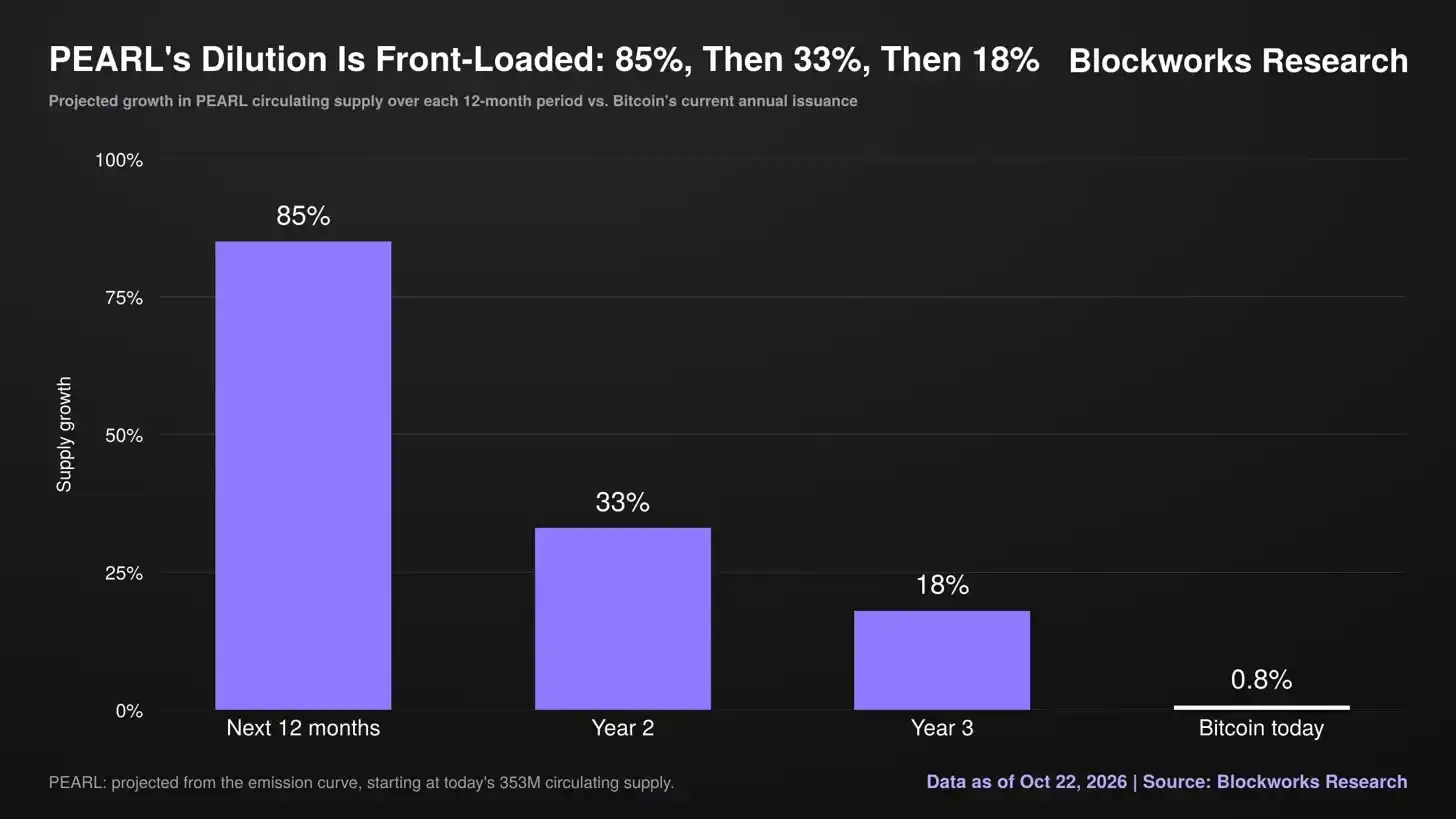
The inflation path cited in the piece is about 85% this year, about 33% next year and about 18% the year after. Supporters, the author says, can argue that the market is pricing the worst inflation year now. PEARL has also been gaining attention in the market: the token is up roughly 8x from an August low near $0.27, weekly trading volume rose from $2 million-$3 million in August to $51 million last week, and Coinbase added PEARL to its listing roadmap on Oct. 19.
1. Inflation near 85% leaves the market with a heavy absorption problem
Koch-Gallup’s first objection is that monetary premium only works if the asset is genuinely scarce, and he argues PEARL is not. The comparison with Bitcoin is central to his point. Bitcoin’s annual supply growth is about 0.8%, while PEARL’s annual supply growth over the next year is about 85%.
Using a token price of $2.17, the report estimates that roughly $2.2 million worth of new PEARL is distributed to miners every day. It places average daily real trading volume at about $8.5 million. On that basis, newly mined tokens alone would amount to roughly 30% of the network’s average daily real trading activity.
Stretch that over 12 months and the numbers get larger. The article estimates that newly issued tokens over the next year would be worth about $654 million, against a current total market capitalization of about $768 million. In the author’s framing, the secondary market would need to find almost an entire market cap’s worth of fresh demand over the next year just to keep the price from breaking lower.
He also pushes back on a familiar bullish response: early Bitcoin had high inflation too. In his view, that comparison misses the difference in valuation scale. When Bitcoin was inflating at similarly high rates in 2010 and 2011, the whole network was worth only a few million dollars. PEARL, by contrast, reached a circulating market cap of about $768 million and a fully diluted valuation of about $4.6 billion only six months after launch. The report argues that crypto markets now price new assets far more efficiently than they did more than a decade ago, leaving less room for the kind of severe underpricing that helped define Bitcoin’s earliest years.
2. AI users pay in dollars, so usage does not automatically create token demand
The second part of the bear case is about settlement. AI customers pay for inference in U.S. dollars, not in PEARL, which means useful work does not create native demand for the token itself.
Bulls may answer that Bitcoin also lacks a token-burn mechanism, and they may point to the 25% inference discount offered by Together AI as proof that the network is delivering value to real users. Koch-Gallup’s response is that the 25% discount is effectively funded by selling PEARL into the market. Miners receive tokens, sell them for dollars, and then pass some of those dollars through to inference users as a discount.
That means value is flowing out of the token system to subsidize real-world customers, not flowing in from outside to support token demand. Until AI inference is actually priced or settled in PEARL, the report argues, rising AI usage does not necessarily mean more buying pressure. It can just as easily mean more sell pressure hitting the market.
The article adds another point here. Pearl Research Labs, the business entity behind the project, earns inference revenue directly in dollars. Koch-Gallup argues that even if the PEARL token were to fall to zero, the company itself could still function. In his view, that exposes a weak competitive moat, because a rival could fork Bitcoin’s code and attach its own useful-work mechanism while end users continue paying in dollars anyway.
3. Standard GPUs can be rented, so more hashpower does not mean more security
The security argument is the third pillar of the report. Koch-Gallup says that even if PEARL eventually claims more total hashpower than Bitcoin, that would not mean the network is safer than Bitcoin.
His reasoning is tied to hardware type. Bitcoin runs on specialized ASIC miners, and nearly all machines capable of mining Bitcoin are already doing so. An attacker would generally need to design, manufacture or acquire a large amount of hardware at significant cost, and if the attack destroyed confidence in the network, those machines could lose much of their value.
PEARL runs on standard data-center GPUs used across the AI industry. The report says the amount of cloud GPU compute available for rent globally is far larger than the amount currently mining PEARL. Koch-Gallup compares that setup to the history of Ethereum Classic, Bitcoin Gold and Vertcoin between 2018 and 2020, when smaller proof-of-work networks suffered repeated 51% double-spend attacks because attackers could rent generic compute from a much larger external market.
The report also compares security budgets. Bitcoin miners currently earn about $36.6 million per day from block subsidies alone, while PEARL miners earn about $2.2 million per day in total. Based on that gap, Koch-Gallup estimates that PEARL’s price would need to rise by about 17x for its security budget to approach Bitcoin’s. As block issuance falls over time, he says, the price hurdle needed to maintain that budget only gets higher.
4. Zcash’s early history is presented as the closer warning sign
For historical comparison, the article turns to Zcash. Koch-Gallup writes that from Oct. 31, 2016 to Feb. 20, 2017, ZEC fell from $328 to $29.80, a 91% drop. Over the same period, however, the network’s total market capitalization expanded from about $2.9 million to about $22 million.
He argues that the apparent contradiction came from supply growth overwhelming price support. In that stretch, the network’s market cap grew about 8x, but circulating token supply expanded 84x. The result, in his telling, was severe damage for secondary-market holders even as the network looked larger on paper.
The report does not say PEARL is already in the same condition. It says the structure is similar enough that Zcash’s early inflation cycle should be treated as a serious reference point rather than dismissed as irrelevant history.
Short-term price and long-term fundamentals are not the same question
Koch-Gallup does not rule out further upside in the near term. He writes that crypto markets still price many tokens on emotion and narrative rather than on strict fundamentals, even if that pricing logic may be changing. On that basis, PEARL could continue to rally in the short run.
His conclusion is narrower and more direct than a market call. The project’s current setup, he argues, leaves it exposed to a supply-demand imbalance, weak native token demand, a security model tied to rentable generic hardware and a historical pattern that has already hurt holders in other high-inflation networks. Even if the token keeps climbing, he says he will stay on the sidelines and keep making the bearish fundamental case.