
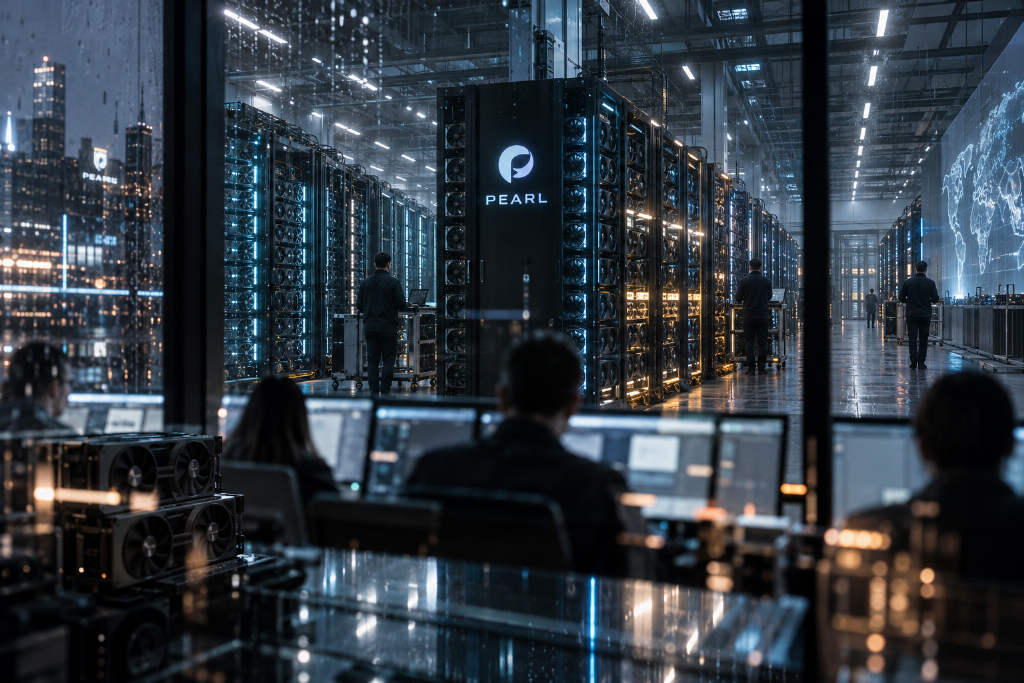
A crypto network with 320,000 GPUs attached to it is already being used to price GPU compute through real market activity.
That is the core argument in an analysis published by TechFlowPost, written by Decentralisedco and translated by AididiaoJP for Foresight News. The piece says Bloomberg terminals currently display GPU price indexes from Silicon Data, Ornn, and Compute Desk. All three track H100 rental prices, yet none can settle on what one H100 is actually worth because most GPU capacity changes hands through private bilateral contracts at discounted rates.
The same H100 can represent very different products
The article starts with a simple question: when someone pays $3 to $10 per hour for an H100, what are they really renting?
On Vast.ai, $3 an hour may buy access to a GPU sitting in someone’s spare server rack, connected over standard Ethernet, with no uptime guarantee. At the other end, the same H100 can cost $10 an hour on Oracle Cloud, where it sits inside a purpose-built facility, linked to other GPUs over 400-gigabit-per-second InfiniBand and watched around the clock by an engineering team.
The price is more than three times higher because Oracle is selling a full compute environment, not just access to a chip. The article says that difference alone can create a 6.7x spread for the same silicon across providers.
In that framing, a GPU is not the product. It is an input inside a larger service. A 512-GPU cluster tied together with NVLink and InfiniBand inside one building can run distributed training jobs. Another 512 GPUs scattered across five low-cost data centers cannot do the same job efficiently, even if the chip count matches. The article compares that gap to calling both a studio in Queens and a penthouse on the Upper East Side “a New York apartment.”
Debt markets already price the contract layer above the hardware
The piece points to CoreWeave’s borrowing history as evidence that markets do not value GPUs in isolation.
CoreWeave has borrowed multiple times against the same class of H100 hardware. When that debt was backed by a long-term take-or-pay agreement with Meta, the interest rate was about 5.9%. When the company borrowed against the same hardware without that contract wrapper, the rate rose to 9.75%.
The 400-basis-point gap came from the customer contract sitting on top of the hardware, not from the GPU itself. In the article’s view, that shows bond markets understand what they are actually underwriting.
Why GPU futures run into a grading problem
Futures contracts work when the underlying product can be graded and the spread between the best and worst deliverable quality is narrow enough for the pricing system to absorb. The article uses several comparisons.
Gold deviates by less than 1% from London good-delivery bars, which is one reason gold futures have functioned well since the 1970s. WTI crude allows about a 5% deviation from the benchmark grade, with the rest handled through premium and discount schedules. Even live cattle, one of the stranger things ever pushed into a futures contract because every animal is biologically unique, still sits inside a quality band of roughly 15% to 20%.
GPUs do not fit that pattern. Silicon Data benchmarked 3,500 H100S GPUs across 11 facilities and found a 38% performance spread. And that only covered chip performance. It did not include networking, uptime, cooling, or the rest of the stack that separates a low-cost rack from an enterprise cluster.
Once the full service configuration is included, the article says the spread expands to 200% to 700%. No grading table can absorb a seven-to-one quality range. In that setting, a deliverable futures contract invites adverse selection: if a seller owes 1,000 H100 hours, they can technically deliver premium cluster time or cheap fragmented spot instances, and they will choose the cheaper option every time.
The article cites George Akerlof’s 1970 paper on the market for lemons, arguing that when buyers cannot verify quality before delivery, the worst version of the product systematically drives out the better ones.
CME’s answer is cash settlement, not physical delivery
According to the article, CME is clearly aware of the problem. Its GPU futures contract, scheduled for launch on Oct. 5, 2026, avoids physical delivery entirely and instead settles in cash against Silicon Data’s survey index.
But the piece says that does not solve the pricing issue. The index collects prices posted on public cloud rate cards, while large buyers often negotiate rates that are 40% to 50% lower. That means settlement is tied to list-price estimates rather than the prices much of the market actually pays.
The article argues this cannot be fixed simply by running a better survey. The information needed to price a specific GPU hour in a specific facility sits with the people operating that hardware, and they have every reason to keep it private. Compute is also a flow good: a GPU hour that is not bought in the moment disappears forever. Any pricing signal has to work in real time or it is stale on arrival.
Pearl replaces SHA-256 with matrix multiplication
That leads to Pearl, which the article describes as a Layer 1 blockchain trying to make GPU compute commercially useful. It keeps the proof-of-work consensus and difficulty adjustment model that has secured Bitcoin since 2009, but miners do matrix multiplication on GPUs instead of running SHA-256 hashes.
The article says matrix multiplication matters because it sits underneath the answers produced by ChatGPT, the images rendered by Nano Banana from text prompts, the fine-tuning of language models on proprietary data, and the real-time processing used in self-driving cars. Over the past three years, the computational core of large language models and diffusion models has run on matrix multiplication, and Pearl gives miners an extra incentive to perform that same work as proof of work.
Security is the hard part. SHA-256 has no shortcut: without doing the full computation, there is no output. Matrix multiplication is different because patterns can let miners derive answers with less effort, weakening proof of work if left unchecked.
How NoisyGEMM is used to keep miners honest
Pearl uses a mechanism called NoisyGEMM, and the article breaks it into three steps.
- Miners first commit to the input matrices before any work begins. Once submitted, the inputs cannot be changed.
- The protocol then adds random noise to those committed matrices. That removes any symmetry or shortcut the miner may have planned, and because the miner does not know the noise in advance, the work has to be done later.
- Miners run the full matrix multiplication on the noisy version, block by block, on the GPU.
Each output block is hashed and checked against the network’s difficulty target. If a block hash falls below the target, the miner wins the block reward.
The article notes that the noise prevents miners from collecting rewards without doing the work, but it also means the network does not directly get the answer to the original workload. Pearl’s fix is to give the noise a known structure so it can be stripped away after the multiplication is complete, with cleanup kept cheap.
A 194-second block interval becomes a live benchmark for compute
When a GPU mines Pearl, the network measures how many matrix multiplications that machine actually completes during the protocol’s target block interval of 194 seconds, under the power, cooling, and networking conditions that exist at that moment.
An H100 in a well-cooled enterprise facility may complete more work per block than the same chip sitting in someone’s garage on consumer Ethernet with poor airflow. The article says Pearl captures that difference automatically, something a model-average price index cannot do.
Scaled across 320,000 GPUs in dozens of geographic regions, the resulting hashrate becomes what the article calls the largest continuous real-world benchmark for AI compute ever assembled, updating every 194 seconds without surveys or posted rate cards.
Operators move between Pearl and the rental market
The article says the network also tracks configuration through operator behavior. Every one of those 320,000 GPUs could be earning rental income on Vast.ai, CoreWeave, Lambda, or other cloud providers competing for AI customers. Instead, operators point those machines at Pearl when that choice makes economic sense.
When real demand for GPU compute spikes somewhere in the world, operators pull machines off Pearl and send them to paying customers, pushing network hashrate lower. When demand softens and rental income falls, those GPUs flow back and hashrate rises. Difficulty adjusts to those shifts in the same way Bitcoin’s difficulty has responded to mining economics since 2009.
The article compares that logic with Bitcoin mining economics. Bitcoin miners weigh electricity costs against the revenue from selling mined BTC. During the Texas heat wave in August 2023, Riot Platforms shut down most of its miners and collected $31.7 million in power credits, more than three times the value of the 333 BTC it mined that month. When enough miners make that choice, hashrate falls and difficulty retargets every 2,016 blocks to keep block production near 10 minutes.
On Pearl, the movement of GPUs between mining and the rental market produces a continuously updated equilibrium price for compute. Rising hashrate means public-market compute is cheap because operators find Pearl mining more attractive than renting out capacity. Falling hashrate means someone, somewhere, has started paying enough to pull machines away.
That signal comes from revealed preference, the article says, from what thousands of GPU operators choose to do with their own hardware and money, not from what cloud providers print on a rate card.
Together AI has already launched a commercial endpoint on Pearl
The first commercial example cited in the piece is Together AI. On May 15, 2026, the company announced an inference endpoint running on the Pearl mining network, offering Gemma-4-31B-it-Pearl at a price more than 25% below standard cloud rates.
The economics, according to the article, work because GPUs serving inference through Together’s endpoint are also mining Pearl at the same time. Mining revenue offsets part of the operating cost, allowing Together to price below the broader market without subsidizing the difference out of its own margin.
The article adds that most of Pearl’s network has not yet reached the level of demand represented by paying inference customers, and closing that gap remains a challenge. Even so, it argues that the pricing mechanism does not depend on full commercial utilization. It depends on the opportunity cost being real for each of those 320,000 machines, as well as for other machines in the inference market.
The article’s conclusion: real switching behavior may be closer to a true price
The piece closes by saying the GPU compute market is worth hundreds of billions of dollars a year but still lacks a reliable price. Bloomberg indexes try to track it, yet cannot give an accurate direction in any given week. CME plans to launch GPU futures on Oct. 5, 2026, but those contracts settle against posted prices that large buyers plainly do not pay.
By contrast, the article says a proof-of-work network built on the Bitcoin codebase and only five months old already has 320,000 GPUs continuously deciding whether to mine or rent out capacity in the public market. The aggregate of those decisions, in its view, is the closest thing the GPU compute industry has yet produced to an accurate price signal.