
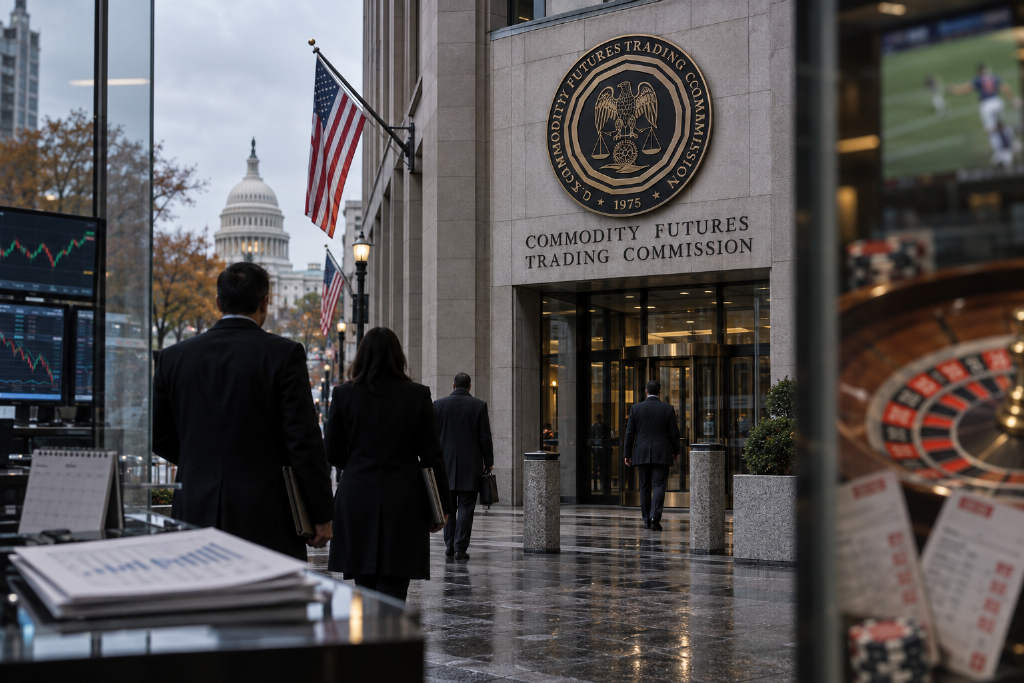
The U.S. Commodity Futures Trading Commission (CFTC) on Friday, Oct. 10, released two proposed rules designed to draw a firmer line between prediction markets and traditional gambling. The first would explicitly place event contracts within the definition of swaps under the Commodity Exchange Act (CEA). The second would exclude casino-style gambling products from that same definition.
Both proposals come with 30-day public comment periods. The signal, according to the report, is that the CFTC wants to cement the legal definitions before a jurisdiction fight potentially reaches the U.S. Supreme Court. CFTC Chair Michael Selig said these products are commodity derivatives and fall within the agency’s exclusive authority.
Event contracts would be treated as swaps
Under the first proposal, event contracts would be written into the definition of a swap. The scope would include contracts tied to sports, politics, cultural events, climate and other outcomes. The proposal says these contracts are already widely referred to as swaps in trading markets, and that the agency is clarifying an area that has remained legally uncertain.
The second proposal moves in the opposite direction for gambling products. It would exclude sports betting and casino games from the definition of a swap. Selig said plainly that casino-style gambling products are not derivatives and that the CFTC is not seeking to regulate beyond its lane.
Taken together, the two proposals set out a two-sided boundary: prediction markets would sit inside the federal derivatives framework, while traditional gambling would remain under state oversight. In that reading, the CFTC is not claiming new power so much as separating derivatives from casino gambling in legal terms.
Lawsuits involving Kalshi and Polymarket form the backdrop
The rulemaking push comes as federal and state authorities continue to clash over who controls prediction-market products. Multiple states have sued Kalshi and Polymarket, alleging illegal gambling. The CFTC, in turn, has argued that event contracts fall outside state regulatory reach.
In September last year, the U.S. Court of Appeals for the 6th Circuit ruled against Kalshi, siding with Ohio and Tennessee over jurisdiction for sports event contracts. The court said Kalshi had not shown that those contracts qualified as swaps under CFTC authority.
A different result came from the 3rd Circuit in April. That ruling allowed Kalshi to continue operating in New Jersey, finding that federal law preempted state rules. With two appellate courts reaching opposite conclusions, the dispute now has a strong chance of heading to the Supreme Court.
The report said the CFTC’s two proposals are effectively laying down legal arguments in advance of that broader constitutional fight over jurisdiction.
More clarity for the market, but no immediate relief from states
For the prediction-market industry, defining event contracts as swaps would give those products a clearer path inside the federal derivatives regime and strengthen their legal footing. Excluding gambling products from the same category would also help prevent the entire sector from being treated as gambling by default.
That said, the proposals do not mean states will step back right away. Ohio and Tennessee already hold an advantage from the 6th Circuit ruling, and pressure in New Jersey has continued as well, according to the report.
Whether the U.S. Supreme Court takes the case, when it might do so, and how it would rule all remain unresolved. For Kalshi, Polymarket and the broader prediction-market ecosystem, the fight over the line between federal and state authority is still very much alive.