

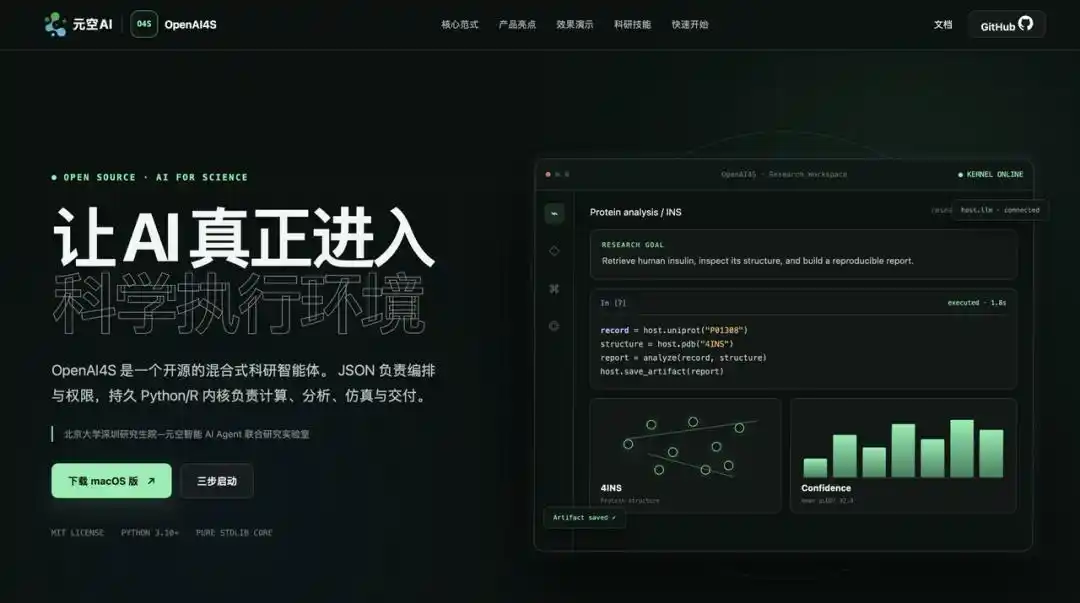
Peking University and the YuanKong AI Agent Joint Lab have open-sourced OpenAI4S, short for Open AI for Scientist, positioning it as a research agent aimed at real scientific workflows rather than a chatbot that only produces plausible answers. The project went live on GitHub on July 6, 2026 under the MIT license.
The release describes OpenAI4S as an independent open implementation of a research-agent stack inspired by the Code-as-Action approach. The team says the project does not simply resemble Anthropic’s Claude Science at the interface level. Instead, it recreates the underlying engine, a persistent kernel, a host-RPC protocol, and a security layer in an open-source form. The project page for YuanKong AI Science is listed at https://www.chatexcel.com/homesite/openAI4S.
Code execution sits at the center of the workflow
According to the project description, many AI agents still follow a similar pattern: a model is given a predefined menu of tools, picks one, then moves step by step. That can work for short tasks. Scientific work usually does not.
A single research task may require querying several databases, downloading data, cleaning datasets, revising code multiple times, calling specialized algorithms, requesting GPU resources, generating charts, and compiling a report. If one step breaks, the workflow may need to roll back and restart.
OpenAI4S takes a different route. Under its Code-as-Action design, the agent writes Python or R code directly and runs it inside a persistent kernel environment. Loops, conditional logic, batch data processing, and plotting can be handled within one execution. Intermediate results remain in the workspace instead of being repeatedly passed back to the model at every step.

The project summarizes the idea in one line: code is the action, and the kernel is the environment. In practical terms, that means longer and more complex tasks can stay connected. Data downloaded in one step can flow into the next analysis, generated images, tables, and reports are saved automatically, and researchers can open the notebook at any time to inspect the code, take over the analysis, or revise the output.
A shared scientific workspace for people and AI
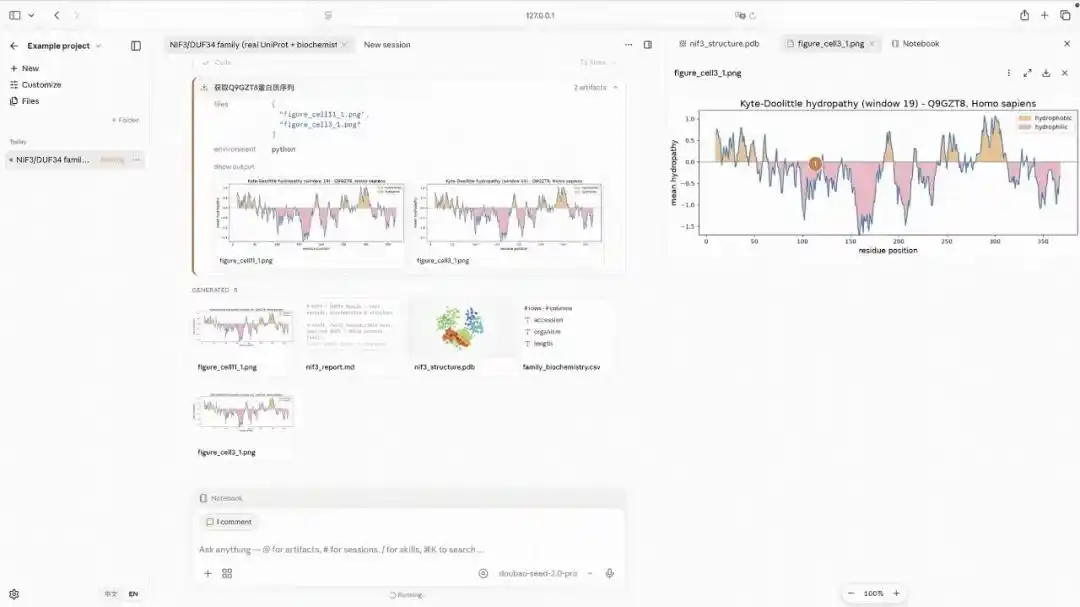
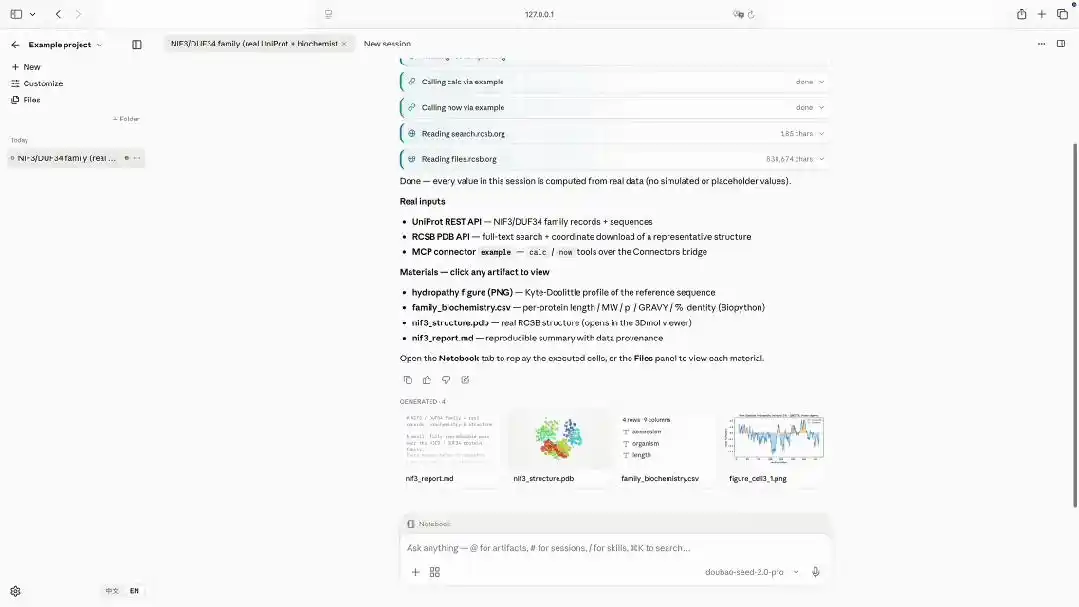
The team describes OpenAI4S as a shared research workbench used by both humans and AI. A user provides a task, and the system can search public scientific data sources, write and run analysis code, invoke specialized compute, then package the results into figures, tables, 3D structures, or Markdown reports.
Those outputs do not disappear after a single run. Each research artifact is recorded, stored, and versioned so it can be checked, revised, and reused later.
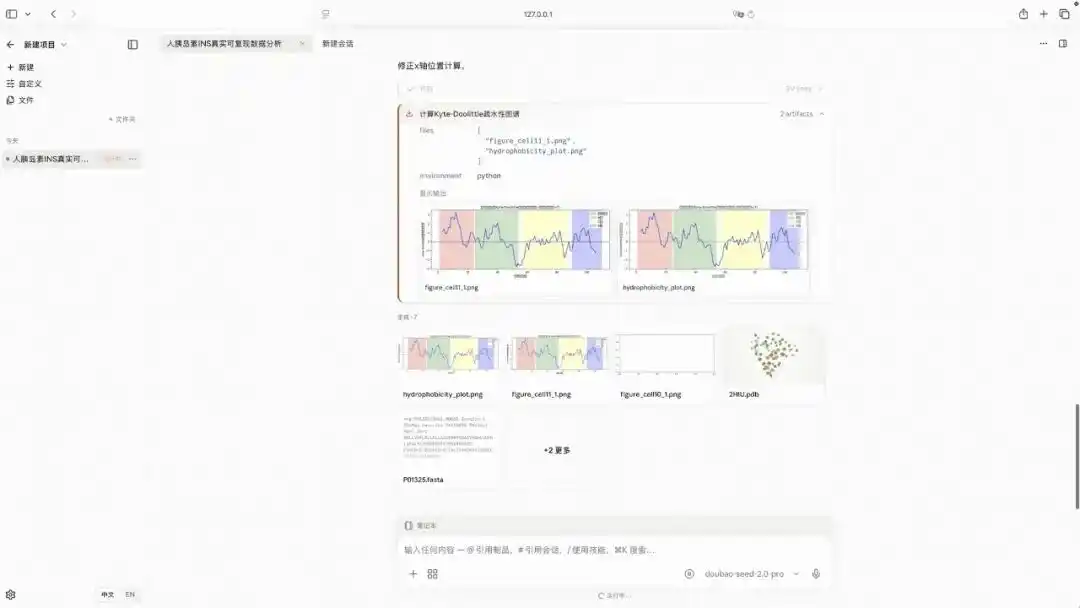
One example in the release focuses on protein analysis. OpenAI4S can retrieve real protein sequence and structure data, perform feature calculation and visualization, then write the process, the data sources, and the results into a paper. The project stresses two points in that flow: the data is real, and the computation is real. If an external service cannot be reached, or the required compute environment is missing, the system is expected to say exactly what could not be completed rather than silently inserting simulated data or fabricated results.
The same logic applies when a researcher wants revisions. In a conventional workflow, someone might need to locate the plotting script again, change parameters, rerun the job, and export the files. In OpenAI4S, the user can request changes in natural language, and the agent regenerates the artifact from the existing data and code while preserving version history.
More than 30 scientific skills in the first release
The project argues that a general-purpose model needs more than raw intelligence to function as a scientific assistant. It also needs to know where domain data lives, how specialist tools should be used, and how advanced algorithms are actually executed.
OpenAI4S launches with more than 30 built-in scientific skills. The set covers protein structure work, sequence analysis, protein design, molecular docking, single-cell analysis, literature search, and open-data retrieval, among other common computational research scenarios.
Fourteen of those skills package scientific compute capabilities that require GPUs or specialized models. The release says these skills are not rigid tool-parameter forms. They are closer to code recipes that the agent can read, understand, and execute. Required data, service calls, code patterns, and result-checking logic can all be embedded inside a skill. If new databases, algorithms, or lab workflows appear later, developers can attach them to the system instead of rebuilding the entire stack.
Users can route jobs to their own GPU infrastructure
Scientific computing also runs into a basic constraint: hardware. Tasks such as protein folding, mutation scoring, and molecular simulation often depend on dedicated models, software environments, and GPU resources that are not practical on a standard laptop.
OpenAI4S supports external compute environments owned by the user. Local components handle interaction and task orchestration, while GPU-heavy jobs can be dispatched to the user’s own server and then brought back into the same research workflow after completion.
The release says the hard part in jobs like protein structure prediction and mutation-effect scoring is often not writing the call itself, but sending the input into the right compute environment and returning the output intact. The project’s architecture is meant to solve that handoff without forcing labs to squeeze everything onto one machine or rewrite the whole process just to connect a compute server. Data, models, and compute resources can stay in the user’s own environment while the agent ties them together.
A strict no-fabrication policy
One of the clearest rules in the project is what it calls a no-fabrication policy. The release explicitly bans practices such as using np.random to fake experimental results, inventing conservation signals, passing off BLOSUM as ESM, or treating simulated datasets as if they were real data.
The standard is simple: call the real service or return an error. The INS example cited by the team uses a sequence retrieved from UniProt and a structure downloaded from RCSB. If the system cannot reach the network, it skips the step honestly instead of filling the gap with a synthetic answer.
For protein structure work, the release says GPU calls are real as well. It states that host.fold connects by ssh to a machine with 8×A100 GPUs, runs single-sequence Protenix inference described in the release as AlphaFold3-level, and returns a structure with pLDDT. The host.score_mutations component runs real ESM scoring to select mutations. If no GPU is configured, the system throws an error instead of manufacturing a structure that merely looks credible.
The team frames that choice as a core principle for scientific agents: it would rather say a task cannot be computed than generate a result that appears polished but is not real.
Joint-lab project and contributors
The release presents OpenAI4S as more than a standalone repository. It is also described as a stage result of collaboration between Peking University and YuanKong AI through their joint lab.
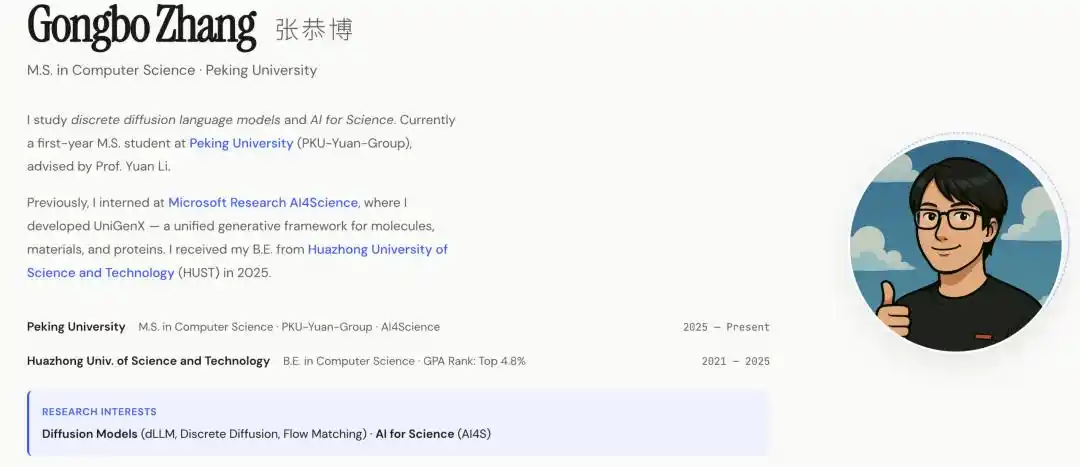
According to the project note, development and open-sourcing of OpenAI4S relied on sustained work by Zhang Gongbo. Zhang’s research focuses on AI for Science, and the release links that background to UniGenX, where Zhang is listed as a co-first author. UniGenX explored a general scientific foundation model for molecules, materials, and proteins, and those research efforts are described as feeding into the development and deployment of OpenAI4S.
The project also credits Li Hao, Wang Yu, Liu Yuyang, Lv Liuzhenghao, Mao Yicheng, Lin Mujie, Peng Shinyao, Jiang Zhengxiang, and Wang Yimi for work across framework design, feature development, and the open-source release.
YuanKong AI is described as an edge AI company focused on model post-training, Agent Runtime, long-term memory, and on-device inference so that AI systems can complete complex tasks in local and offline environments. The company currently lists two product lines, YuanKong AI Work and YuanKong AI Science, aimed at smart office use and scientific discovery.
The joint lab and YuanKong AI say their view is that research agents should not remain at the demo stage. They should become executable, inspectable, and extensible scientific infrastructure. That is why the open release covers not just examples, but also the core architecture, the scientific skills, and the full application. The team says universities, research institutions, developers, and industry partners can build on that base by plugging in data sources, algorithms, tools, and domain workflows.
Call for contributors
The team says getting OpenAI4S running is straightforward, with startup possible in three lines. The project itself does not require a model key before launch; users can enter one later through Customize → Models in the interface.
It also ships with a set of real cases that users can run directly. Those include a Live API workflow, real-data analysis of human insulin INS, one-sentence figure editing, and plan-mode tasks such as solubility prediction for artemisinin and paclitaxel, along with protein engineering.
Still, the release makes clear that starting the project is only the first step. Real research spans life science, chemistry, materials, medicine, earth science, and other fields. Each area has its own databases, specialist models, and compute processes, and the team says no single group can complete that entire capability map in one pass.
For that reason, OpenAI4S is issuing a call for contributors to universities, research institutions, developers, and industry teams. The release adds that Tuzhan Intelligence’s Skills UI already provides partial support for the open-source project.
Contributors who know a scientific domain can add new skills and connect specialist databases, algorithm models, and compute platforms. Those with agent or software engineering experience can work on the core architecture, remote compute, security mechanisms, testing, and documentation. The project also says non-coding work matters: filing an issue, adding a reproducible case, reporting a failed task, or telling the community what a discipline actually needs are all treated as meaningful contributions.
The repository is available at https://github.com/PKU-YuanGroup/OpenAI4S. The original article was published via the WeChat public account Quantum Bit, with authorship credited as “关注前沿科技.”