

Perpetual DEX growth has been driven in large part by token incentives, according to Foresight Ventures, which argues that the real debate is not whether to incentivize users at all but how those incentives are delivered and whether rewards line up with actual contribution.
The firm says platforms usually rely on points, airdrops and trading mining before a token generation event, or TGE, to attract current trading volume and liquidity with expectations tied to future token distribution. After TGE, fee revenue is commonly redirected into buybacks, burns and staking rewards. Value begins to flow back into the ecosystem, but distribution still tends to revolve around the platform token.
In that framework, the issue is not incentives themselves. Foresight Ventures says the problem is that incentive systems can become too dependent on future expectations. Traders create trading demand and fee income. Liquidity providers add depth and execution quality. Wallets, trading terminals and communities bring recurring order flow. Yet current mechanisms often reward the ability to farm points or hold tokens more than the participants who actually keep the market running.
That question has also been central to the firm’s discussions during its investment in and incubation of PopDEX: whether a platform can build a more direct and sustainable route for value to flow back so that rewards sit closer to real market contribution.
Early growth under token incentives and what it really validates
Why tokens became the default tool
Foresight Ventures writes that a Perp DEX in cold start mode needs traders, liquidity and distribution channels at the same time, while early platforms usually lack stable revenue and cannot easily sustain large cash subsidies over long periods.
Tokens offered an efficient coordination mechanism. Platforms could convert the contribution of traders, market makers and early participants into future claims, exchanging future value for current trading activity, liquidity and market attention.
dYdX is presented as an early full token incentive model. In its initial token supply, 25% was allocated to trading rewards, 7.5% to historical users and 7.5% to liquidity rewards. Trading rewards were calculated based on fee contribution and open interest, while liquidity rewards evaluated quote uptime, two-sided depth, bid-ask spread and the number of markets covered. In that setup, user acquisition, market-making subsidies and early ownership distribution were folded into one token framework.
Later platforms adjusted that structure in different ways:
- Hyperliquid combined points, Referral and HLP to attract traders, expand order flow and build protocol liquidity.
- Aster used multi-season trading mining, maintaining user participation and activity through continuous points cycles and phased token distribution.
- Lighter lowered trading barriers with zero fees and separated retail points from market-making points to distinguish trading activity from liquidity quality.
Foresight Ventures says these platforms do not rely only on tokens, but tokens remain the core coordination tool in cold start systems. Their advantage is not simply that they distribute rewards. They convert different forms of contribution into future claims and push much of the customer acquisition and liquidity cost back to TGE. The mechanisms differ, but the exchange is broadly the same: future claims and early subsidies are used to buy present trading volume, liquidity and attention.
Points-driven volume is not always long-term trading demand
The article says points and airdrops do more than determine whether users enter a platform. They also affect why users trade there in the first place.
Under ordinary conditions, traders choose a venue based on liquidity, execution stability, fees, asset coverage and risk management. Once points and airdrops enter the picture, those considerations do not disappear, but their weighting changes. Users also start calculating how many points they can earn for a given trading cost, whether a potential airdrop can cover fees and capital usage, and when rewards may be realized.
Foresight Ventures does not argue that points participants are not professional traders. On the contrary, it says many professional traders rationally assess points returns. The problem comes when points become a major variable in the trading decision. At that stage, platform volume no longer reflects product competitiveness alone; it also reflects how users price future rewards.
The firm splits trading behavior into two broad categories. One comes from persistent product demand, where users stay because the platform’s liquidity, execution, cost structure and asset coverage meet their needs. The other comes more from reward expectations, where continued activity depends on whether points still hold value, whether the airdrop still carries upside and whether the input-output calculation still works.
In an earlier retail survey on Perp DEXs conducted by Foresight Ventures, 69% of respondents listed points or airdrops as an important factor in choosing a trading platform. That was higher than reliability at 61%, liquidity and depth at 58%, and fees at 47%. The article says points and airdrops are no longer just add-on rewards outside the product. They now compete directly with reliability, liquidity and fees as a core decision variable.
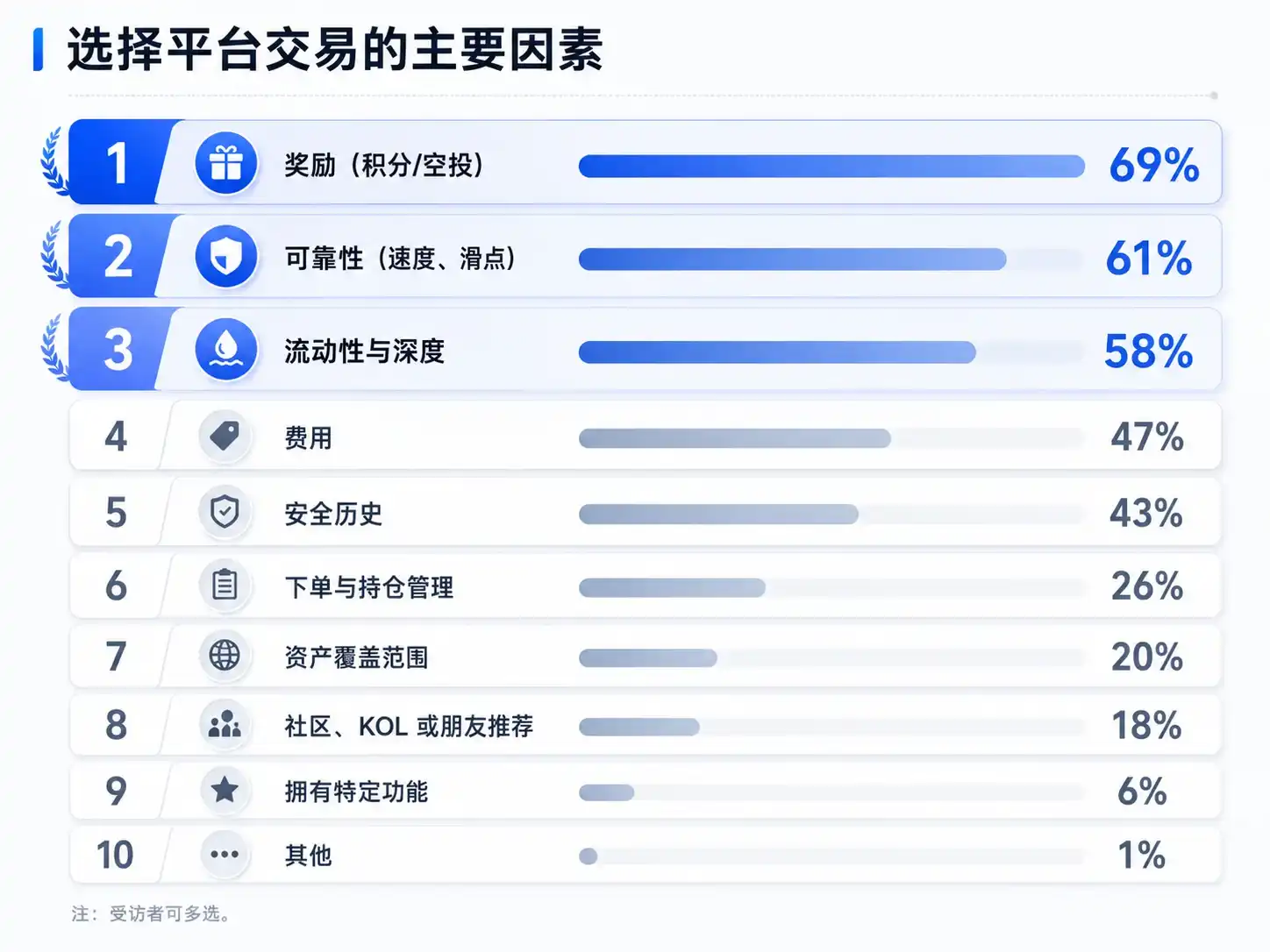
That changes the nature of the order flow a platform acquires. If users enter primarily because of reward expectations, the platform is not building high switching costs rooted in product habit. It is building a trading relationship that needs ongoing subsidies. Rewards can lower the barrier to entry, but they can also lower the barrier to exit.
TGE is the first pressure test for real demand
During a points cycle, the platform is buying more than raw volume, the firm says. It is also buying users’ willingness to wait for future claims. As long as the airdrop still holds appeal, users may keep trading, paying fees, tying up capital and tolerating a product experience that is not yet fully mature.
But points-period data is not pure. A trade may reflect genuine market demand or a bet on an airdrop. A new user may become recurring order flow or stop trading once tasks are complete. On the surface, both count as growth.
Once those different motives are placed inside the same points-and-token system, platforms have trouble telling what they really acquired. Foresight Ventures says post-TGE data should not be judged simply by whether it rises or falls. Three things matter more:
- whether trading volume remains after rewards fade or is still being maintained by a new round of incentives;
- whether market share improves rather than merely moving with broader Perp DEX conditions;
- whether the platform has entered a stage of natural retention or is still inside a new incentive cycle.
The article includes a comparison covering only platforms for which a unified pre- and post-TGE 30-day trading volume and market share dataset was available. Aster was excluded because the current public data standard was incomplete.
| Platform | TGE date | Average daily volume, 30 days before TGE | Average daily volume, 30 days after TGE | Market share change |
|---|---|---|---|---|
| Hyperliquid | Nov. 29, 2024 | about $2.41 billion | about $5.08 billion | +18.6% |
| Lighter | Dec. 30, 2025 | about $6.64 billion | about $3.72 billion | -7.5% |
| edgeX | March 31, 2026 | about $2.55 billion | about $1.70 billion | -2.9% |
Foresight Ventures says the key question is not which platform posted higher volume after TGE, but which one converted attention brought by an airdrop into a lasting trading relationship. If a new round of points, mining or subsidies is still running after TGE, volume still contains an incentive component and cannot simply be treated as retained demand. The real dividing line comes when the marginal pull of reward expectations falls and users still choose to trade because of the platform itself.
Put differently, pre-TGE data tests whether a platform can attract users in. Post-TGE data tests whether it can keep them there. The first can be bought with incentives. The second depends on product strength and the way value is distributed.
Value starts returning, but it still revolves around the platform token
From distributing tokens to supporting tokens
After TGE, the incentive framework usually shifts from distributing tokens to supporting them. Platforms commonly use fee income for buybacks, burns, staking yield and token-holder discounts. Value starts to flow back, but the basis for distribution also shifts from trading contribution to token ownership.
That means traders first create revenue through activity, then must buy or stake the platform token to qualify for a share of that revenue. In practice, the platform has to maintain two markets at once: the trading market and the platform-token market.
Those two can reinforce each other, but they do not always align. Professional traders may contribute fees over the long term while having little interest in taking on additional token risk. In that case, the platform ends up rewarding not only trading itself but also users’ capital commitment to the token.
For Foresight Ventures, the useful comparison is not just whether buybacks happen. It is how much revenue enters the token system, what happens to bought-back tokens, and who ultimately absorbs that value.
| Platform | How fee revenue is handled | Buyback ratio | Use after buyback | Main value recipient |
|---|---|---|---|---|
| Hyperliquid | Fees enter the Assistance Fund and are used to buy HYPE | about 99% | burned after purchase | HYPE holders benefit indirectly through supply contraction |
| Aster | Most platform fees are used to buy back ASTER | 99% | handled under tokenomics rules | ASTER holders and ecosystem incentive participants |
| Lighter | Trading fee revenue is used for programmatic LIT buybacks | about 97% | permanently burned after buyback | LIT holders benefit indirectly through supply contraction |
Broader token participation does not equal trading demand
To examine the gap between token participation and derivatives demand, the article cross-analyzes HYPE holder addresses, wealth-management user addresses and derivatives-trading user addresses on Hyperliquid.
The result: within the union of the three user groups, HYPE holder addresses accounted for 89%, wealth-management users for 27%, and derivatives users for just 20%. Only 5% of the overall set participated in all three at the same time: holding HYPE, using wealth-management products and trading derivatives.
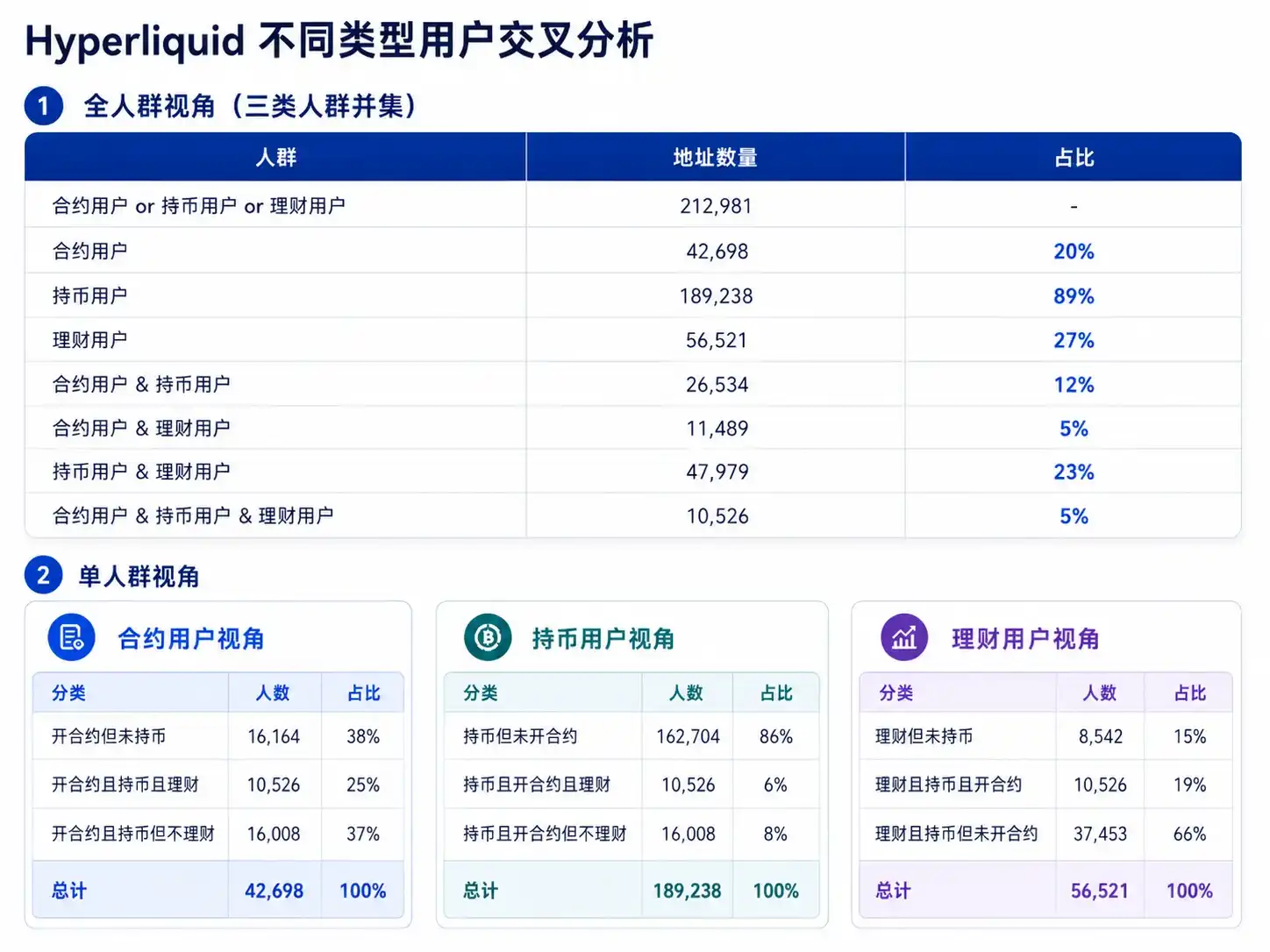
A closer breakdown showed:
- among derivatives users, 62% held HYPE, but more than 70% did not participate in wealth management;
- among HYPE holders, 86% had never traded derivatives;
- among wealth-management users, 85% held HYPE, but only 19% traded derivatives.
Foresight Ventures says those figures show that a platform token can broaden asset holding and ecosystem participation, but token holding, wealth management and trading do not map to the same demand source. Holding may come from asset allocation and price expectations. Wealth management aligns more with yield strategies. Derivatives trading is what directly reflects trading demand and order flow.
When holder addresses, asset scale and wealth-management users are all counted together as ecosystem growth, capital participation can be mistaken for trading-market growth. For a Perp DEX, however, the article says market quality still rests on sustained trading, effective liquidity and real fee income. A platform token may expand participation, but it does not replace trading demand itself.
One platform, two growth objectives
Once revenue sharing, fee discounts and product permissions are tied to the platform token, a Perp DEX is effectively running two markets at the same time: a trading market and a token market. That creates a basic tension, the firm says. What comes first: serving the trading product itself, or maintaining a value loop built around the token?
Those goals do not always move together. The trading market cares about execution quality, liquidity and cost, and depends on durable product capability. The token market cares about demand, scarcity and price expectations, and depends on constantly creating reasons to hold the token.
The risk is not only split resources. The benchmark for success can shift as well. Volume, fees and user growth are no longer used only to judge whether the trading product is healthy; they also start to support the token narrative. In that setup, the platform may end up chasing data that reinforces token demand rather than more real trading.
PopDEX and a different answer to incentives
From Foresight Ventures’ investment perspective, what stands out about PopDEX is not a simple debate over whether a platform token should exist. The team did not make token expectations the starting point for growth, and it did not make token-holder status a prerequisite for trading rights. Instead of routing platform value into the token first and redistributing it from there, PopDEX starts more directly from real market contribution: value should return to those who create it.
Based on that approach, PopDEX has built what the article calls a 100% value return system.
The 100% figure refers to distributable value generated by trading fees, not a direct rebate of every fee payment back to traders. The central idea is that distributable value formed by trading fees is no longer used first to support the platform token. It enters a return framework designed around real contribution.
Under that structure, PopDEX’s value return will cover two groups. One is ecosystem contributors, including Referral, Affiliate, trading events and joint Campaign efforts that continue to bring users, order flow and market attention. The other is real trading users, with PopDEX exploring a more direct, periodic, transparent and verifiable way to return value based on actual trading contribution.
As for the final form of that distribution, Foresight Ventures says PopDEX will disclose it gradually in later product stages.
The article frames this not as a rejection of current models, but as an attempt at a different incentive structure: incentives are not only a tool to buy growth, they can also become a mechanism for ongoing returns to the ecosystem. Foresight Ventures closes by saying there is no single standard answer for how incentive systems should evolve, and the market will make its own judgment. Its view is that as the Perp DEX sector matures, incentive design should not be limited to one path.