
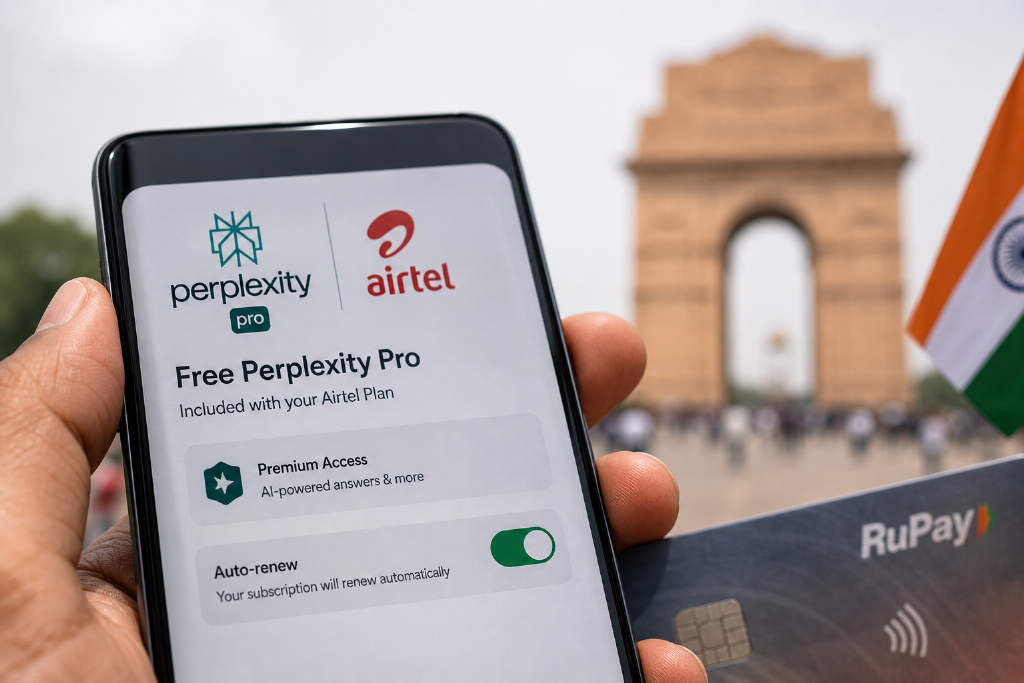
Perplexity’s year-long giveaway to Airtel’s 360 million customers in India produced a split result: installs collapsed after the promotion ended, but paid app revenue kept rising.
One free year of Pro for Airtel customers
In July 2025, Perplexity partnered with Indian telecom operator Airtel to offer a free one-year Pro subscription to its 360 million customers. The annual plan was valued at $200. New-user redemption closed on Jan. 16, 2026, but each subscription ran for one year from the date of activation, meaning the earliest users did not reach expiration until July 2026. Users who did not want to be charged had to turn off auto-renew manually.
The campaign was a straightforward test: use a free period to build habit, then see how much of that audience stayed when the bill came due.
Downloads and usage surged during the offer period
According to Sensor Tower data provided to TechCrunch, Perplexity’s downloads in India reached 5.9 million in July 2025, up 625% from the previous month. That single month exceeded the 5.4 million downloads recorded across the first half of 2025.
Over the seven months in which the offer remained open to new users, Perplexity recorded 56 million cumulative downloads in India, more than nine times the total from the preceding seven months. Monthly active users kept climbing, first reaching 8.9 million and then peaking at 22 million in October.
India is the world’s second-largest smartphone market, with more than 700 million smartphones and over 1 billion internet users. Mobile data is inexpensive, making the country a major source of app downloads for technology companies. It is also widely seen as difficult to monetize, which is why Anthropic, Google, and OpenAI are all competing for scale there.
After the promotion closed, downloads fell sharply
Once the offer stopped accepting new users in January 2026, the growth trend reversed quickly. From February through July 2026, Perplexity’s downloads in India totaled just 3.3 million, down more than 90% from the previous six months.
Monthly active users also retreated. MAU fell from the 22 million peak in October 2025 to nearly 14 million in July 2026, a decline of 37%. Even so, that figure was still more than five times the average 2.6 million MAU recorded in the first half of 2025.
Abe Yousef, senior insights analyst at Sensor Tower, told TechCrunch that a decline in adoption after a time-limited promotion ends is a natural outcome. He added that continued usage still showed resilience, with Perplexity’s user base in India remaining “significantly above” the level seen in the six months before the campaign.
Revenue moved in the opposite direction
Sensor Tower estimated that Perplexity’s in-app purchase and subscription revenue in India rose by about 60% from February 2026 to mid-August 2026, compared with the stretch when the offer was still open to new users.
The shorter-term trend pointed the same way. From July 18 to Aug. 12, India’s average daily in-app purchase revenue was 9% higher than in the prior 30 days and 27% above the first-half 2026 average. That window aligned with the point when the earliest Airtel subscribers began to lose free access.
There is an important limitation in the data. Because the free subscription defaulted to auto-renew, some of the revenue increase may have come from users forgetting to cancel rather than making an active choice to pay. Sensor Tower said it could not distinguish between those two cases, and it also could not separate former Airtel subscribers from other paying users.
Appfigures points to the same upward revenue trend
App analytics firm Appfigures estimated that Perplexity’s monthly net mobile revenue in India rose from about $34,000 in January 2025 to $70,000 in December 2025, then reached $156,000 in July 2026.
Using Appfigures’ estimates, Perplexity generated $878,000 in net mobile revenue in India over the first seven months of 2026, 16% more than in all of 2025.
Whether that result meets Perplexity’s expectations is another matter. The company has not commented, according to the report.
India’s free-AI battle is still in progress
Perplexity is not the only company using giveaways in India. In August 2025, OpenAI made its lower-priced ChatGPT Go plan free for one year in the country. Google later partnered with Reliance Jio to give eligible Jio subscribers 18 months of free access to an AI Pro subscription.
India is the largest market in the world for generative AI app downloads, but turning that scale into meaningful revenue remains difficult. Companies are still making the same trade: give up near-term revenue in exchange for reach. The bigger answer on conversion will likely come later, after more Airtel subscribers roll off their free year and the larger free cohorts from OpenAI and Google also reach the end of their promotional periods.