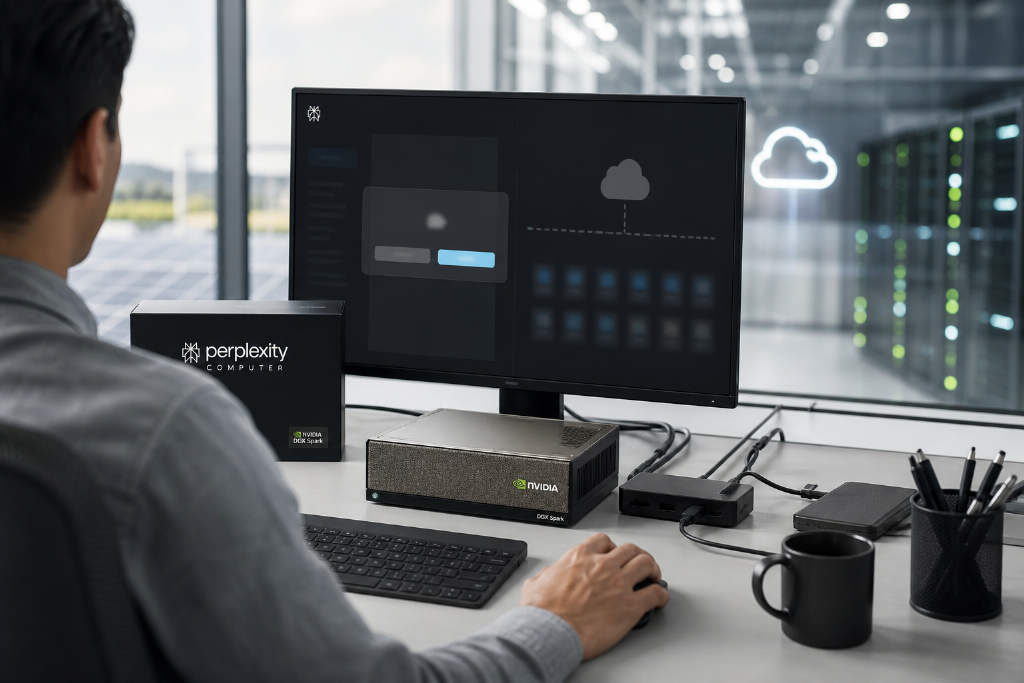
Perplexity has introduced a portable AI computer as a local-first version of its agent platform, Computer, designed to run directly on NVIDIA DGX Spark. The system packages local models, an inference engine, a tool sandbox, and application connectors so that tasks can begin on-device, with work handled by local models generating no token-based charges. When a step needs live internet access or stronger frontier reasoning, the orchestrator pauses, asks the user, and then sends only that single step to one of more than 15 cloud models.
Deployment requires GB10-class hardware or an RTX GPU with 24 GB of VRAM. Perplexity is targeting enterprises that already have NVIDIA workstations, mid-sized teams, and well-funded AI-native startups. The company says the setup fits sectors such as finance, legal, healthcare, government, and defense, where data residency or contractual confidentiality requirements are strict. In a 53-task local knowledge-work benchmark, Computer running Qwen 3.8 27B scored 82.6% on DGX Spark, ahead of the open-source Pi toolchain at 77.6% and Hermes at 74.0%. Using the PPLX 27B model pushed the score to 85.4%. In hybrid mode, fully local execution carries zero marginal cost, while an advisor upgrade can improve performance at about $0.415 per run.
Perplexity rolls out a local-first version of Computer
Perplexity has launched a portable AI computer, described as a local-first version of its agent platform Computer. The setup can run agent toolchains, an orchestrator, a planner, and post-trained models directly on NVIDIA DGX Spark.
The system bundles local models, an inference engine, a tool sandbox, and application connectors. Tasks start on the device, and work handled by local models does not incur token-based charges. If a step requires live web access or frontier-level reasoning, the orchestrator pauses, asks the user, and sends only that single step to one of more than 15 cloud models.
Hardware requirements and target users
Deployment requires GB10-class hardware or an RTX GPU with 24 GB of VRAM. Perplexity is aiming the product at enterprises that already have NVIDIA workstations, mid-sized teams, and well-funded AI-native startups.
The company said the system is suited to fields such as finance, legal, healthcare, government, and defense, where data residency rules or contractual confidentiality requirements are strict.
Benchmark results
In a local knowledge-work benchmark covering 53 tasks, Computer running the Qwen 3.8 27B model scored 82.6% on DGX Spark. That was above the open-source Pi toolchain at 77.6% and Hermes at 74.0%.
Using the PPLX 27B model lifted the score to 85.4%. In hybrid mode, fully local execution has zero marginal cost, while an advisor upgrade can raise performance at an estimated cost of about $0.415 per run.
The item cited MarkTechPost.
This article was originally published by Bit.Fan. For more cryptocurrency news and market insights, visit www.bit.fan. Disclaimer:
The market information, project data, and third-party content displayed on this platform are for industry information sharing only and do not constitute any form of investment advice or return commitment.
Cryptocurrency trading carries high risks. Users should fully assess their risk tolerance and make independent decisions. All profits, losses, and legal responsibilities are borne by the users themselves.