
Peter Schiff has again pushed the question of Bitcoin’s value backing into public view, this time by challenging the idea that mining energy can serve as a foundation for that value.
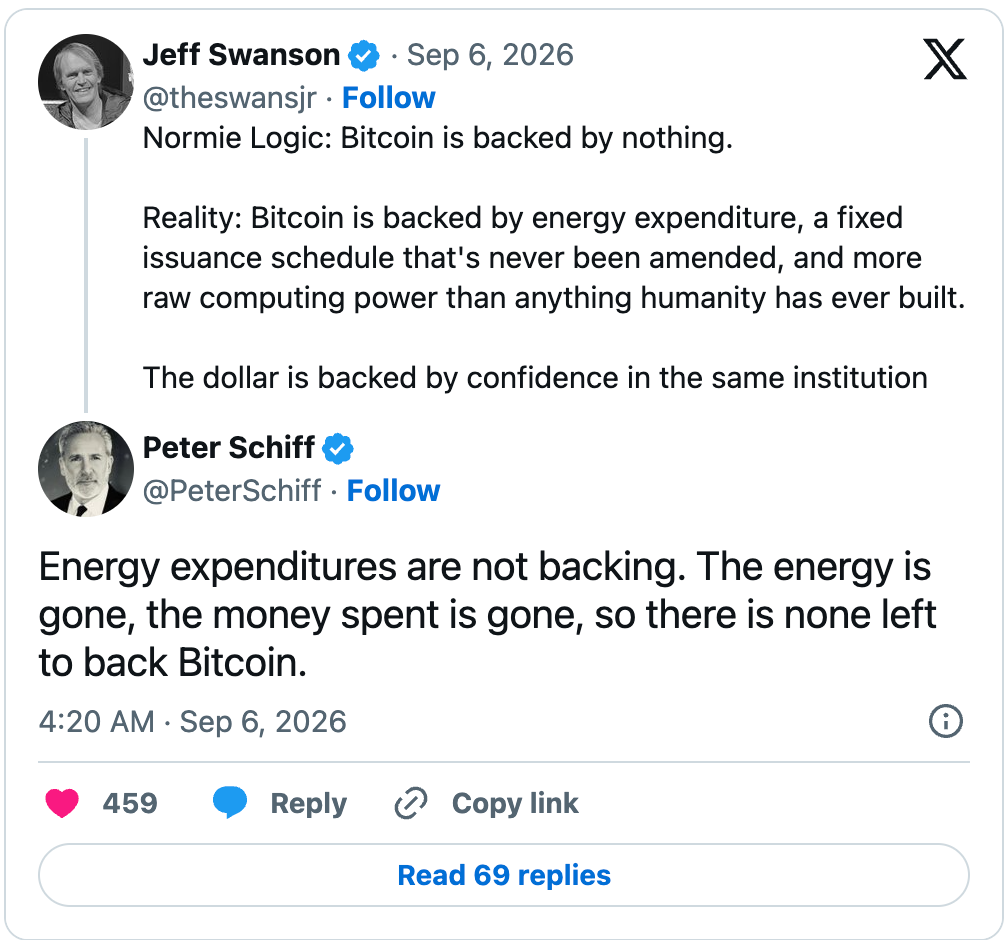
The latest clash followed comments from Jeff Swanson, identified in the report as a Bitcoin maximalist who has previously argued that Bitcoin is the future of money. Swanson laid out three pillars for Bitcoin’s value: energy consumption, a fixed issuance mechanism, and very high hash power. Schiff responded by rejecting that framework, especially the claim tied to energy use.
Schiff rejects the idea that energy consumption underpins Bitcoin’s value
Schiff argued that the energy miners consume disappears the moment it is used and does not leave behind anything that can support the network in a way that creates stored value. In his view, mining consumes value rather than preserving it.
The report notes that this has long been a core part of Schiff’s position. As a gold advocate, he has repeatedly contrasted Bitcoin mining with gold extraction, arguing that gold remains as a physical asset after it is mined, while electricity, once spent, no longer exists.
Current industry conditions have given that argument fresh attention. According to the report, some hash power operators have redirected electricity resources toward artificial intelligence businesses. At the same time, Bitcoin’s network hash rate has fallen for several consecutive months, and many miners have exited the network this year.
Schiff, however, did not address Bitcoin’s capped supply in this exchange. The report says that leaves Bitcoin supporters still relying on the hard limit on total supply as a central part of their value argument, rather than energy consumption alone.
The $39 trillion debt figure cited by Swanson is already outdated
Swanson also referred to U.S. government debt at $39 trillion, but the report says public data from the U.S. Treasury contradict that figure.
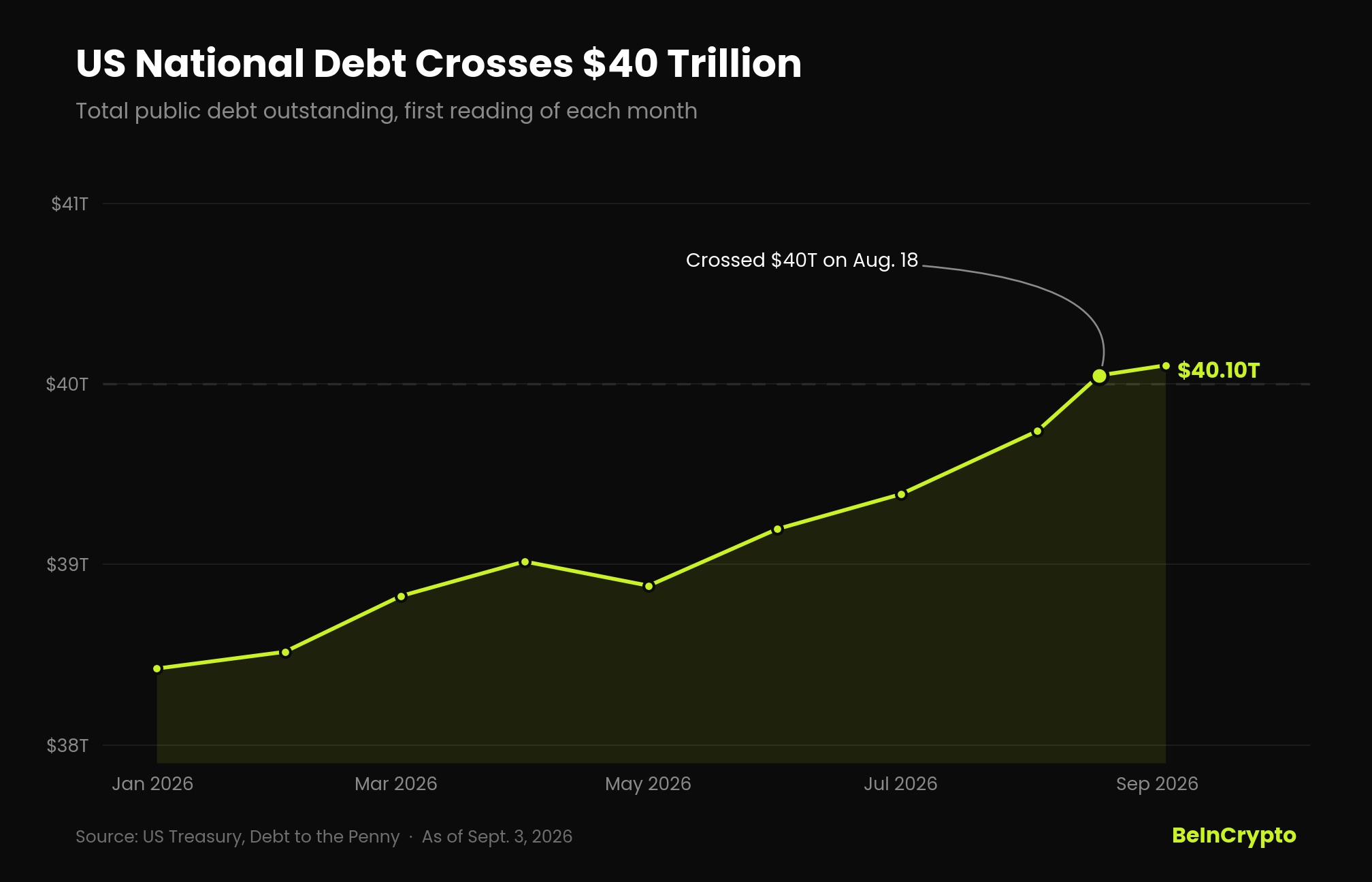
Daily Treasury statistics show that outstanding public debt passed $40 trillion on Aug. 18 and reached $40.10 trillion by Sept. 3.
That discrepancy matters because much of Swanson’s broader argument was built on comparisons with U.S. debt levels. The report adds that after debt hit a new high of $40 trillion in August, U.S. borrowing still had not slowed.
No side gained support from price action
Swanson also tied Bitcoin’s case to market confidence in the institutions responsible for issuing the U.S. dollar. Schiff did not respond to that point and instead focused only on disputing the idea that energy gives Bitcoin value.
Market pricing did not offer clear support for either side, according to the report. Bitcoin (BTC) traded at about $79,600 on Sunday, down roughly 1.5% over the previous 24 hours. The article noted that this was only a snapshot at the time of publication and did not represent the current market price.
The report also says Schiff’s position has shown limited movement before. Last month, he acknowledged that he had missed Bitcoin’s upside, but he still maintained that long-term Bitcoin holders had not earned as much in real terms as they claimed publicly.
Neither side gave ground in the latest exchange. The report concludes that as long as U.S. debt keeps reaching new highs, the question of whether Bitcoin has real value backing is likely to return to the center of discussion.